



Community hub
Recent from talks
Knowledge base stats:
Talk channels stats:
Members stats:
Church Fathers
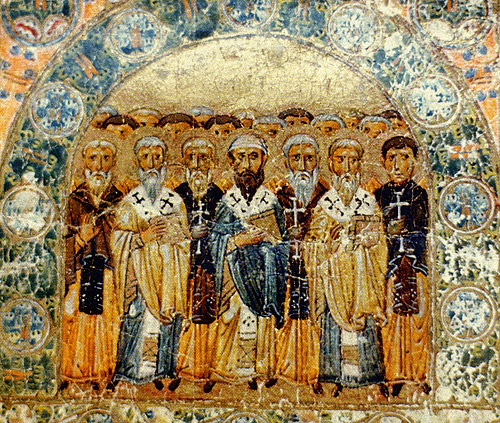
The Church Fathers, Early Church Fathers, Christian Fathers, or Fathers of the Church were ancient and influential Christian theologians and writers who established the intellectual and doctrinal foundations of Christianity. The historical period in which they worked became known as the Patristic Era and spans approximately from the late 1st to mid-8th centuries, flourishing in particular during the 4th and 5th centuries, when Christianity was in the process of establishing itself as the state church of the Roman Empire.
For many denominations of Christianity, the writings of the Ante-Nicene Fathers, Nicene Fathers and Post-Nicene Fathers are included in Sacred Tradition. As such, in traditional dogmatic theology, authors considered Church Fathers are treated as authoritative for the establishment of doctrine. The academic field of patristics, the study of the Church Fathers, has extended the scope of the term, and there is no definitive list.[better source needed] Some, such as Origen and Tertullian, made major contributions to the development of later Christian theology, but certain elements of their teaching were later condemned.
The Apostolic Fathers were Christian theologians who lived in the 1st and 2nd centuries AD, who are believed to have personally known some of the Twelve Apostles, or to have been significantly influenced by them. Their writings, though popular in Early Christianity, were ultimately not included in the canon of the New Testament once it reached its final form. Many of the writings derive from the same time period and geographical location as other works of early Christian literature that did come to be part of the New Testament, and some of the writings found among the Apostolic Fathers' seem to have been just as highly regarded as some of the writings that became the New Testament. The first three, Clement, Ignatius, and Polycarp, are considered the chief ones.
Clement of Rome (also known as Pope Clement I) was a late 1st-century bishop of Rome who, according to Tertullian, was ordained by Saint Peter. According to Irenaeus, Clement was the fourth bishop of Rome after Anacletus. Eusebius described him as the "co-laborer" of Paul and identified him with the Clement mentioned in Philippians 4:3.
The First Epistle of Clement (c. 96) is the earliest extant epistle from a Church Father. In the epistle, Clement calls on the Christians of Corinth to maintain harmony and order. Copied and widely read in the Early Church, First Clement had been considered by some as part of the New Testament canon, e.g., listed as canonical in Canon 85 of the Canons of the Apostles, among other early canons of the New Testament, showing that it had canonical rank in at least some regions of early Christendom. As late as the 14th century Ibn Khaldun mentions it as part of the New Testament.
Ignatius of Antioch (also known as Theophorus) (c. 35 – c. 110) was the third bishop of Antioch, and was said to be a student of the Apostle John. En route to his martyrdom in Rome, Ignatius wrote a series of letters which have been preserved. Important topics addressed in these letters include ecclesiology, the sacraments, the role of bishops, and the incarnation of Christ. He is the second after Clement to mention Paul's epistles.
Polycarp of Smyrna (c. 69 – c. 155) was a Christian bishop of Smyrna (now İzmir in Turkey). It is recorded that he had been a disciple of "John". The options/possibilities for this John are John, the son of Zebedee, traditionally viewed as the author of the Gospel of John, or John the Presbyter. Traditional advocates follow Eusebius of Caesarea in insisting that the apostolic connection of Polycarp was with John the Evangelist and that he was the author of the Gospel of John, and thus the Apostle John.
Polycarp tried and failed to persuade Pope Anicetus to have the West celebrate Passover on the 14th of Nisan, as in the Eastern calendar. Around AD 155, the Smyrnans of his town demanded Polycarp's execution as a Christian, and he died a martyr. The story of his martyrdom describes how the fire built around him would not burn him, and that when he was stabbed to death, so much blood issued from his body that it quenched the flames around him.
Hub AI
Church Fathers AI simulator
(@Church Fathers_simulator)
Church Fathers
The Church Fathers, Early Church Fathers, Christian Fathers, or Fathers of the Church were ancient and influential Christian theologians and writers who established the intellectual and doctrinal foundations of Christianity. The historical period in which they worked became known as the Patristic Era and spans approximately from the late 1st to mid-8th centuries, flourishing in particular during the 4th and 5th centuries, when Christianity was in the process of establishing itself as the state church of the Roman Empire.
For many denominations of Christianity, the writings of the Ante-Nicene Fathers, Nicene Fathers and Post-Nicene Fathers are included in Sacred Tradition. As such, in traditional dogmatic theology, authors considered Church Fathers are treated as authoritative for the establishment of doctrine. The academic field of patristics, the study of the Church Fathers, has extended the scope of the term, and there is no definitive list.[better source needed] Some, such as Origen and Tertullian, made major contributions to the development of later Christian theology, but certain elements of their teaching were later condemned.
The Apostolic Fathers were Christian theologians who lived in the 1st and 2nd centuries AD, who are believed to have personally known some of the Twelve Apostles, or to have been significantly influenced by them. Their writings, though popular in Early Christianity, were ultimately not included in the canon of the New Testament once it reached its final form. Many of the writings derive from the same time period and geographical location as other works of early Christian literature that did come to be part of the New Testament, and some of the writings found among the Apostolic Fathers' seem to have been just as highly regarded as some of the writings that became the New Testament. The first three, Clement, Ignatius, and Polycarp, are considered the chief ones.
Clement of Rome (also known as Pope Clement I) was a late 1st-century bishop of Rome who, according to Tertullian, was ordained by Saint Peter. According to Irenaeus, Clement was the fourth bishop of Rome after Anacletus. Eusebius described him as the "co-laborer" of Paul and identified him with the Clement mentioned in Philippians 4:3.
The First Epistle of Clement (c. 96) is the earliest extant epistle from a Church Father. In the epistle, Clement calls on the Christians of Corinth to maintain harmony and order. Copied and widely read in the Early Church, First Clement had been considered by some as part of the New Testament canon, e.g., listed as canonical in Canon 85 of the Canons of the Apostles, among other early canons of the New Testament, showing that it had canonical rank in at least some regions of early Christendom. As late as the 14th century Ibn Khaldun mentions it as part of the New Testament.
Ignatius of Antioch (also known as Theophorus) (c. 35 – c. 110) was the third bishop of Antioch, and was said to be a student of the Apostle John. En route to his martyrdom in Rome, Ignatius wrote a series of letters which have been preserved. Important topics addressed in these letters include ecclesiology, the sacraments, the role of bishops, and the incarnation of Christ. He is the second after Clement to mention Paul's epistles.
Polycarp of Smyrna (c. 69 – c. 155) was a Christian bishop of Smyrna (now İzmir in Turkey). It is recorded that he had been a disciple of "John". The options/possibilities for this John are John, the son of Zebedee, traditionally viewed as the author of the Gospel of John, or John the Presbyter. Traditional advocates follow Eusebius of Caesarea in insisting that the apostolic connection of Polycarp was with John the Evangelist and that he was the author of the Gospel of John, and thus the Apostle John.
Polycarp tried and failed to persuade Pope Anicetus to have the West celebrate Passover on the 14th of Nisan, as in the Eastern calendar. Around AD 155, the Smyrnans of his town demanded Polycarp's execution as a Christian, and he died a martyr. The story of his martyrdom describes how the fire built around him would not burn him, and that when he was stabbed to death, so much blood issued from his body that it quenched the flames around him.