



Community hub
Recent from talks
Knowledge base stats:
Talk channels stats:
Members stats:
Sinterklaas
Sinterklaas (Dutch: [ˌsɪntərˈklaːs] ⓘ) or Sint-Nicolaas (Dutch: [sɪnt ˈnikoːlaːs] ⓘ) is a legendary figure based on Saint Nicholas, patron saint of children. Other Dutch names for the figure include De Sint ("The Saint"), De Goede Sint ("The Good Saint") and De Goedheiligman (derived from goed hylickman meaning "good marriage man", alluding to his historical reputation as a Saint who can help you find a good life partner). Many descendants and cognates of "Sinterklaas" or "Saint Nicholas" in other languages are also used in the Low Countries, nearby regions, and former Dutch colonies.
The feast of Sinterklaas celebrates the name day of Saint Nicholas on 6 December. The Sinterklaas feast is celebrated annually with the giving of gifts on St. Nicholas' Eve (5 December) in the Netherlands and on the morning of Saint Nicholas Day (6 December) in Belgium, Luxembourg, western Germany, and northern France (French Flanders, Lorraine, Alsace and Artois). The tradition is also celebrated in some territories of the former Dutch Empire, including Aruba.
Sinterklaas is one of the sources of the popular Christmas icon of Santa Claus.
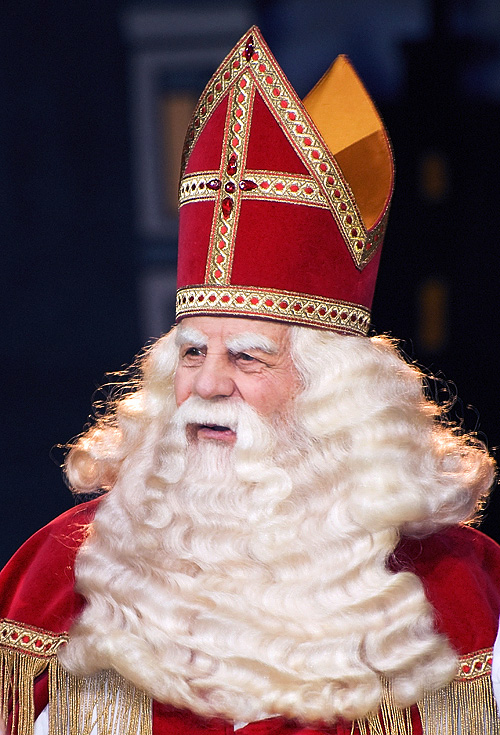
Sinterklaas is based on the historical figure of Saint Nicholas (270–343), a Greek bishop of Myra in present-day Turkey. He is depicted as an elderly, stately and serious man with white hair and a long, full beard. He wears a long red cape or chasuble over a traditional white bishop's alb and a sometimes-red stole, dons a red mitre and ruby ring, and holds a gold-coloured crosier, a long ceremonial shepherd's staff with a fancy curled top.
He traditionally rides a white horse. In the Netherlands, the televised Sinterklaas specials have named the horse. Until 2019, Sinterklaas rode Amerigo, who was "pensioned" (i.e., died) and replaced with a horse called Ozosnel ("oh so fast"), after a passage in a well-known Sinterklaas song. In Belgium, the horse is named Slecht weer vandaag, meaning "bad weather today" or Mooi weer vandaag ("nice weather today").
Sinterklaas carries a big, red book which traditionally records whether each child has been good or naughty in the past year.
Sinterklaas is assisted by Zwarte Piet ("Black Pete"), a helper dressed in Moorish attire and in a black painted face. Zwarte Piet first appeared in print as the nameless servant of Saint Nicholas in Sint-Nikolaas en zijn knecht ("St. Nicholas and His Servant"), published in 1850 by Amsterdam schoolteacher Jan Schenkman; however, the tradition appears to date back at least as far as the early 19th century. Zwarte Piet's colourful dress is based on 16th-century noble attire, with a ruff (lace collar) and a feathered cap. He is typically depicted carrying a bag which contains candy for the children, which he tosses around, a tradition supposedly originating in the story of Saint Nicholas saving three young girls from prostitution by tossing golden coins through their window at night to pay their dowries.
Traditionally, he would also carry a birch rod (Dutch: roe), a chimney sweep's broom made of willow branches, used to spank children who had been naughty. Some of the older Sinterklaas songs make mention of naughty children being put in Zwarte Piet's bag and being taken back to Spain. This part of the legend refers to the times that the Moors raided the European coasts, and as far as Iceland, to abduct the local people into slavery. This quality can be found in other companions of Saint Nicholas such as Krampus and Père Fouettard. In modern versions of the Sinterklaas feast, however, Zwarte Piet no longer carries the roe and children are no longer told that they will be taken back to Spain in Zwarte Piet's bag if they have been naughty.
Hub AI
Sinterklaas AI simulator
(@Sinterklaas_simulator)
Sinterklaas
Sinterklaas (Dutch: [ˌsɪntərˈklaːs] ⓘ) or Sint-Nicolaas (Dutch: [sɪnt ˈnikoːlaːs] ⓘ) is a legendary figure based on Saint Nicholas, patron saint of children. Other Dutch names for the figure include De Sint ("The Saint"), De Goede Sint ("The Good Saint") and De Goedheiligman (derived from goed hylickman meaning "good marriage man", alluding to his historical reputation as a Saint who can help you find a good life partner). Many descendants and cognates of "Sinterklaas" or "Saint Nicholas" in other languages are also used in the Low Countries, nearby regions, and former Dutch colonies.
The feast of Sinterklaas celebrates the name day of Saint Nicholas on 6 December. The Sinterklaas feast is celebrated annually with the giving of gifts on St. Nicholas' Eve (5 December) in the Netherlands and on the morning of Saint Nicholas Day (6 December) in Belgium, Luxembourg, western Germany, and northern France (French Flanders, Lorraine, Alsace and Artois). The tradition is also celebrated in some territories of the former Dutch Empire, including Aruba.
Sinterklaas is one of the sources of the popular Christmas icon of Santa Claus.
Sinterklaas is based on the historical figure of Saint Nicholas (270–343), a Greek bishop of Myra in present-day Turkey. He is depicted as an elderly, stately and serious man with white hair and a long, full beard. He wears a long red cape or chasuble over a traditional white bishop's alb and a sometimes-red stole, dons a red mitre and ruby ring, and holds a gold-coloured crosier, a long ceremonial shepherd's staff with a fancy curled top.
He traditionally rides a white horse. In the Netherlands, the televised Sinterklaas specials have named the horse. Until 2019, Sinterklaas rode Amerigo, who was "pensioned" (i.e., died) and replaced with a horse called Ozosnel ("oh so fast"), after a passage in a well-known Sinterklaas song. In Belgium, the horse is named Slecht weer vandaag, meaning "bad weather today" or Mooi weer vandaag ("nice weather today").
Sinterklaas carries a big, red book which traditionally records whether each child has been good or naughty in the past year.
Sinterklaas is assisted by Zwarte Piet ("Black Pete"), a helper dressed in Moorish attire and in a black painted face. Zwarte Piet first appeared in print as the nameless servant of Saint Nicholas in Sint-Nikolaas en zijn knecht ("St. Nicholas and His Servant"), published in 1850 by Amsterdam schoolteacher Jan Schenkman; however, the tradition appears to date back at least as far as the early 19th century. Zwarte Piet's colourful dress is based on 16th-century noble attire, with a ruff (lace collar) and a feathered cap. He is typically depicted carrying a bag which contains candy for the children, which he tosses around, a tradition supposedly originating in the story of Saint Nicholas saving three young girls from prostitution by tossing golden coins through their window at night to pay their dowries.
Traditionally, he would also carry a birch rod (Dutch: roe), a chimney sweep's broom made of willow branches, used to spank children who had been naughty. Some of the older Sinterklaas songs make mention of naughty children being put in Zwarte Piet's bag and being taken back to Spain. This part of the legend refers to the times that the Moors raided the European coasts, and as far as Iceland, to abduct the local people into slavery. This quality can be found in other companions of Saint Nicholas such as Krampus and Père Fouettard. In modern versions of the Sinterklaas feast, however, Zwarte Piet no longer carries the roe and children are no longer told that they will be taken back to Spain in Zwarte Piet's bag if they have been naughty.