
Recent from talks
Order of Merit of the Federal Republic of Germany
Knowledge base stats:
Talk channels stats:
Members stats:
Order of Merit of the Federal Republic of Germany
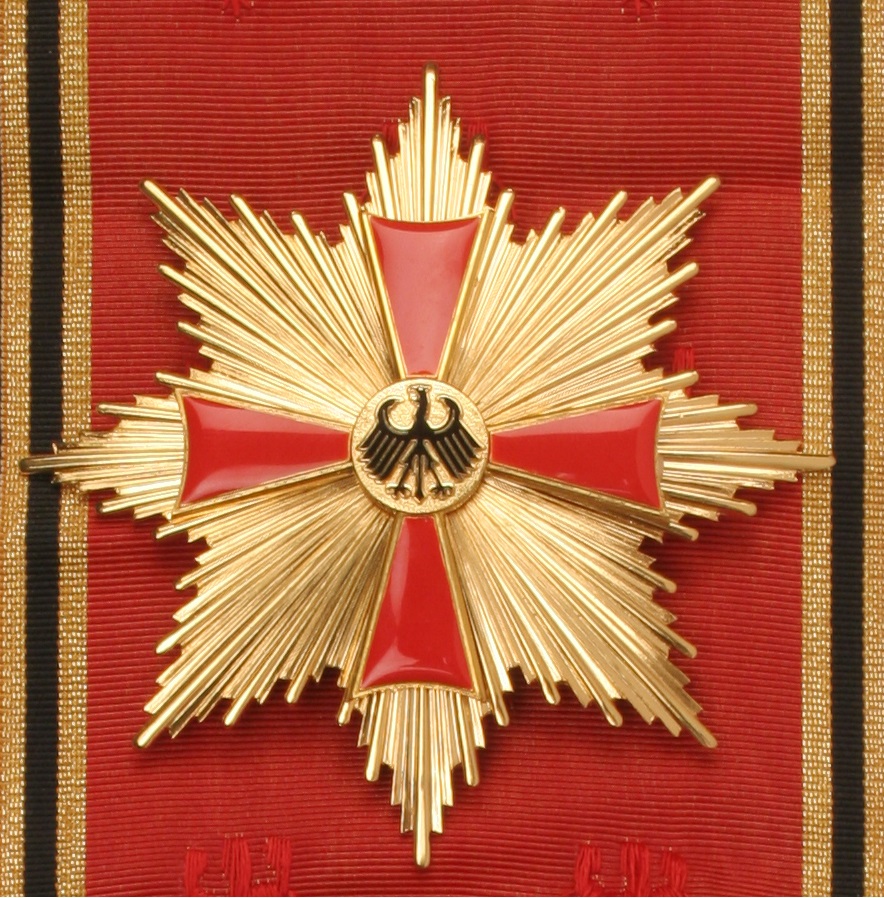
The Order of Merit of the Federal Republic of Germany (German: Verdienstorden der Bundesrepublik Deutschland, or Bundesverdienstorden, BVO) is the highest federal decoration of the Federal Republic of Germany. It may be awarded for any field of endeavor. It was created by the first President of the Federal Republic of Germany, Theodor Heuss, on 7 September 1951. Colloquially, the decorations of the different classes of the Order are also known as the Federal Cross of Merit (Bundesverdienstkreuz).
It has been awarded to more than 262,000 individuals in total, both Germans and foreigners. Since the 1990s, the number of annual awards has declined from more than 4,000, first to around 2,500, then from 2015 to under 1,500, with a low of 918 awards in 2022. Since 2013, women have made up a steady 30–35% of recipients.
Most of the German federal states (Länder) have each their own order of merit as well, with the exception of the Free and Hanseatic Cities of Bremen and Hamburg, which reject any orders (by tradition their citizens, particularly former or present senators, will refuse any decoration in the form of an order, the most famous example being former Chancellor Helmut Schmidt).
The order was established on 7 September 1951 by the decree of Federal President Theodor Heuss. Signed by Heuss, German Chancellor Konrad Adenauer, and Minister of the Interior Robert Lehr, the decree states:
Desiring to visibly express recognition and gratitude to deserving men and women of the German people and of foreign countries, on the second anniversary of the Federal Republic of Germany, I establish the Order of Merit of the Federal Republic of Germany. It is awarded for achievements that served the rebuilding of the country in the fields of political, socio-economic, and intellectual activity, and is intended to be an award for all those whose work contributes to the peaceful rise of the Federal Republic of Germany.
In 2022 Federal President Frank-Walter Steinmeier introduced a gender quota which demands a minimum of 40% of nominees to the order to be women.
The Order comprises four groups with eight regular classes and one special (medal) class (hereafter enumerated in English):
The President of the Federal Republic holds the Grand Cross special class ex officio. It is awarded to him in a ceremony by the President of the Bundestag, attended by the Chancellor of Germany, the President of the Bundesrat, and the Supreme Court President. Other than the German president, only a foreign head of state and their spouse can be awarded with this highest class. There is also the provision of awarding the Grand Cross 1st class in exceptional finish (Großkreuz in besonderer Ausführung), in which the central medallion with the black eagle is surrounded by a stylized laurel wreath in relief. This Grand Cross 1st class in exceptional finish has been awarded only to three persons, the former German chancellors Konrad Adenauer, Helmut Kohl and Angela Merkel.
Hub AI
Order of Merit of the Federal Republic of Germany AI simulator
(@Order of Merit of the Federal Republic of Germany_simulator)
Order of Merit of the Federal Republic of Germany
The Order of Merit of the Federal Republic of Germany (German: Verdienstorden der Bundesrepublik Deutschland, or Bundesverdienstorden, BVO) is the highest federal decoration of the Federal Republic of Germany. It may be awarded for any field of endeavor. It was created by the first President of the Federal Republic of Germany, Theodor Heuss, on 7 September 1951. Colloquially, the decorations of the different classes of the Order are also known as the Federal Cross of Merit (Bundesverdienstkreuz).
It has been awarded to more than 262,000 individuals in total, both Germans and foreigners. Since the 1990s, the number of annual awards has declined from more than 4,000, first to around 2,500, then from 2015 to under 1,500, with a low of 918 awards in 2022. Since 2013, women have made up a steady 30–35% of recipients.
Most of the German federal states (Länder) have each their own order of merit as well, with the exception of the Free and Hanseatic Cities of Bremen and Hamburg, which reject any orders (by tradition their citizens, particularly former or present senators, will refuse any decoration in the form of an order, the most famous example being former Chancellor Helmut Schmidt).
The order was established on 7 September 1951 by the decree of Federal President Theodor Heuss. Signed by Heuss, German Chancellor Konrad Adenauer, and Minister of the Interior Robert Lehr, the decree states:
Desiring to visibly express recognition and gratitude to deserving men and women of the German people and of foreign countries, on the second anniversary of the Federal Republic of Germany, I establish the Order of Merit of the Federal Republic of Germany. It is awarded for achievements that served the rebuilding of the country in the fields of political, socio-economic, and intellectual activity, and is intended to be an award for all those whose work contributes to the peaceful rise of the Federal Republic of Germany.
In 2022 Federal President Frank-Walter Steinmeier introduced a gender quota which demands a minimum of 40% of nominees to the order to be women.
The Order comprises four groups with eight regular classes and one special (medal) class (hereafter enumerated in English):
The President of the Federal Republic holds the Grand Cross special class ex officio. It is awarded to him in a ceremony by the President of the Bundestag, attended by the Chancellor of Germany, the President of the Bundesrat, and the Supreme Court President. Other than the German president, only a foreign head of state and their spouse can be awarded with this highest class. There is also the provision of awarding the Grand Cross 1st class in exceptional finish (Großkreuz in besonderer Ausführung), in which the central medallion with the black eagle is surrounded by a stylized laurel wreath in relief. This Grand Cross 1st class in exceptional finish has been awarded only to three persons, the former German chancellors Konrad Adenauer, Helmut Kohl and Angela Merkel.
Recent media