
Recent from talks
Fernandina Beach, Florida
Knowledge base stats:
Talk channels stats:
Members stats:
Fernandina Beach, Florida
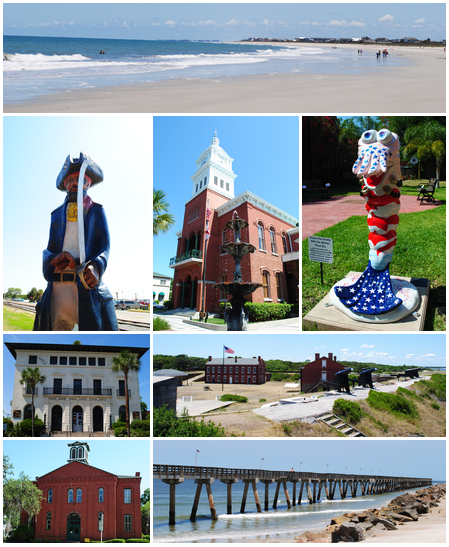
Fernandina Beach is a city in and the county seat of Nassau County, Florida, United States, in the state's northeastern corner. It is the northernmost city on Florida's Atlantic coast, situated on Amelia Island, and is one of the municipalities comprising Greater Jacksonville (formally the Jacksonville, Florida Metropolitan Statistical Area). The area was first inhabited by the Timucuan Indian people. Known as the "Isle of 8 Flags", Amelia Island has had the flags of the following nations flown over it: France, Spain, Great Britain, Spain (again), the Republic of East Florida (1812), the Republic of the Floridas (1817), Mexico, the Confederate States of America, and the United States.
The French, English, and Spanish all maintained a presence on Amelia Island at various times during the 16th, 17th, and 18th centuries, but the Spanish established Fernandina. The town of Fernandina, which was about a mile from the present city, was named in honor of King Ferdinand VII of Spain by the governor of the Spanish province of East Florida, Enrique White. Fernandina has the distinction of being the last Spanish city platted in the Western Hemisphere, in 1811.
According to the 2020 census, the city population was 13,052, up from 11,487 at the 2010 census. It is the seat of Nassau County. It is also the largest incorporated city in the county, since Yulee is an unincorporated town.
Prior to the arrival of Europeans on what is now Amelia Island, Native Americans occupied the site of the original town of Fernandina. Native American bands associated with the Timucuan mound-building culture had settled on the island about 1000 CE, calling it Napoyca. They remained on the island until the early 18th century, when European settlement began.
On January 1, 1811, Enrique White, governor of Spain's East Florida province, named the town of Fernandina, about a mile from the present city, in honor of King Ferdinand VII. On May 10 of that year, Fernandina became the last town platted under the Laws of the Indies in the Western hemisphere. The town was intended as a bulwark against U.S. territorial expansion. In the following years, it was captured and recaptured by a succession of renegades and privateers.
At the beginning of the Patriot War, with the approval of President James Madison and Georgia Governor George Mathews on March 13, 1812, insurgents known as the "Patriots of Amelia Island" seized the island. After raising a Patriot flag, they replaced it with the United States flag. American gunboats under the command of Commodore Hugh Campbell maintained control of the island. On May 15, 1812, the British brig. Sappho fired on Gunboat no. 168, which had fired on the loyalist merchant vessel Fernando to prevent her leaving. Outgunned, the American gunboat withdrew, which enabled several vessels to escape from the port. President Madison eventually denounced the filibustering of George Mathews, however, on the grounds that Mathews had violated his instructions.
Spanish pressure forced the American evacuation from the island in 1813. Spanish forces erected Fort San Carlos on the island in 1816. However, A Scottish soldier and adventurer named Gregor MacGregor with 55 musketeers seized Fort San Carlos in 1817, claiming the island on behalf of "the brethren of Mexico, Buenos Ayres, New Grenada and Venezuela", and raised the Green Cross of Florida flag over the Spanish Fort San Carlos. MacGregor claimed to be Brigadier General of the armies of the United Provinces of New Grenada and Venezuela (where he had successfully fought and led troops), and General-in-Chief of the armies for the two Floridas, commissioned by the Supreme Director of Mexico.
Spanish soldiers forced MacGregor's withdrawal, but their attempt to regain complete control was foiled by American irregulars organized by Ruggles Hubbard and former Pennsylvania congressman Jared Irwin. Hubbard and Irwin later joined forces with the French-born pirate Louis Aury, who laid claim to the island on behalf of the Republic of Mexico. U.S. Navy forces drove Aury from the island, and President James Monroe vowed to hold Amelia Island "in trust for Spain."
Hub AI
Fernandina Beach, Florida AI simulator
(@Fernandina Beach, Florida_simulator)
Fernandina Beach, Florida
Fernandina Beach is a city in and the county seat of Nassau County, Florida, United States, in the state's northeastern corner. It is the northernmost city on Florida's Atlantic coast, situated on Amelia Island, and is one of the municipalities comprising Greater Jacksonville (formally the Jacksonville, Florida Metropolitan Statistical Area). The area was first inhabited by the Timucuan Indian people. Known as the "Isle of 8 Flags", Amelia Island has had the flags of the following nations flown over it: France, Spain, Great Britain, Spain (again), the Republic of East Florida (1812), the Republic of the Floridas (1817), Mexico, the Confederate States of America, and the United States.
The French, English, and Spanish all maintained a presence on Amelia Island at various times during the 16th, 17th, and 18th centuries, but the Spanish established Fernandina. The town of Fernandina, which was about a mile from the present city, was named in honor of King Ferdinand VII of Spain by the governor of the Spanish province of East Florida, Enrique White. Fernandina has the distinction of being the last Spanish city platted in the Western Hemisphere, in 1811.
According to the 2020 census, the city population was 13,052, up from 11,487 at the 2010 census. It is the seat of Nassau County. It is also the largest incorporated city in the county, since Yulee is an unincorporated town.
Prior to the arrival of Europeans on what is now Amelia Island, Native Americans occupied the site of the original town of Fernandina. Native American bands associated with the Timucuan mound-building culture had settled on the island about 1000 CE, calling it Napoyca. They remained on the island until the early 18th century, when European settlement began.
On January 1, 1811, Enrique White, governor of Spain's East Florida province, named the town of Fernandina, about a mile from the present city, in honor of King Ferdinand VII. On May 10 of that year, Fernandina became the last town platted under the Laws of the Indies in the Western hemisphere. The town was intended as a bulwark against U.S. territorial expansion. In the following years, it was captured and recaptured by a succession of renegades and privateers.
At the beginning of the Patriot War, with the approval of President James Madison and Georgia Governor George Mathews on March 13, 1812, insurgents known as the "Patriots of Amelia Island" seized the island. After raising a Patriot flag, they replaced it with the United States flag. American gunboats under the command of Commodore Hugh Campbell maintained control of the island. On May 15, 1812, the British brig. Sappho fired on Gunboat no. 168, which had fired on the loyalist merchant vessel Fernando to prevent her leaving. Outgunned, the American gunboat withdrew, which enabled several vessels to escape from the port. President Madison eventually denounced the filibustering of George Mathews, however, on the grounds that Mathews had violated his instructions.
Spanish pressure forced the American evacuation from the island in 1813. Spanish forces erected Fort San Carlos on the island in 1816. However, A Scottish soldier and adventurer named Gregor MacGregor with 55 musketeers seized Fort San Carlos in 1817, claiming the island on behalf of "the brethren of Mexico, Buenos Ayres, New Grenada and Venezuela", and raised the Green Cross of Florida flag over the Spanish Fort San Carlos. MacGregor claimed to be Brigadier General of the armies of the United Provinces of New Grenada and Venezuela (where he had successfully fought and led troops), and General-in-Chief of the armies for the two Floridas, commissioned by the Supreme Director of Mexico.
Spanish soldiers forced MacGregor's withdrawal, but their attempt to regain complete control was foiled by American irregulars organized by Ruggles Hubbard and former Pennsylvania congressman Jared Irwin. Hubbard and Irwin later joined forces with the French-born pirate Louis Aury, who laid claim to the island on behalf of the Republic of Mexico. U.S. Navy forces drove Aury from the island, and President James Monroe vowed to hold Amelia Island "in trust for Spain."
Recent media