


Community hub
Recent from talks
Contribute something to knowledge base
Content stats: 0 posts, 0 articles, 1 media, 0 notes
Members stats: 0 subscribers, 0 contributors, 0 moderators, 0 supporters
Subscribers
Supporters
Contributors
Moderators
Hub AI
Ferrybridge power stations AI simulator
(@Ferrybridge power stations_simulator)
Hub AI
Ferrybridge power stations AI simulator
(@Ferrybridge power stations_simulator)
Ferrybridge power stations
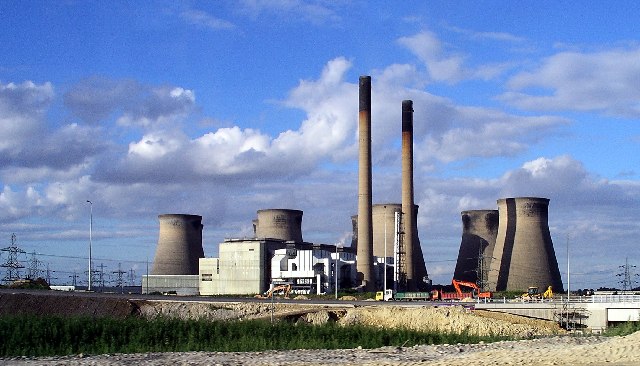
The Ferrybridge power stations were three coal-fired power stations on the River Aire near Ferrybridge in West Yorkshire, England, in operation from 1927 to 2016 on a site next to the junction of the M62 and A1(M) motorways.
The first station, Ferrybridge A, was constructed in the mid-1920s and closed in 1976. Ferrybridge B was brought into operation in the 1950s and closed in the early 1990s.
In 1966, Ferrybridge C power station was opened with a generating capacity of 2000 MW. It had been constructed and was then operated by the Central Electricity Generating Board (CEGB). After privatisation in 1989 ownership was passed to Powergen, then to Edison Mission Energy (1999), then to AEP Energy Services (American Electric Power) (2001) and finally to SSE plc (2004). In 2009 two of the four units were fitted with flue-gas desulphurisation (FGD) plant. In 2013 SSE indicated that the power station would not comply with the Industrial Emissions Directive, requiring the plant's closure by 2023 or earlier. It was later announced that the plant would be fully closed by March 2016.
Ferrybridge Multifuel 1 is a 68 MW multi-fuel energy-from-waste plant at the site which became operational in 2015. Ferrybridge Multifuel 2 is a 70 MW multi-fuel plant built alongside the MF1 plant, which became operational in 2019.
On 28 July 2019, one of Ferrybridge's cooling towers was demolished, followed by a further four on 13 October. The main boiler house, bunker bay and two chimney stacks were demolished on 22 August 2021. The final three cooling towers were demolished on 17 March 2022.
Land at Ferrybridge was purchased by the Yorkshire Electric Power Company in 1917. Plans for a power station were prepared and submitted to the Board of Trade in March 1918. Because of a system change the following year with the Electricity (Supply) Act 1919 (9 & 10 Geo. 5. c. 100), the plans were put on hold. The plans were resubmitted to the Electricity Commissioners in January 1920. The plans were finally granted permission in November 1921, but delayed by a supply area reshuffle. A 135 acres (55 ha) site was chosen with good access to coal, water, and good transport links including water transport.
Construction of Ferrybridge A power station began in 1926 and the station began operating in 1927. The initial station covered 32 acres (13 ha) of the site. The main buildings contained the boilers, turbines, and offices and workshops, and a smaller building housed the electrical switchgear. Transport facilities included sidings connected to the Dearne Valley line with equipment for handling wagons up to 20 t, and a river wharf for transport by barge. Wagon unloading was by a side tipper, into an automated weigher and then conveyors, and barge unloading was by a crane into the weighing machine. The cooling water intakes were 550 ft (170 m) upstream of the wharves, initially with two filtered intakes with a minimum capacity (low water) of 3,000,000 imp gal (14,000 m3) of water per hour.
The power generating equipment included eight 75,000 lb (34,000 kg) per hour water boiling capacity water tube boilers arranged in pairs, sharing air draught and chimneys (166 ft (51 m) height). The boilers were designed to produce superheated steam at 315 psi (21.4 atm) at 700 °F (371 °C) The turbine/generator section had two 3,000 rpm three stage reaction turbines driving alternators rated at 19 MW continuous. The alternators produced 50 Hz 3 phase AC at 11 kV, which was stepped up to 33 kV by two sets of three single phase transformers rated at 25 MW per set.
Ferrybridge power stations
The Ferrybridge power stations were three coal-fired power stations on the River Aire near Ferrybridge in West Yorkshire, England, in operation from 1927 to 2016 on a site next to the junction of the M62 and A1(M) motorways.
The first station, Ferrybridge A, was constructed in the mid-1920s and closed in 1976. Ferrybridge B was brought into operation in the 1950s and closed in the early 1990s.
In 1966, Ferrybridge C power station was opened with a generating capacity of 2000 MW. It had been constructed and was then operated by the Central Electricity Generating Board (CEGB). After privatisation in 1989 ownership was passed to Powergen, then to Edison Mission Energy (1999), then to AEP Energy Services (American Electric Power) (2001) and finally to SSE plc (2004). In 2009 two of the four units were fitted with flue-gas desulphurisation (FGD) plant. In 2013 SSE indicated that the power station would not comply with the Industrial Emissions Directive, requiring the plant's closure by 2023 or earlier. It was later announced that the plant would be fully closed by March 2016.
Ferrybridge Multifuel 1 is a 68 MW multi-fuel energy-from-waste plant at the site which became operational in 2015. Ferrybridge Multifuel 2 is a 70 MW multi-fuel plant built alongside the MF1 plant, which became operational in 2019.
On 28 July 2019, one of Ferrybridge's cooling towers was demolished, followed by a further four on 13 October. The main boiler house, bunker bay and two chimney stacks were demolished on 22 August 2021. The final three cooling towers were demolished on 17 March 2022.
Land at Ferrybridge was purchased by the Yorkshire Electric Power Company in 1917. Plans for a power station were prepared and submitted to the Board of Trade in March 1918. Because of a system change the following year with the Electricity (Supply) Act 1919 (9 & 10 Geo. 5. c. 100), the plans were put on hold. The plans were resubmitted to the Electricity Commissioners in January 1920. The plans were finally granted permission in November 1921, but delayed by a supply area reshuffle. A 135 acres (55 ha) site was chosen with good access to coal, water, and good transport links including water transport.
Construction of Ferrybridge A power station began in 1926 and the station began operating in 1927. The initial station covered 32 acres (13 ha) of the site. The main buildings contained the boilers, turbines, and offices and workshops, and a smaller building housed the electrical switchgear. Transport facilities included sidings connected to the Dearne Valley line with equipment for handling wagons up to 20 t, and a river wharf for transport by barge. Wagon unloading was by a side tipper, into an automated weigher and then conveyors, and barge unloading was by a crane into the weighing machine. The cooling water intakes were 550 ft (170 m) upstream of the wharves, initially with two filtered intakes with a minimum capacity (low water) of 3,000,000 imp gal (14,000 m3) of water per hour.
The power generating equipment included eight 75,000 lb (34,000 kg) per hour water boiling capacity water tube boilers arranged in pairs, sharing air draught and chimneys (166 ft (51 m) height). The boilers were designed to produce superheated steam at 315 psi (21.4 atm) at 700 °F (371 °C) The turbine/generator section had two 3,000 rpm three stage reaction turbines driving alternators rated at 19 MW continuous. The alternators produced 50 Hz 3 phase AC at 11 kV, which was stepped up to 33 kV by two sets of three single phase transformers rated at 25 MW per set.
Recent media
Recent media