
Recent from talks
Fibrocystic breast changes
Knowledge base stats:
Talk channels stats:
Members stats:
Fibrocystic breast changes
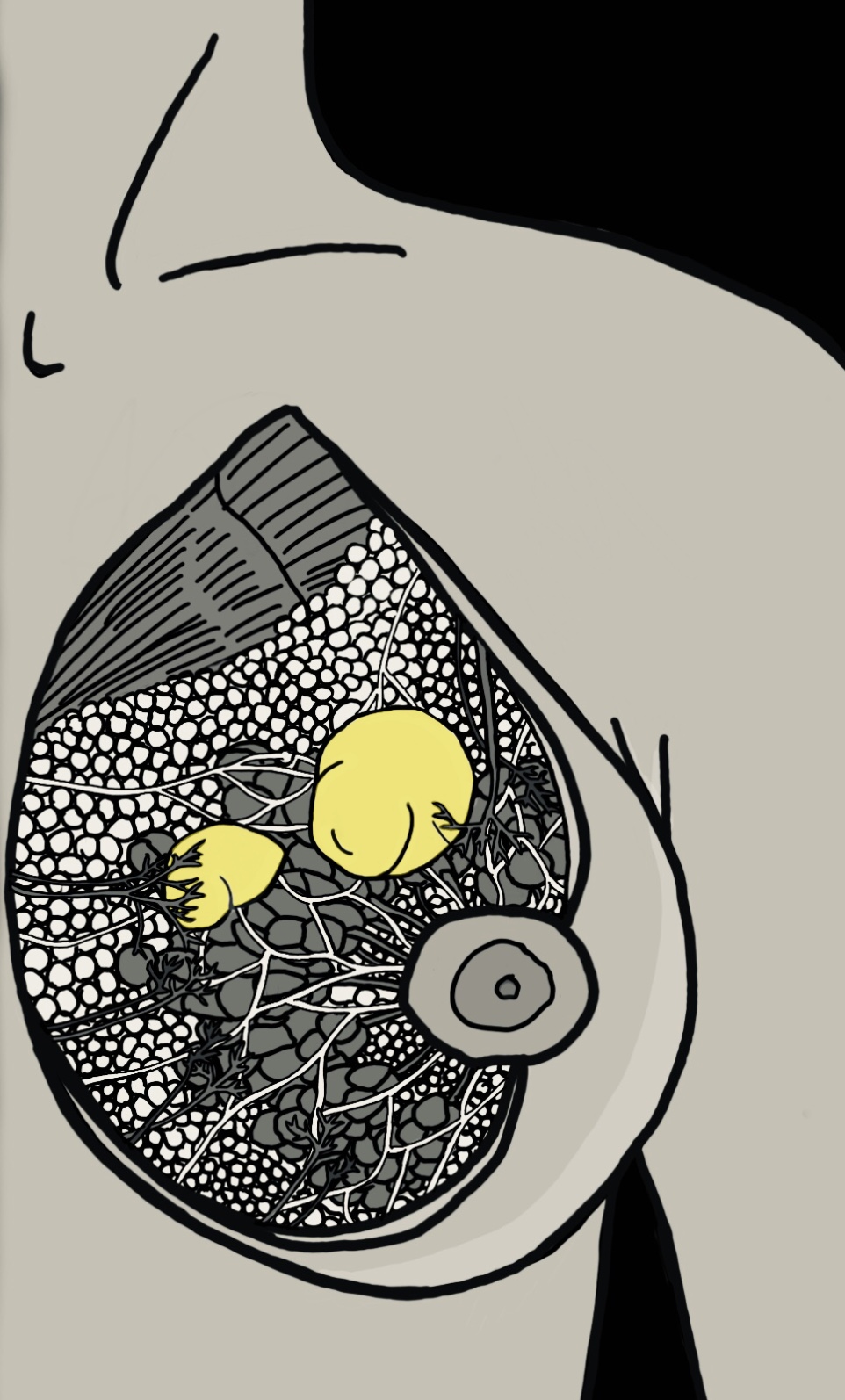
Fibrocystic breast changes is a condition of the breasts where there may be pain, breast cysts, and breast masses. The breasts may be described as "lumpy" or "doughy". Symptoms may worsen during certain parts of the menstrual cycle due to hormonal stimulation. These are normal breast changes, not associated with cancer.
Risk factors include an early age at first menstrual period and either having children at a late age or not at all. It is not a disease but represents normal breast changes. Diagnosis involves ruling out breast cancer. Fibrocystic changes include fibroadenomas, fibrosis, papillomas of the breast, and apocrine-type metaplasia.
Management may involve education about the condition, using a well fitting bra, and pain medication, if needed. Occasionally danazol or tamoxifen may be used for pain. It is estimated that up to 60% of women are affected, most commonly between the ages of 30 and 50 years.
The changes in fibrocystic breast disease are characterised by the appearance of fibrous tissue and a lumpy, cobblestone texture in the breasts. These lumps are smooth with well defined edges, and free-moving regarding adjacent structures. These lumps can sometimes be obscured by irregularities in the breast associated with the condition. They are often found in the upper, outer sections of the breast (nearest to the armpit), but can be found throughout the breast. Women with fibrocystic changes may experience a persistent or intermittent aching or breast tenderness related to periodic swelling. Breasts and nipples may also be tender or itchy.
Symptoms follow a periodic trend closely tied to the menstrual cycle. Symptoms tend to peak in the days to weeks before each period and decrease afterwards. At peak, breasts may feel full, heavy, swollen, and tender to the touch. No complications related to breastfeeding have been found.
The exact mechanism of the condition is not fully understood, though it is known to be tied to hormone level fluctuation; the condition usually subsides after menopause and is closely related to the menstrual cycle. Post-menopausal women under hormone replacement therapy have also reported symptoms of fibrocystic breast changes, indicating hormones may play a major role.[citation needed]
This condition is an accumulative process, partly caused by the normal hormonal variation during a woman's monthly cycle. The most important of these hormones include estrogen, progesterone and prolactin.
These hormones directly affect the breast tissue by causing cells to grow and multiply. Other hormones such as TSH, insulin, growth hormone and growth factors such as TGF-beta exert both direct and indirect effects by amplifying or regulating cell growth. Chronic hormonal fluctuations eventually produce small cysts and/or areas of dense or fibrotic tissue over the years. By the age of 30, multiple small cysts and breast pain may arise. Larger cysts usually do not occur until after the age of 35. Over time, presumably driven by aberrant growth signals, such lesions may accumulate epigenetic, genetic and karyotypic changes such as modified expression of hormone receptors and loss of heterozygosity.
Hub AI
Fibrocystic breast changes AI simulator
(@Fibrocystic breast changes_simulator)
Fibrocystic breast changes
Fibrocystic breast changes is a condition of the breasts where there may be pain, breast cysts, and breast masses. The breasts may be described as "lumpy" or "doughy". Symptoms may worsen during certain parts of the menstrual cycle due to hormonal stimulation. These are normal breast changes, not associated with cancer.
Risk factors include an early age at first menstrual period and either having children at a late age or not at all. It is not a disease but represents normal breast changes. Diagnosis involves ruling out breast cancer. Fibrocystic changes include fibroadenomas, fibrosis, papillomas of the breast, and apocrine-type metaplasia.
Management may involve education about the condition, using a well fitting bra, and pain medication, if needed. Occasionally danazol or tamoxifen may be used for pain. It is estimated that up to 60% of women are affected, most commonly between the ages of 30 and 50 years.
The changes in fibrocystic breast disease are characterised by the appearance of fibrous tissue and a lumpy, cobblestone texture in the breasts. These lumps are smooth with well defined edges, and free-moving regarding adjacent structures. These lumps can sometimes be obscured by irregularities in the breast associated with the condition. They are often found in the upper, outer sections of the breast (nearest to the armpit), but can be found throughout the breast. Women with fibrocystic changes may experience a persistent or intermittent aching or breast tenderness related to periodic swelling. Breasts and nipples may also be tender or itchy.
Symptoms follow a periodic trend closely tied to the menstrual cycle. Symptoms tend to peak in the days to weeks before each period and decrease afterwards. At peak, breasts may feel full, heavy, swollen, and tender to the touch. No complications related to breastfeeding have been found.
The exact mechanism of the condition is not fully understood, though it is known to be tied to hormone level fluctuation; the condition usually subsides after menopause and is closely related to the menstrual cycle. Post-menopausal women under hormone replacement therapy have also reported symptoms of fibrocystic breast changes, indicating hormones may play a major role.[citation needed]
This condition is an accumulative process, partly caused by the normal hormonal variation during a woman's monthly cycle. The most important of these hormones include estrogen, progesterone and prolactin.
These hormones directly affect the breast tissue by causing cells to grow and multiply. Other hormones such as TSH, insulin, growth hormone and growth factors such as TGF-beta exert both direct and indirect effects by amplifying or regulating cell growth. Chronic hormonal fluctuations eventually produce small cysts and/or areas of dense or fibrotic tissue over the years. By the age of 30, multiple small cysts and breast pain may arise. Larger cysts usually do not occur until after the age of 35. Over time, presumably driven by aberrant growth signals, such lesions may accumulate epigenetic, genetic and karyotypic changes such as modified expression of hormone receptors and loss of heterozygosity.
Recent media