
Recent from talks
Fiddler's Ferry power station
Knowledge base stats:
Talk channels stats:
Members stats:
Fiddler's Ferry power station
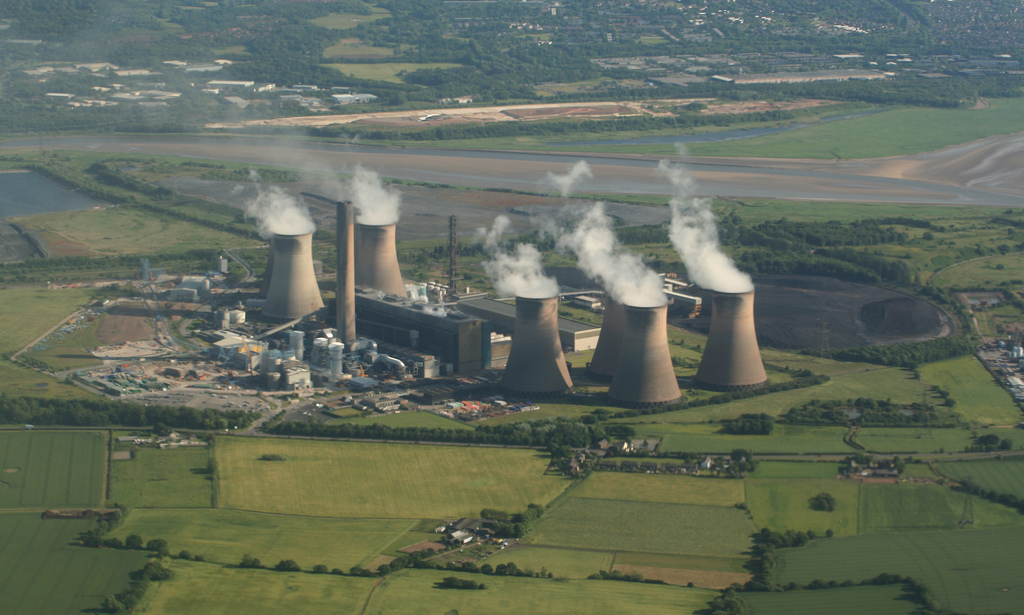
Fiddler's Ferry power station is a decommissioned coal fired power station in the Borough of Warrington, Cheshire, England. Opened in 1971, the station had a generating capacity of 1,989 megawatts and took water from the River Mersey. After privatisation in 1990, the station was operated by various companies, and from 2004 to 2022 by SSE Thermal. The power station closed on 31 March 2020. The site was acquired by Peel NRE in July 2022.
With four of its original eight 114-metre (374 ft) high cooling towers still standing and its 200-metre (660 ft) high chimney, the station is a prominent local landmark and can be seen from as far away as the Peak District and the Pennines. The power station's four northernmost cooling towers were demolished on 3 December 2023, with the remaining four southernmost towers set to be demolished at a later date.
One of the Hinton Heavies, an application to build Fiddler's Ferry power station was proposed in 1962. The civil works were built by Taylor Woodrow Construction, the cooling towers by Yorkshire Hennibique, the chimney by Tileman and the steelwork for the main buildings by the Cleveland Bridge Company between 1964 and 1971, and came into full operation in 1973.
There were eight cooling towers arranged in two groups of four located to the north and south of the main building. There is a single chimney located to the east of the main building. One of the station's cooling towers collapsed in high winds on 13 January 1984 and was rebuilt. When it was built, the station mainly burned coal mined in the South Yorkshire Coalfield and transported across the Pennines on the Manchester–Sheffield–Wath electric railway. In later years, the coal was imported.[citation needed]
Between 2006 and 2008, Fiddler's Ferry was fitted with a flue-gas desulphurisation (FGD) plant to reduce the emissions of sulphur by 94%, meeting the European Large Combustion Plant Directive. In 2010, the station was being considered for the installation of selective catalytic reduction (SCR) equipment. This would reduce the station's emissions of nitrogen oxides, to meet the requirements of the Industrial Emissions (Integrated Pollution Prevention and Control) Directive. The SCR technology would replace the Separated Over Fire Air (SOFA) technology which was used in the station. The SCR equipment was ultimately not fitted, due to uncertainty over the future of the plant.
The station was built by the Central Electricity Generating Board but was transferred to Powergen after privatisation of the UK's electricity industry in 1990. Fiddler's Ferry, along with the Ferrybridge power stations in Yorkshire, was then sold to Edison Mission Energy in 1999. They were subsequently sold on to AEP Energy Services in 2001, and both were sold again in July 2004 to SSE Thermal for £136 million.
Between 2001 and 2011 the station was featured in the opening and closing titles and was in some background scenes of the BBC comedy series Two Pints of Lager and a Packet of Crisps.
The station generated electricity using four 500 MW generating sets and consumed 195 million litres of water daily from the River Mersey. At full capacity, 16,000 tonnes of coal were burned each day. It also burned biofuels together with the coal. It used SOFA technology to control nitrogen oxide emissions and FGD to reduce the emission of sulphur.
Hub AI
Fiddler's Ferry power station AI simulator
(@Fiddler's Ferry power station_simulator)
Fiddler's Ferry power station
Fiddler's Ferry power station is a decommissioned coal fired power station in the Borough of Warrington, Cheshire, England. Opened in 1971, the station had a generating capacity of 1,989 megawatts and took water from the River Mersey. After privatisation in 1990, the station was operated by various companies, and from 2004 to 2022 by SSE Thermal. The power station closed on 31 March 2020. The site was acquired by Peel NRE in July 2022.
With four of its original eight 114-metre (374 ft) high cooling towers still standing and its 200-metre (660 ft) high chimney, the station is a prominent local landmark and can be seen from as far away as the Peak District and the Pennines. The power station's four northernmost cooling towers were demolished on 3 December 2023, with the remaining four southernmost towers set to be demolished at a later date.
One of the Hinton Heavies, an application to build Fiddler's Ferry power station was proposed in 1962. The civil works were built by Taylor Woodrow Construction, the cooling towers by Yorkshire Hennibique, the chimney by Tileman and the steelwork for the main buildings by the Cleveland Bridge Company between 1964 and 1971, and came into full operation in 1973.
There were eight cooling towers arranged in two groups of four located to the north and south of the main building. There is a single chimney located to the east of the main building. One of the station's cooling towers collapsed in high winds on 13 January 1984 and was rebuilt. When it was built, the station mainly burned coal mined in the South Yorkshire Coalfield and transported across the Pennines on the Manchester–Sheffield–Wath electric railway. In later years, the coal was imported.[citation needed]
Between 2006 and 2008, Fiddler's Ferry was fitted with a flue-gas desulphurisation (FGD) plant to reduce the emissions of sulphur by 94%, meeting the European Large Combustion Plant Directive. In 2010, the station was being considered for the installation of selective catalytic reduction (SCR) equipment. This would reduce the station's emissions of nitrogen oxides, to meet the requirements of the Industrial Emissions (Integrated Pollution Prevention and Control) Directive. The SCR technology would replace the Separated Over Fire Air (SOFA) technology which was used in the station. The SCR equipment was ultimately not fitted, due to uncertainty over the future of the plant.
The station was built by the Central Electricity Generating Board but was transferred to Powergen after privatisation of the UK's electricity industry in 1990. Fiddler's Ferry, along with the Ferrybridge power stations in Yorkshire, was then sold to Edison Mission Energy in 1999. They were subsequently sold on to AEP Energy Services in 2001, and both were sold again in July 2004 to SSE Thermal for £136 million.
Between 2001 and 2011 the station was featured in the opening and closing titles and was in some background scenes of the BBC comedy series Two Pints of Lager and a Packet of Crisps.
The station generated electricity using four 500 MW generating sets and consumed 195 million litres of water daily from the River Mersey. At full capacity, 16,000 tonnes of coal were burned each day. It also burned biofuels together with the coal. It used SOFA technology to control nitrogen oxide emissions and FGD to reduce the emission of sulphur.
Recent media