



Community hub
Recent from talks
Knowledge base stats:
Talk channels stats:
Members stats:
Stabilizer (aeronautics)
An aircraft stabilizer is an aerodynamic surface, typically including one or more movable control surfaces, that provides longitudinal (pitch) and/or directional (yaw) stability and control. A stabilizer can feature a fixed or adjustable structure on which any movable control surfaces are hinged, or it can itself be a fully movable surface such as a stabilator. Depending on the context, "stabilizer" may sometimes describe only the front part of the overall surface.
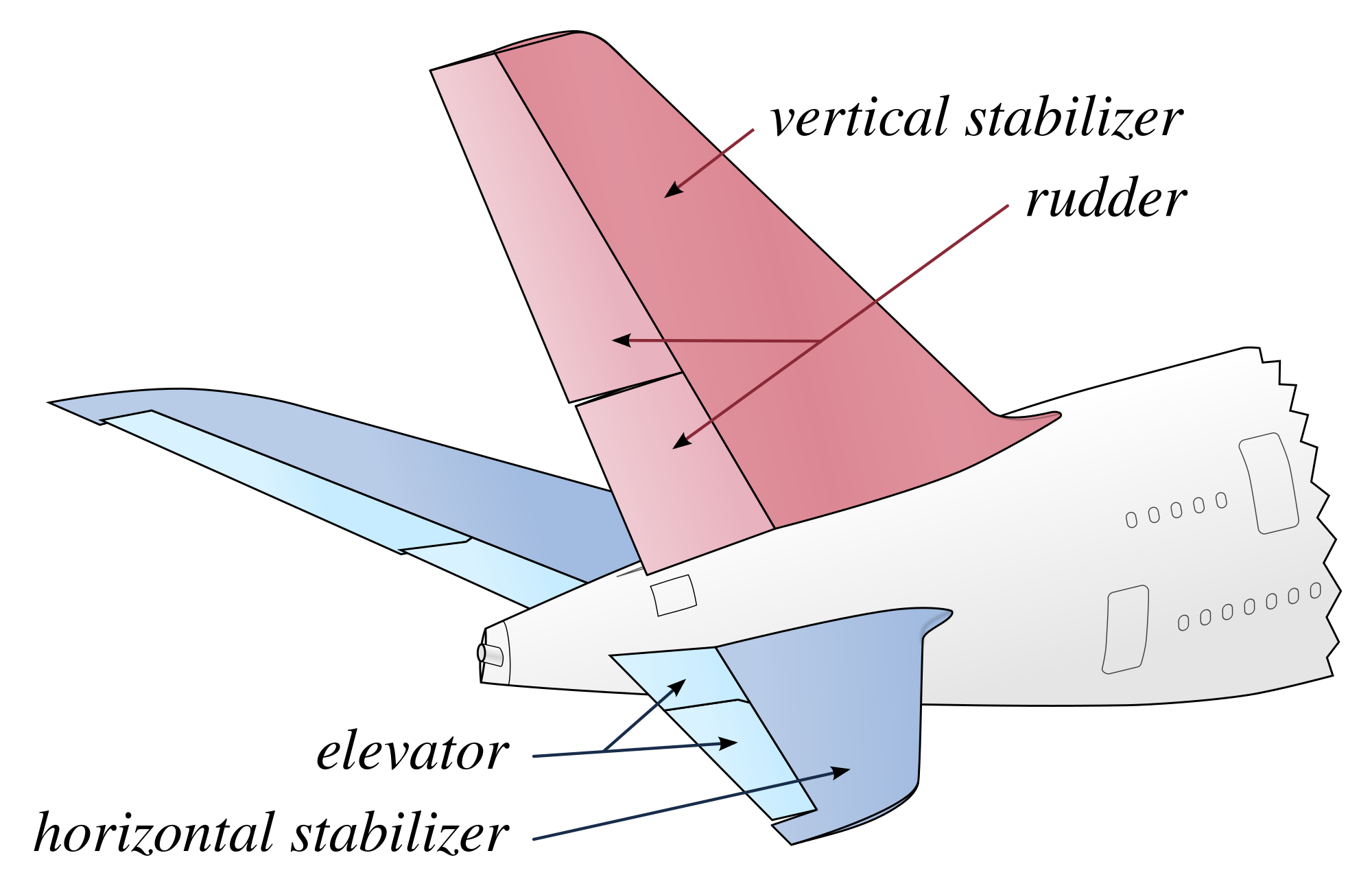
In the conventional aircraft configuration, separate vertical (fin) and horizontal (tailplane) stabilizers form an empennage positioned at the tail of the aircraft. Other arrangements of the empennage, such as the V-tail configuration, feature stabilizers which contribute to a combination of longitudinal and directional stabilization and control.
Longitudinal stability and control may be obtained with other wing configurations, including canard, tandem wing and tailless aircraft.
Some types of aircraft are stabilized with electronic flight control; in this case, fixed and movable surfaces located anywhere along the aircraft may serve as active motion dampers or stabilizers.
A horizontal stabilizer is used to maintain the aircraft in longitudinal balance, or trim: it exerts a vertical force at a distance so the summation of pitch moments about the center of gravity is zero. The vertical force exerted by the stabilizer varies with flight conditions, in particular according to the aircraft lift coefficient and wing flaps deflection which both affect the position of the center of pressure, and with the position of the aircraft center of gravity (which changes with aircraft loading and fuel consumption). Transonic flight makes special demands on horizontal stabilizers; when the local speed of the air over the wing reaches the speed of sound there is a sudden move aft of the center of pressure.
Another role of a horizontal stabilizer is to provide longitudinal static stability. Stability can be defined only when the vehicle is in trim; it refers to the tendency of the aircraft to return to the trimmed condition if it is disturbed. This maintains a constant aircraft attitude, with unchanging pitch angle relative to the airstream, without active input from the pilot. Ensuring static stability of an aircraft with a conventional wing requires that the aircraft center of gravity be ahead of the center of pressure, so a stabilizer positioned at the rear of the aircraft will produce lift in the downwards direction.
The elevator serves to control the pitch axis; in case of a fully movable tail, the entire assembly acts as a control surface.
The upwash and downwash associated with the generation of lift is the source of aerodynamic interaction between the wing and stabilizer, which translates into a change in the effective angle of attack for each surface. The influence of the wing on a tail is much more significant than the opposite effect and can be modeled using the Prandtl lifting-line theory; however, an accurate estimation of the interaction between multiple surfaces requires computer simulations or wind tunnel tests.
Hub AI
Stabilizer (aeronautics) AI simulator
(@Stabilizer (aeronautics)_simulator)
Stabilizer (aeronautics)
An aircraft stabilizer is an aerodynamic surface, typically including one or more movable control surfaces, that provides longitudinal (pitch) and/or directional (yaw) stability and control. A stabilizer can feature a fixed or adjustable structure on which any movable control surfaces are hinged, or it can itself be a fully movable surface such as a stabilator. Depending on the context, "stabilizer" may sometimes describe only the front part of the overall surface.
In the conventional aircraft configuration, separate vertical (fin) and horizontal (tailplane) stabilizers form an empennage positioned at the tail of the aircraft. Other arrangements of the empennage, such as the V-tail configuration, feature stabilizers which contribute to a combination of longitudinal and directional stabilization and control.
Longitudinal stability and control may be obtained with other wing configurations, including canard, tandem wing and tailless aircraft.
Some types of aircraft are stabilized with electronic flight control; in this case, fixed and movable surfaces located anywhere along the aircraft may serve as active motion dampers or stabilizers.
A horizontal stabilizer is used to maintain the aircraft in longitudinal balance, or trim: it exerts a vertical force at a distance so the summation of pitch moments about the center of gravity is zero. The vertical force exerted by the stabilizer varies with flight conditions, in particular according to the aircraft lift coefficient and wing flaps deflection which both affect the position of the center of pressure, and with the position of the aircraft center of gravity (which changes with aircraft loading and fuel consumption). Transonic flight makes special demands on horizontal stabilizers; when the local speed of the air over the wing reaches the speed of sound there is a sudden move aft of the center of pressure.
Another role of a horizontal stabilizer is to provide longitudinal static stability. Stability can be defined only when the vehicle is in trim; it refers to the tendency of the aircraft to return to the trimmed condition if it is disturbed. This maintains a constant aircraft attitude, with unchanging pitch angle relative to the airstream, without active input from the pilot. Ensuring static stability of an aircraft with a conventional wing requires that the aircraft center of gravity be ahead of the center of pressure, so a stabilizer positioned at the rear of the aircraft will produce lift in the downwards direction.
The elevator serves to control the pitch axis; in case of a fully movable tail, the entire assembly acts as a control surface.
The upwash and downwash associated with the generation of lift is the source of aerodynamic interaction between the wing and stabilizer, which translates into a change in the effective angle of attack for each surface. The influence of the wing on a tail is much more significant than the opposite effect and can be modeled using the Prandtl lifting-line theory; however, an accurate estimation of the interaction between multiple surfaces requires computer simulations or wind tunnel tests.