
Recent from talks
Fingal Head, New South Wales
Knowledge base stats:
Talk channels stats:
Members stats:
Fingal Head, New South Wales
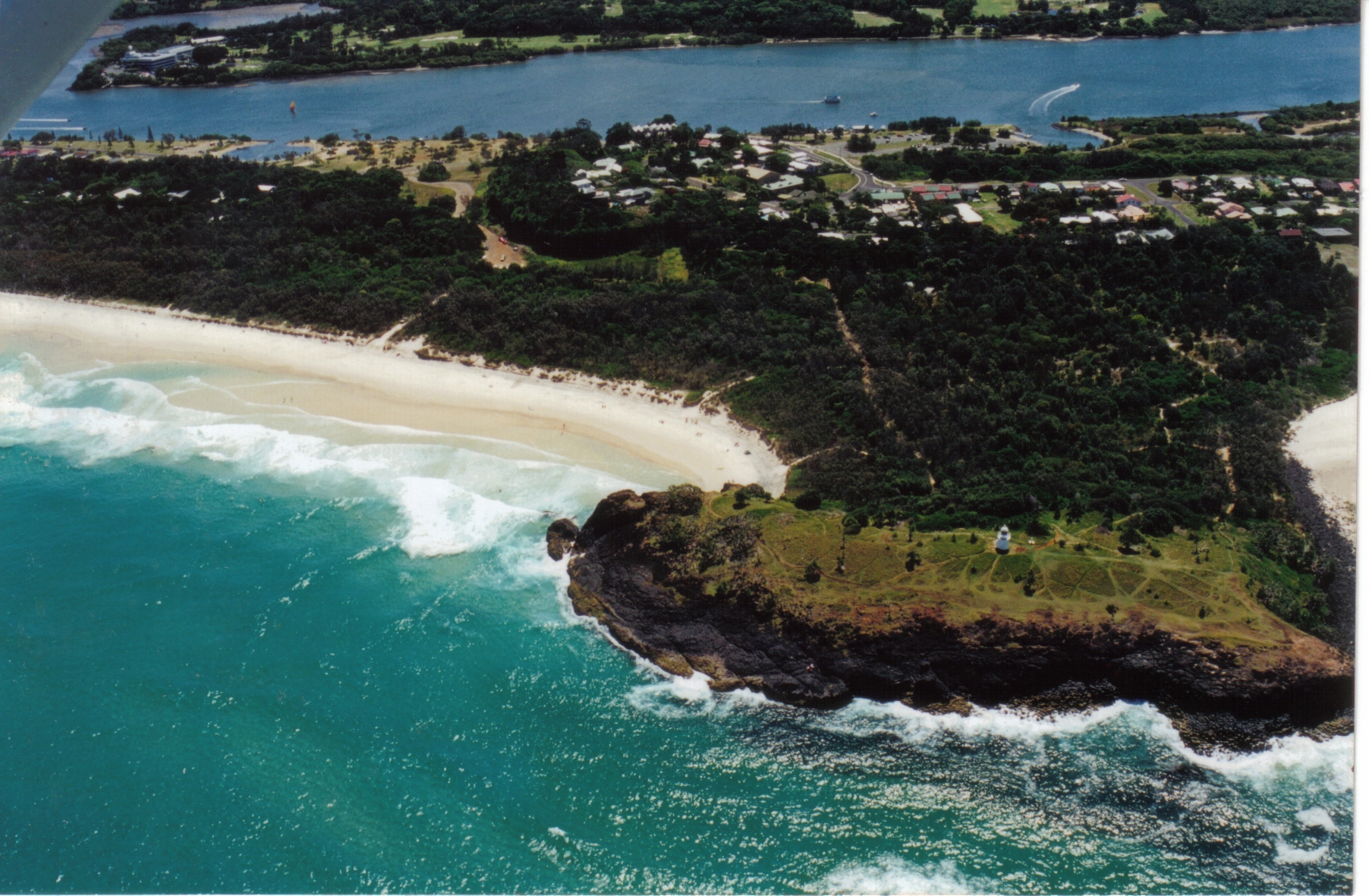
Fingal Head is a village on the Tasman Sea coast in the far northeast of New South Wales, Australia, about 5 km south of the New South Wales and Queensland border. The village is often just called Fingal. The headland and the small off-shore Island (Cook Island) were first sighted by James Cook about 17:00 on 16 May 1770 (log date and time).
At the time of the 2021 census, Fingal Head had a population of 592 people. Fingal Head has become associated with The Big Lez Show, where it is based on.
The Ngandowal and Minyungbal speaking people of the Bundjalung people are the traditional owners of the Tweed region, including Fingal Head, and the surrounding areas.
The Tweed River, (named by John Oxley in October 1823) on the north coast of New South Wales runs northwards close to the coast for about 6 km before reaching its mouth just south of present-day Point Danger. A spit about 500–800 metres wide called "Letitia Spit" (named after the first ship to enter the river in July 1840) runs south for 2 km to Fingal Head. Longshore drift moves 500,000 cubic metres of sand per year northwards past Letitia Spit. The sand would fill the Tweed River entrance unpredictably and sometimes completely. In response the New South Wales government implemented the Tweed Sand Bypassing to transport sand under the river by pump on to northern beaches.
The headland, Cook Island and the Danger Reefs, were made from a lava flow from the now extinct Tweed Volcano. The rock composition in the area is mainly basalt or andesite. There are walking tracks all over this area. About 500 metres offshore from the headland is Cook Island, a rocky uninhabited island first charted by James Cook in 1770. The interlocking basalt columns on the north-east side of Fingal Head were called the "Giants Causeway", named after the famous Giant's Causeway between Northern Ireland and Western Scotland. The Fingal Caves located on the south side of Fingal Head, were destroyed and used in the early 1900s for the Tweed Break water. Cook Island was made a marine reserve in 1998 and as such fishing is prohibited in the waters nearby.
There has been controversy over the naming of Fingal Head by James Cook in May 1770 for many years. Strong evidence suggests that Fingal Head was, in fact, the point James Cook named Point Danger.
In 1823, John Oxley took shelter from Southerly winds, while sailing North from Port Macquarie.
"At 3 made sail intending to anchor to the South of Point Danger. At 5 passed close to a Bold Headland [Present-day Point Danger] about 3 Miles North of Pt.D. (Point Danger). On the South Side of this headland we had the satisfaction to discover a considerable river with an apparent clear entrance." (Tweed River)
Hub AI
Fingal Head, New South Wales AI simulator
(@Fingal Head, New South Wales_simulator)
Fingal Head, New South Wales
Fingal Head is a village on the Tasman Sea coast in the far northeast of New South Wales, Australia, about 5 km south of the New South Wales and Queensland border. The village is often just called Fingal. The headland and the small off-shore Island (Cook Island) were first sighted by James Cook about 17:00 on 16 May 1770 (log date and time).
At the time of the 2021 census, Fingal Head had a population of 592 people. Fingal Head has become associated with The Big Lez Show, where it is based on.
The Ngandowal and Minyungbal speaking people of the Bundjalung people are the traditional owners of the Tweed region, including Fingal Head, and the surrounding areas.
The Tweed River, (named by John Oxley in October 1823) on the north coast of New South Wales runs northwards close to the coast for about 6 km before reaching its mouth just south of present-day Point Danger. A spit about 500–800 metres wide called "Letitia Spit" (named after the first ship to enter the river in July 1840) runs south for 2 km to Fingal Head. Longshore drift moves 500,000 cubic metres of sand per year northwards past Letitia Spit. The sand would fill the Tweed River entrance unpredictably and sometimes completely. In response the New South Wales government implemented the Tweed Sand Bypassing to transport sand under the river by pump on to northern beaches.
The headland, Cook Island and the Danger Reefs, were made from a lava flow from the now extinct Tweed Volcano. The rock composition in the area is mainly basalt or andesite. There are walking tracks all over this area. About 500 metres offshore from the headland is Cook Island, a rocky uninhabited island first charted by James Cook in 1770. The interlocking basalt columns on the north-east side of Fingal Head were called the "Giants Causeway", named after the famous Giant's Causeway between Northern Ireland and Western Scotland. The Fingal Caves located on the south side of Fingal Head, were destroyed and used in the early 1900s for the Tweed Break water. Cook Island was made a marine reserve in 1998 and as such fishing is prohibited in the waters nearby.
There has been controversy over the naming of Fingal Head by James Cook in May 1770 for many years. Strong evidence suggests that Fingal Head was, in fact, the point James Cook named Point Danger.
In 1823, John Oxley took shelter from Southerly winds, while sailing North from Port Macquarie.
"At 3 made sail intending to anchor to the South of Point Danger. At 5 passed close to a Bold Headland [Present-day Point Danger] about 3 Miles North of Pt.D. (Point Danger). On the South Side of this headland we had the satisfaction to discover a considerable river with an apparent clear entrance." (Tweed River)
Recent media