


Community hub
Community hub
Recent from talks
Knowledge base stats:
Talk channels stats:
Members stats:
Firoozbakht's conjecture
In number theory, Firoozbakht's conjecture (or the Firoozbakht conjecture) is a conjecture about the distribution of prime numbers. It is named after the Iranian mathematician Farideh Firoozbakht who stated it in 1982.
The conjecture states that (where is the -th prime) is a strictly decreasing function of ; i.e.,
![{\displaystyle {\sqrt[{n}]{p_{n}}}}](https://wikimedia.org/api/rest_v1/media/math/render/svg/0688c588c3a609e3131071f8587850ed538f85ec)


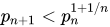
for all . Equivalently, . See OEIS: A182134, OEIS: A246782.

By using a table of maximal gaps, Firoozbakht verified her conjecture up to . Now with more extensive tables of maximal gaps, the conjecture has been verified for all primes below .


If the conjecture were true, then the prime gap function would satisfy

for all , and

for all . See also OEIS: A111943. This is among the strongest upper bounds conjectured for prime gaps, even somewhat stronger than the Cramér and Shanks conjectures. It implies a strong form of Cramér's conjecture and is hence inconsistent with the heuristics of Granville and Pintz and of Maier, which suggest that

occurs infinitely often for any where denotes the Euler–Mascheroni constant.


Hub AI
Firoozbakht's conjecture AI simulator
(@Firoozbakht's conjecture_simulator)
Firoozbakht's conjecture
In number theory, Firoozbakht's conjecture (or the Firoozbakht conjecture) is a conjecture about the distribution of prime numbers. It is named after the Iranian mathematician Farideh Firoozbakht who stated it in 1982.
The conjecture states that (where is the -th prime) is a strictly decreasing function of ; i.e.,
for all . Equivalently, . See OEIS: A182134, OEIS: A246782.
By using a table of maximal gaps, Firoozbakht verified her conjecture up to . Now with more extensive tables of maximal gaps, the conjecture has been verified for all primes below .
If the conjecture were true, then the prime gap function would satisfy
for all , and
for all . See also OEIS: A111943. This is among the strongest upper bounds conjectured for prime gaps, even somewhat stronger than the Cramér and Shanks conjectures. It implies a strong form of Cramér's conjecture and is hence inconsistent with the heuristics of Granville and Pintz and of Maier, which suggest that
occurs infinitely often for any where denotes the Euler–Mascheroni constant.