



Community hub
Recent from talks
Contribute something to knowledge base
Content stats: 0 posts, 0 articles, 1 media, 0 notes
Members stats: 0 subscribers, 0 contributors, 0 moderators, 0 supporters
Subscribers
Supporters
Contributors
Moderators
Hub AI
Achaemenid Empire AI simulator
(@Achaemenid Empire_simulator)
Hub AI
Achaemenid Empire AI simulator
(@Achaemenid Empire_simulator)
Achaemenid Empire
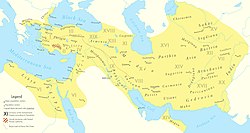
The Achaemenid Empire or Achaemenian Empire, also known as the Persian Empire or First Persian Empire (/əˈkiːmənɪd/; Old Persian: 𐎧𐏁𐏂, Xšāça, lit. 'The Empire' or 'The Kingdom'), was an Iranian empire founded by Cyrus the Great of the Achaemenid dynasty in 550 BC. Based in modern-day Iran, it was the largest empire at the time, spanning a total of 5.5 million square kilometres (2.1 million square miles). The empire included the Balkans, Turkey, Mesopotamia and Egypt to the west, large parts of Central Asia, and stretched all the way to the Indus Valley in the east.
By the 7th century BC, the region of Persis located in the southwestern part of the Iranian plateau had been settled by Persians. From Persis, Cyrus rose and defeated Media, Lydia and the Neo-Babylonian Empire. Thus marking the establishment of a new imperial polity under the Achaemenid dynasty.
In modern times, the Achaemenid Empire has been recognised for its centralised bureaucracy and administration, its multicultural policy, religious tolerance, complex infrastructure projects such as the Royal road, an organized postal system, the use of official languages across its territories and the development of a Civil service and a large professional army. These systems were adopted by a variety of later empires which tried to model themselves after the Achaemenids.
The Achaemenid Empire has been referred to as the first “world empire” due to it's vast size and diverse population.
By 330 BC, the Achaemenid Empire fell to the invading Macedonians under Alexander the Great who was himself an ardent admirer of Cyrus the Great. Alexander's death marked the beginning of the Hellenistic period, which saw most of the fallen Achaemenid territories come under the rule of the Ptolemaic and Seleucid empires for almost a century after which the Iranian elites of the central plateau were able to reclaim power and establish the Parthian Empire.
The Persians were eventually able to re-establish their empire under the Sassanids.
The Achaemenid Empire borrows its name from the ancestor of Cyrus the Great, the founder of the empire, Achaemenes. The term Achaemenid means "of the family of the Achaemenis/Achaemenes" (Old Persian: 𐏃𐎧𐎠𐎶𐎴𐎡𐏁, romanized: Haxāmaniš; a bahuvrihi compound translating to "having a friend's mind"). Achaemenes was himself a minor seventh-century ruler of the Anshan in southwestern Iran, and a vassal of Assyria.
Around 850 BC the original nomadic people who began the empire called themselves the Parsa and their constantly shifting territory Parsua, for the most part localized around Persis. The name "Persia" is a Greek and Latin pronunciation of the native word referring to the country of the people originating from Persis (Old Persian: 𐎱𐎠𐎼𐎿, romanized: Pārsa). The Persian term 𐎧𐏁𐏂 Xšāça, literally meaning "The Kingdom", was used to refer to the Empire formed by their multinational state.
Achaemenid Empire
The Achaemenid Empire or Achaemenian Empire, also known as the Persian Empire or First Persian Empire (/əˈkiːmənɪd/; Old Persian: 𐎧𐏁𐏂, Xšāça, lit. 'The Empire' or 'The Kingdom'), was an Iranian empire founded by Cyrus the Great of the Achaemenid dynasty in 550 BC. Based in modern-day Iran, it was the largest empire at the time, spanning a total of 5.5 million square kilometres (2.1 million square miles). The empire included the Balkans, Turkey, Mesopotamia and Egypt to the west, large parts of Central Asia, and stretched all the way to the Indus Valley in the east.
By the 7th century BC, the region of Persis located in the southwestern part of the Iranian plateau had been settled by Persians. From Persis, Cyrus rose and defeated Media, Lydia and the Neo-Babylonian Empire. Thus marking the establishment of a new imperial polity under the Achaemenid dynasty.
In modern times, the Achaemenid Empire has been recognised for its centralised bureaucracy and administration, its multicultural policy, religious tolerance, complex infrastructure projects such as the Royal road, an organized postal system, the use of official languages across its territories and the development of a Civil service and a large professional army. These systems were adopted by a variety of later empires which tried to model themselves after the Achaemenids.
The Achaemenid Empire has been referred to as the first “world empire” due to it's vast size and diverse population.
By 330 BC, the Achaemenid Empire fell to the invading Macedonians under Alexander the Great who was himself an ardent admirer of Cyrus the Great. Alexander's death marked the beginning of the Hellenistic period, which saw most of the fallen Achaemenid territories come under the rule of the Ptolemaic and Seleucid empires for almost a century after which the Iranian elites of the central plateau were able to reclaim power and establish the Parthian Empire.
The Persians were eventually able to re-establish their empire under the Sassanids.
The Achaemenid Empire borrows its name from the ancestor of Cyrus the Great, the founder of the empire, Achaemenes. The term Achaemenid means "of the family of the Achaemenis/Achaemenes" (Old Persian: 𐏃𐎧𐎠𐎶𐎴𐎡𐏁, romanized: Haxāmaniš; a bahuvrihi compound translating to "having a friend's mind"). Achaemenes was himself a minor seventh-century ruler of the Anshan in southwestern Iran, and a vassal of Assyria.
Around 850 BC the original nomadic people who began the empire called themselves the Parsa and their constantly shifting territory Parsua, for the most part localized around Persis. The name "Persia" is a Greek and Latin pronunciation of the native word referring to the country of the people originating from Persis (Old Persian: 𐎱𐎠𐎼𐎿, romanized: Pārsa). The Persian term 𐎧𐏁𐏂 Xšāça, literally meaning "The Kingdom", was used to refer to the Empire formed by their multinational state.
Recent media
Recent media