



Community hub
Recent from talks
Knowledge base stats:
Talk channels stats:
Members stats:
Mr. Darcy
Fitzwilliam Darcy Esquire, generally referred to as Mr. Darcy, is one of the two central characters in Jane Austen's 1813 novel Pride and Prejudice. He is an archetype of the aloof romantic hero, and a romantic interest of Elizabeth Bennet, the novel's protagonist. The story's narration is almost exclusively from Elizabeth's perspective; the reader is given a one-sided view of Darcy for much of the novel, but hints are given throughout that there is much more to his character than meets the eye. The reader gets a healthy dose of dramatic irony as Elizabeth continually censures Mr. Darcy's character despite the aforementioned hints (via the narrative voice and other characters' observations) that Mr. Darcy is really a noble character at heart, albeit somewhat prideful. Usually referred to only as "Mr. Darcy" or "Darcy" by characters and the narrator, his first name is mentioned twice in the novel.
Mr. Darcy is a wealthy young gentleman with an income exceeding £10,000 a year (equivalent to over £800,000 a year in relative income). The Darcy family have long owned Pemberley, a large estate in Derbyshire, England. As the head of the family and single, Mr Darcy is a highly attractive marital prospect; but is widely expected to marry his first cousin, Anne de Bourgh who has inherited the similarly wealthy estate of Rosings Park in Kent. He is however, also being pursued by Caroline Bingley, the sister of his close friend.
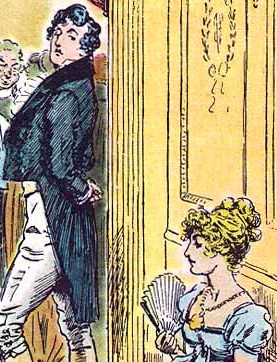
Darcy first meets Elizabeth Bennet at a ball, where he makes rather demeaning remarks about her while she is within earshot. Gradually he becomes attracted to her and later attempts to court her while simultaneously struggling against his continued feelings of superiority. Darcy disapproves when his friend Bingley develops a serious attachment to Elizabeth's elder sister Jane, and persuades Bingley that Jane does not return his feelings (which Darcy honestly but inaccurately believes). He later explains this seeming hypocrisy by asserting, "I was kinder to [Bingley] than to myself". Although Darcy doesn't realise it, Elizabeth has come to dislike him immensely due to Mr. Wickham's tale of how Darcy mistreated him and Elizabeth's later discovery of Darcy's interference in Bingley and Jane's budding relationship, along with Elizabeth's previous observations of Darcy's arrogance, conceit, and selfish disdain of the feelings of others.
Eventually, Mr. Darcy declares his love for Elizabeth and asks for her hand; but in the very course of proposing, he reminds her of the large gap in their social status. Elizabeth is offended and vehemently refuses him, expressing her reasons for disliking him, including her knowledge of his interference with Jane and Bingley and the account she received from Mr. Wickham of Darcy's alleged unfair treatment toward him. Insulted by Darcy's arrogant retorts, Elizabeth says that the rudeness in his proposal prevented her from feeling concerns for him she "might have felt had you behaved in a more gentlemanlike manner". Darcy departs in anger and mortification; the next morning, he writes and hand delivers a letter to Elizabeth in which he defends his wounded honour, reveals the motives for his interference in Jane and Bingley's relationship, and gives a full account of his dealings with Wickham, who had attempted to seduce and elope with Darcy's younger sister, Georgiana, the previous summer.
Although initially angered by Elizabeth's vehement refusal and harsh criticism, Darcy is shocked to discover the reality of how his behaviour is perceived by others, particularly Elizabeth, and commits himself to re-evaluate his actions. A few months later, Darcy unexpectedly encounters Elizabeth when she is visiting his estate in Derbyshire with her aunt and uncle. Elizabeth is first embarrassed to be discovered at Pemberley, having only visited on the belief that Darcy was absent; however, she is surprised to discover a marked change in Darcy's manner. Having responded to Elizabeth's criticism, Darcy is now determined to display the "gentlemanlike manner" she accused him of lacking and astonishes her with his kindness towards both her and her relations.
On discovering that Elizabeth's youngest sister Lydia has fallen prey to and run off with Mr. Wickham, Darcy tracks them down and induces Wickham to marry Lydia, thus saving both Lydia and her family from social disgrace. Darcy's intervention was done not to win Elizabeth—he attempted to keep her from knowing of his involvement—but rather to ease her distress (the narrator hints through Mr. Bennet that Darcy's intervention to help Elizabeth may have cost him as much as a year's income: "Wickham's a fool if he takes [Lydia] with a farthing less than ten thousand pounds"). Darcy also felt partially responsible for failing to warn Elizabeth's family and the public of Wickham's true character.
Darcy then releases Bingley to return to Longbourn and to Jane, accepting his misjudgement of her character. Accompanying his friend to Longbourn, Darcy proposes to Elizabeth again, who accepts his proposal.
Mr. Darcy is a proud and arrogant man, particularly to those that he considers of lower social status. It is suggested that he is a member of the old Anglo-Norman aristocracy, as indicated by his own name as well as that of his aunt, Lady Catherine de Bourgh. At the dance, he does not dance with any ladies outside his own party because he believes them to be beneath him in class and beauty. He does, however, mention later on to Elizabeth that he does not find it easy to make new acquaintances and finds it hard to converse with people he does not know. This shows a sort of shy, perhaps even reclusive nature in Darcy that is not illustrated before this point in the book. After receiving Mr. Darcy's letter of explanation, Elizabeth notes: that she has never "seen anything that betrayed him to be unprincipled or unjust—anything that spoke him of irreligious or immoral habits; that among his own connections he was esteemed and valued". For example, his behaviour with Bingley is more than brotherly as he rescues him from what he believed was a bad marriage and is a constant companion at his side. Through Elizabeth, he learns to be less boastful and arrogant because he realizes that his actions have deeply affected others. This arrogance is seen in his first proposal to Elizabeth whereby he acts with more pride rather than in a loving manner. Despite the way in which Elizabeth often mocks him, she is surprised by his "gallantry" as he persists in pursuing her.
Hub AI
Mr. Darcy AI simulator
(@Mr. Darcy_simulator)
Mr. Darcy
Fitzwilliam Darcy Esquire, generally referred to as Mr. Darcy, is one of the two central characters in Jane Austen's 1813 novel Pride and Prejudice. He is an archetype of the aloof romantic hero, and a romantic interest of Elizabeth Bennet, the novel's protagonist. The story's narration is almost exclusively from Elizabeth's perspective; the reader is given a one-sided view of Darcy for much of the novel, but hints are given throughout that there is much more to his character than meets the eye. The reader gets a healthy dose of dramatic irony as Elizabeth continually censures Mr. Darcy's character despite the aforementioned hints (via the narrative voice and other characters' observations) that Mr. Darcy is really a noble character at heart, albeit somewhat prideful. Usually referred to only as "Mr. Darcy" or "Darcy" by characters and the narrator, his first name is mentioned twice in the novel.
Mr. Darcy is a wealthy young gentleman with an income exceeding £10,000 a year (equivalent to over £800,000 a year in relative income). The Darcy family have long owned Pemberley, a large estate in Derbyshire, England. As the head of the family and single, Mr Darcy is a highly attractive marital prospect; but is widely expected to marry his first cousin, Anne de Bourgh who has inherited the similarly wealthy estate of Rosings Park in Kent. He is however, also being pursued by Caroline Bingley, the sister of his close friend.
Darcy first meets Elizabeth Bennet at a ball, where he makes rather demeaning remarks about her while she is within earshot. Gradually he becomes attracted to her and later attempts to court her while simultaneously struggling against his continued feelings of superiority. Darcy disapproves when his friend Bingley develops a serious attachment to Elizabeth's elder sister Jane, and persuades Bingley that Jane does not return his feelings (which Darcy honestly but inaccurately believes). He later explains this seeming hypocrisy by asserting, "I was kinder to [Bingley] than to myself". Although Darcy doesn't realise it, Elizabeth has come to dislike him immensely due to Mr. Wickham's tale of how Darcy mistreated him and Elizabeth's later discovery of Darcy's interference in Bingley and Jane's budding relationship, along with Elizabeth's previous observations of Darcy's arrogance, conceit, and selfish disdain of the feelings of others.
Eventually, Mr. Darcy declares his love for Elizabeth and asks for her hand; but in the very course of proposing, he reminds her of the large gap in their social status. Elizabeth is offended and vehemently refuses him, expressing her reasons for disliking him, including her knowledge of his interference with Jane and Bingley and the account she received from Mr. Wickham of Darcy's alleged unfair treatment toward him. Insulted by Darcy's arrogant retorts, Elizabeth says that the rudeness in his proposal prevented her from feeling concerns for him she "might have felt had you behaved in a more gentlemanlike manner". Darcy departs in anger and mortification; the next morning, he writes and hand delivers a letter to Elizabeth in which he defends his wounded honour, reveals the motives for his interference in Jane and Bingley's relationship, and gives a full account of his dealings with Wickham, who had attempted to seduce and elope with Darcy's younger sister, Georgiana, the previous summer.
Although initially angered by Elizabeth's vehement refusal and harsh criticism, Darcy is shocked to discover the reality of how his behaviour is perceived by others, particularly Elizabeth, and commits himself to re-evaluate his actions. A few months later, Darcy unexpectedly encounters Elizabeth when she is visiting his estate in Derbyshire with her aunt and uncle. Elizabeth is first embarrassed to be discovered at Pemberley, having only visited on the belief that Darcy was absent; however, she is surprised to discover a marked change in Darcy's manner. Having responded to Elizabeth's criticism, Darcy is now determined to display the "gentlemanlike manner" she accused him of lacking and astonishes her with his kindness towards both her and her relations.
On discovering that Elizabeth's youngest sister Lydia has fallen prey to and run off with Mr. Wickham, Darcy tracks them down and induces Wickham to marry Lydia, thus saving both Lydia and her family from social disgrace. Darcy's intervention was done not to win Elizabeth—he attempted to keep her from knowing of his involvement—but rather to ease her distress (the narrator hints through Mr. Bennet that Darcy's intervention to help Elizabeth may have cost him as much as a year's income: "Wickham's a fool if he takes [Lydia] with a farthing less than ten thousand pounds"). Darcy also felt partially responsible for failing to warn Elizabeth's family and the public of Wickham's true character.
Darcy then releases Bingley to return to Longbourn and to Jane, accepting his misjudgement of her character. Accompanying his friend to Longbourn, Darcy proposes to Elizabeth again, who accepts his proposal.
Mr. Darcy is a proud and arrogant man, particularly to those that he considers of lower social status. It is suggested that he is a member of the old Anglo-Norman aristocracy, as indicated by his own name as well as that of his aunt, Lady Catherine de Bourgh. At the dance, he does not dance with any ladies outside his own party because he believes them to be beneath him in class and beauty. He does, however, mention later on to Elizabeth that he does not find it easy to make new acquaintances and finds it hard to converse with people he does not know. This shows a sort of shy, perhaps even reclusive nature in Darcy that is not illustrated before this point in the book. After receiving Mr. Darcy's letter of explanation, Elizabeth notes: that she has never "seen anything that betrayed him to be unprincipled or unjust—anything that spoke him of irreligious or immoral habits; that among his own connections he was esteemed and valued". For example, his behaviour with Bingley is more than brotherly as he rescues him from what he believed was a bad marriage and is a constant companion at his side. Through Elizabeth, he learns to be less boastful and arrogant because he realizes that his actions have deeply affected others. This arrogance is seen in his first proposal to Elizabeth whereby he acts with more pride rather than in a loving manner. Despite the way in which Elizabeth often mocks him, she is surprised by his "gallantry" as he persists in pursuing her.