


Community hub
Recent from talks
Contribute something to knowledge base
Content stats: 0 posts, 0 articles, 1 media, 0 notes
Members stats: 0 subscribers, 0 contributors, 0 moderators, 0 supporters
Subscribers
Supporters
Contributors
Moderators
Hub AI
Rivet AI simulator
(@Rivet_simulator)
Hub AI
Rivet AI simulator
(@Rivet_simulator)
Rivet
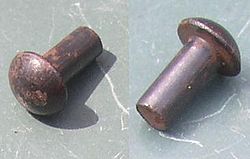
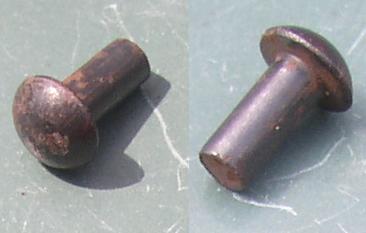
A rivet is a permanent mechanical fastener. Before being installed, a rivet consists of a smooth cylindrical shaft with a head on one end. The end opposite the head is called the tail. On installation, the deformed end is called the shop head or buck-tail.
Because there is effectively a head on each end of an installed rivet, it can support tension loads. However, it is much more capable of supporting shear loads (loads perpendicular to the axis of the shaft).
Fastenings used in traditional wooden boat building, such as copper nails and clinch bolts, work on the same principle as the rivet but were in use long before the term rivet was introduced and, where they are remembered, are usually classified among nails and bolts respectively.
Solid rivets are one of the oldest and most reliable types of fasteners, having been found in archaeological findings dating back to the Bronze Age. Rivet holes have been found in Egyptian spearheads dating back to the Naqada culture of between 4400 and 3000 B.C. Archeologists have also uncovered many Bronze Age swords and daggers with rivet holes where the handles would have been. The rivets themselves were essentially short rods of metal, which metalworkers hammered into a pre-drilled hole on one side and deformed on the other to hold them in place.
High-strength bolts have largely replaced structural steel rivets. Indeed, the latest steel construction specifications published by AISC (the 14th Edition) no longer cover their installation. The reason for the change is primarily due to the expense of skilled workers required to install high-strength structural steel rivets.
There are several methods for installing solid rivets.
Rivets small and soft enough are often bucked. The term bucked comes from a name for one of the two parts of a rivet. The head of the rivet is one part, and is the part that the air-hammer strikes. The other part is referred to as the bucktail, and is the part that the bucking bar is held against. Hence the terms bucking bar, bucked, and buck-man. In this process, the installer places a rivet gun against the factory head and holds a bucking bar against the tail or a hard working surface. The bucking bar is a specially shaped solid block of metal. The rivet gun provides a series of high-impulse forces that upsets and work hardens the tail of the rivet between the work and the inertia of the bucking bar. Rivets that are large or hard may be more easily installed by squeezing instead. In this process, a tool in contact with each end of the rivet clinches to deform the rivet.
Rivets may also be upset by hand, using a ball-peen hammer. The head is placed in a special hole made to accommodate it, known as a rivet-set. The hammer is applied to the buck-tail of the rivet, rolling an edge so that it is flush against the material.
Rivet
A rivet is a permanent mechanical fastener. Before being installed, a rivet consists of a smooth cylindrical shaft with a head on one end. The end opposite the head is called the tail. On installation, the deformed end is called the shop head or buck-tail.
Because there is effectively a head on each end of an installed rivet, it can support tension loads. However, it is much more capable of supporting shear loads (loads perpendicular to the axis of the shaft).
Fastenings used in traditional wooden boat building, such as copper nails and clinch bolts, work on the same principle as the rivet but were in use long before the term rivet was introduced and, where they are remembered, are usually classified among nails and bolts respectively.
Solid rivets are one of the oldest and most reliable types of fasteners, having been found in archaeological findings dating back to the Bronze Age. Rivet holes have been found in Egyptian spearheads dating back to the Naqada culture of between 4400 and 3000 B.C. Archeologists have also uncovered many Bronze Age swords and daggers with rivet holes where the handles would have been. The rivets themselves were essentially short rods of metal, which metalworkers hammered into a pre-drilled hole on one side and deformed on the other to hold them in place.
High-strength bolts have largely replaced structural steel rivets. Indeed, the latest steel construction specifications published by AISC (the 14th Edition) no longer cover their installation. The reason for the change is primarily due to the expense of skilled workers required to install high-strength structural steel rivets.
There are several methods for installing solid rivets.
Rivets small and soft enough are often bucked. The term bucked comes from a name for one of the two parts of a rivet. The head of the rivet is one part, and is the part that the air-hammer strikes. The other part is referred to as the bucktail, and is the part that the bucking bar is held against. Hence the terms bucking bar, bucked, and buck-man. In this process, the installer places a rivet gun against the factory head and holds a bucking bar against the tail or a hard working surface. The bucking bar is a specially shaped solid block of metal. The rivet gun provides a series of high-impulse forces that upsets and work hardens the tail of the rivet between the work and the inertia of the bucking bar. Rivets that are large or hard may be more easily installed by squeezing instead. In this process, a tool in contact with each end of the rivet clinches to deform the rivet.
Rivets may also be upset by hand, using a ball-peen hammer. The head is placed in a special hole made to accommodate it, known as a rivet-set. The hammer is applied to the buck-tail of the rivet, rolling an edge so that it is flush against the material.
Recent media
Recent media