


Community hub
Recent from talks
Contribute something to knowledge base
Content stats: 0 posts, 0 articles, 1 media, 0 notes
Members stats: 0 subscribers, 0 contributors, 0 moderators, 0 supporters
Subscribers
Supporters
Contributors
Moderators
Hub AI
Flying ace AI simulator
(@Flying ace_simulator)
Hub AI
Flying ace AI simulator
(@Flying ace_simulator)
Flying ace
A flying ace, fighter ace or air ace is a military aviator credited with shooting down a certain minimum number of enemy aircraft during aerial combat; the exact number of aerial victories required to officially qualify as an ace varies, but is usually considered to be five or more.
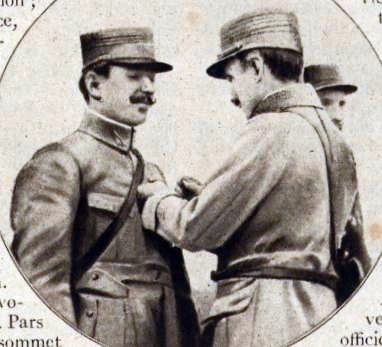
The concept of the "ace" emerged in 1915 during World War I, at the same time as aerial dogfighting. It was a propaganda term intended to provide the home front with a cult of the hero in what was otherwise a war of attrition. The individual actions of aces were widely reported and the image was disseminated of the ace as a chivalrous knight reminiscent of a bygone era. For a brief early period when air-to-air combat was just being invented, the exceptionally skilled pilot could shape the battle in the skies. For most of the war, however, the image of the ace had little to do with the reality of air warfare, in which fighters fought in formation and air superiority depended heavily on the relative availability of resources. The use of the term ace to describe these pilots began in World War I, when French newspapers described Adolphe Pégoud, as l'As (the ace) after he became the first pilot to down five German aircraft.
The successes of such German ace pilots as Max Immelmann and Oswald Boelcke, and especially Manfred von Richthofen, the most victorious fighter pilot of the First World War, were well-publicized for the benefit of civilian morale, and the Pour le Mérite, Prussia's highest award for gallantry, became part of the uniform of a leading German ace. In the Luftstreitkräfte, the Pour le Mérite was nicknamed Der blaue Max/The Blue Max, after Max Immelmann, who was the first pilot to receive this award. Initially, German aviators had to destroy eight Allied aircraft to receive this medal. As the war progressed, the qualifications for Pour le Mérite were raised, but successful German fighter pilots continued to be hailed as national heroes for the remainder of the war.
The few aces among combat aviators have historically accounted for the majority of air-to-air victories in military history.
World War I introduced the systematic use of true single-seat fighter aircraft, with enough speed and agility to catch and maintain contact with targets in the air, coupled with armament sufficiently powerful to destroy the targets. Aerial combat became a prominent feature with the Fokker Scourge, in the last half of 1915. This was also the beginning of a long-standing trend in warfare, showing statistically that approximately five percent of combat pilots account for the majority of air-to-air victories.
As the German fighter squadrons usually fought well within German lines, it was practicable to establish and maintain very strict guidelines for the official recognition of victory claims by German pilots. Shared victories were either credited to one of the pilots concerned or to the unit as a whole – the destruction of the aircraft had to be physically confirmed by locating its wreckage, or an independent witness to the destruction had to be found. Victories were also counted for aircraft forced down within German lines, as this usually resulted in the death or capture of the enemy aircrew.
Allied fighter pilots fought mostly in German-held airspace and were often not in a position to confirm that an enemy aircraft had crashed, so these victories were frequently claimed as "driven down", "forced to land", or "out of control" (called "probables" in later wars). These victories were usually included in a pilot's totals and citations for decorations.
The British high command considered the praise of fighter pilots to be detrimental to equally brave bombers and reconnaissance aircrew – so that the British air services did not publish official statistics on the successes of individuals. Nonetheless, some pilots did become famous through press coverage, making the British system for the recognition of successful fighter pilots much more informal and somewhat inconsistent. One pilot, Arthur Gould Lee, described his own score in a letter to his wife as "Eleven, five by me solo — the rest shared", adding that he was "miles from being an ace". This shows that his No. 46 Squadron RAF counted shared kills, but separately from "solo" ones—one of a number of factors that seems to have varied from unit to unit. Also evident is that Lee considered a higher figure than five kills to be necessary for "ace" status. Aviation historians credit him as an ace with two enemy aircraft destroyed and five driven down out of control, for a total of seven victories.
Flying ace
A flying ace, fighter ace or air ace is a military aviator credited with shooting down a certain minimum number of enemy aircraft during aerial combat; the exact number of aerial victories required to officially qualify as an ace varies, but is usually considered to be five or more.
The concept of the "ace" emerged in 1915 during World War I, at the same time as aerial dogfighting. It was a propaganda term intended to provide the home front with a cult of the hero in what was otherwise a war of attrition. The individual actions of aces were widely reported and the image was disseminated of the ace as a chivalrous knight reminiscent of a bygone era. For a brief early period when air-to-air combat was just being invented, the exceptionally skilled pilot could shape the battle in the skies. For most of the war, however, the image of the ace had little to do with the reality of air warfare, in which fighters fought in formation and air superiority depended heavily on the relative availability of resources. The use of the term ace to describe these pilots began in World War I, when French newspapers described Adolphe Pégoud, as l'As (the ace) after he became the first pilot to down five German aircraft.
The successes of such German ace pilots as Max Immelmann and Oswald Boelcke, and especially Manfred von Richthofen, the most victorious fighter pilot of the First World War, were well-publicized for the benefit of civilian morale, and the Pour le Mérite, Prussia's highest award for gallantry, became part of the uniform of a leading German ace. In the Luftstreitkräfte, the Pour le Mérite was nicknamed Der blaue Max/The Blue Max, after Max Immelmann, who was the first pilot to receive this award. Initially, German aviators had to destroy eight Allied aircraft to receive this medal. As the war progressed, the qualifications for Pour le Mérite were raised, but successful German fighter pilots continued to be hailed as national heroes for the remainder of the war.
The few aces among combat aviators have historically accounted for the majority of air-to-air victories in military history.
World War I introduced the systematic use of true single-seat fighter aircraft, with enough speed and agility to catch and maintain contact with targets in the air, coupled with armament sufficiently powerful to destroy the targets. Aerial combat became a prominent feature with the Fokker Scourge, in the last half of 1915. This was also the beginning of a long-standing trend in warfare, showing statistically that approximately five percent of combat pilots account for the majority of air-to-air victories.
As the German fighter squadrons usually fought well within German lines, it was practicable to establish and maintain very strict guidelines for the official recognition of victory claims by German pilots. Shared victories were either credited to one of the pilots concerned or to the unit as a whole – the destruction of the aircraft had to be physically confirmed by locating its wreckage, or an independent witness to the destruction had to be found. Victories were also counted for aircraft forced down within German lines, as this usually resulted in the death or capture of the enemy aircrew.
Allied fighter pilots fought mostly in German-held airspace and were often not in a position to confirm that an enemy aircraft had crashed, so these victories were frequently claimed as "driven down", "forced to land", or "out of control" (called "probables" in later wars). These victories were usually included in a pilot's totals and citations for decorations.
The British high command considered the praise of fighter pilots to be detrimental to equally brave bombers and reconnaissance aircrew – so that the British air services did not publish official statistics on the successes of individuals. Nonetheless, some pilots did become famous through press coverage, making the British system for the recognition of successful fighter pilots much more informal and somewhat inconsistent. One pilot, Arthur Gould Lee, described his own score in a letter to his wife as "Eleven, five by me solo — the rest shared", adding that he was "miles from being an ace". This shows that his No. 46 Squadron RAF counted shared kills, but separately from "solo" ones—one of a number of factors that seems to have varied from unit to unit. Also evident is that Lee considered a higher figure than five kills to be necessary for "ace" status. Aviation historians credit him as an ace with two enemy aircraft destroyed and five driven down out of control, for a total of seven victories.
Recent media
Recent media