Hubbry Logo
Fur sealFur sealMain
Open search
Fur seal
Community hub
Fur seal
logo
8 pages, 0 posts
0 subscribers
Be the first to start a discussion here.
Fur seal
Fur seal
from Wikipedia

Fur seal
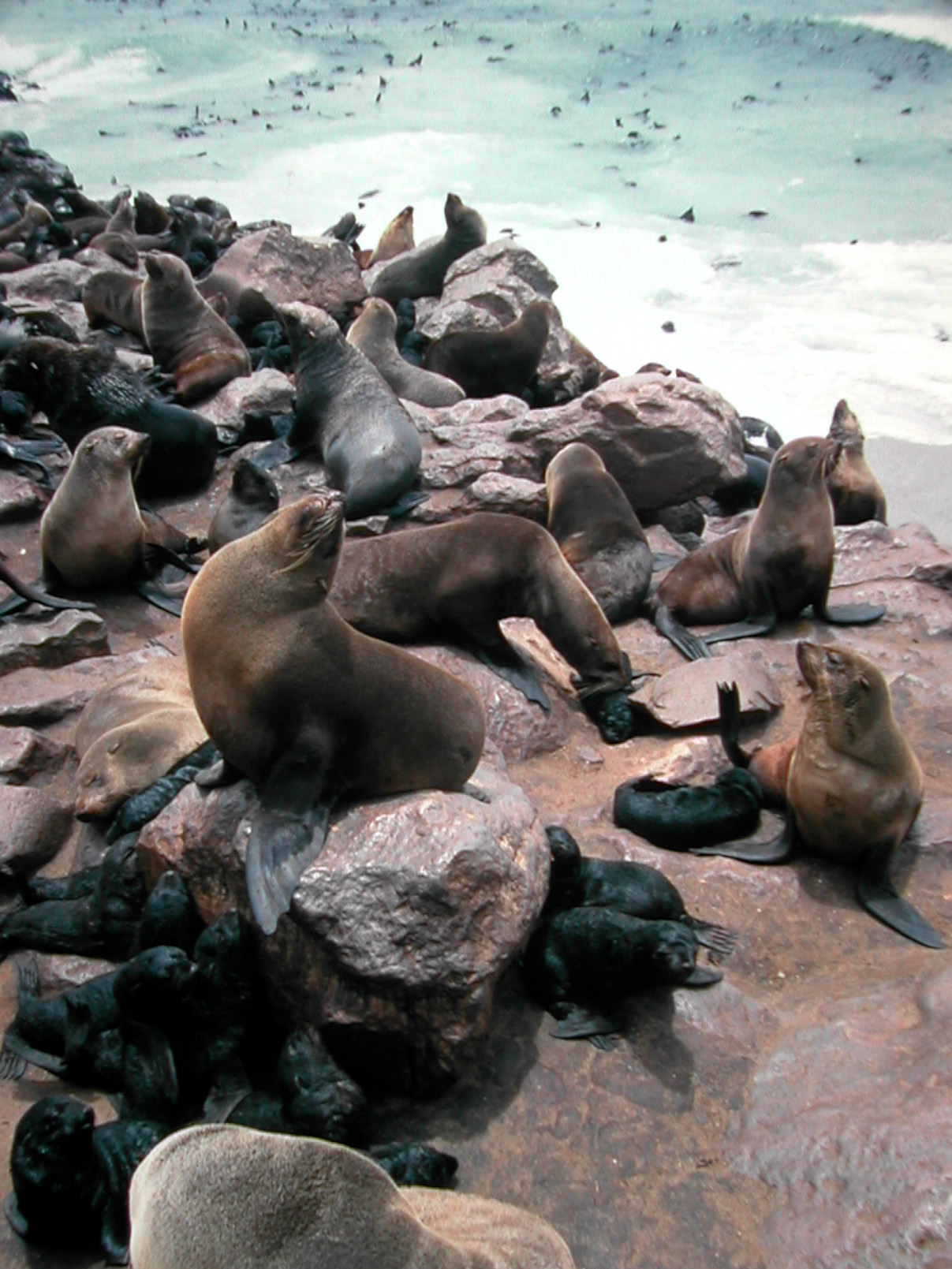
A group of Cape fur seals (Arctocephalus pusillus)
Scientific classification Edit this classification
Kingdom: Animalia
Phylum: Chordata
Class: Mammalia
Order: Carnivora
Family: Otariidae
Subfamily: Arctocephalinae
Scheffer & Rice 1963
Genera

Arctocephalus
Callorhinus

Fur seals are any of nine species of pinnipeds belonging to the subfamily Arctocephalinae in the family Otariidae. They are much more closely related to sea lions than true seals, and share with them external ears (pinnae), relatively long and muscular foreflippers, and the ability to walk on all fours. They are marked by their dense underfur, which made them a long-time object of commercial hunting. Eight species belong to the genus Arctocephalus and are found primarily in the Southern Hemisphere, while a ninth species also sometimes called fur seal, the Northern fur seal (Callorhinus ursinus), belongs to a different genus and inhabits the North Pacific. The fur seals in Arctocephalus are more closely related to sea lions than they are to the Northern fur seal, but all three groups are more closely related to one another than they are to true seals.

Taxonomy

[edit]
Fur seal ranges

Fur seals and sea lions make up the family Otariidae. Along with the Phocidae and Odobenidae, ottariids are pinnipeds descending from a common ancestor most closely related to modern bears (as hinted by the subfamily Arctocephalinae, meaning "bear-headed"). The name pinniped refers to mammals with front and rear flippers. Otariids arose about 15-17 million years ago in the Miocene, and were originally land mammals that rapidly diversified and adapted to a marine environment, giving rise to the semiaquatic marine mammals that thrive today. Fur seals and sea lions are closely related and commonly known together as the "eared seals". Until recently, fur seals were all grouped under a single subfamily of Pinnipedia, called the Arctocephalinae, to contrast them with Otariinae – the sea lions – based on the most prominent common feature, namely the coat of dense underfur intermixed with guard hairs. Recent genetic evidence, however, suggests Callorhinus is more closely related to some sea lion species, and the fur seal/sea lion subfamily distinction has been eliminated from many taxonomies. Nonetheless, all fur seals have certain features in common: the fur, generally smaller sizes, farther and longer foraging trips, smaller and more abundant prey items, and greater sexual dimorphism. For these reasons, the distinction remains useful. Fur seals comprise two genera: Callorhinus, and Arctocephalus. Callorhinus is represented by just one species in the Northern Hemisphere, the northern fur seal (Callorhinus ursinus), and Arctocephalus is represented by eight species in the Southern Hemisphere. The southern fur seals comprising the genus Arctocephalus include Antarctic fur seals, Galapagos fur seals, Juan Fernandez fur seals, New Zealand fur seals, brown fur seals, South American fur seals, and subantarctic fur seals.

Image Name Distribution
Arctocephalus É. Geoffroy Saint-Hilaire & F. Cuvier in F. Cuvier, 1826
Callorhinus Gray, 1859

Physical appearance

[edit]
Northern fur seal pups on St. Paul Island, Alaska

Along with the previously mentioned thick underfur, fur seals are distinguished from sea lions by their smaller body structure, greater sexual dimorphism, smaller prey, and longer foraging trips during the feeding cycle. The physical appearance of fur seals varies with individual species, but the main characteristics remain constant.

Fur seals are characterized by their external pinnae, dense underfur, vibrissae, and long, muscular limbs. They share with other otariids the ability to rotate their rear limbs forward, supporting their bodies and allowing them to ambulate on land. In water, their front limbs, typically measuring about a fourth of their body length, act as oars and can propel them forward for optimal mobility. The surfaces of these long, paddle-like fore limbs are leathery with small claws. Otariids have a dog-like head, sharp, well-developed canines, sharp eyesight, and keen hearing.

They are extremely sexually dimorphic mammals, with the males often two to five times the size of the females, with proportionally larger heads, necks, and chests. Size ranges from about 1.5 m, 64 kg in the male Galapagos fur seal (also the smallest pinniped) to 2.5 m, 180 kg in the adult male New Zealand fur seal. Most fur seal pups are born with a black-brown coat that molts at 2–3 months, revealing a brown coat that typically gets darker with age. Some males and females within the same species have significant differences in appearance, further contributing to the sexual dimorphism. Females and juveniles often have a lighter colored coat overall or only on the chest, as seen in South American fur seals. In a northern fur seal population, the females are typically silvery-gray on the dorsal side and reddish-brown on their ventral side with a light gray patch on their chest. This makes them easily distinguished from the males with their brownish-gray to reddish-brown or black coats.

Habitat

[edit]

Of the fur seal family, eight species are considered southern fur seals, and only one is found in the Northern Hemisphere. The southern group includes Antarctic, Galapagos, Guadalupe, Juan Fernandez, New Zealand, brown, South American, and subantarctic fur seals. They typically spend about 70% of their lives in subpolar, temperate, and equatorial waters. Colonies of fur seals can be seen throughout the Pacific and Southern Oceans from south Australia, Africa, and New Zealand, to the coast of Peru and north to California. They are typically nonmigrating mammals, with the exception of the northern fur seal, which has been known to travel distances up to 10,000 km. Fur seals are often found near isolated islands or peninsulas, and can be seen hauling out onto the mainland during winter. Although they are not migratory, they have been observed wandering hundreds of miles from their breeding grounds in times of scarce resources. For example, the subantarctic fur seal typically resides near temperate islands in the South Atlantic and Indian Oceans north of the Antarctic Polar Front, but juvenile males have been seen wandering as far north as Brazil and South Africa.

Behavior and ecology

[edit]
A fur seal at Living Coasts, sunbathing on a rock
A fur seal rookery with thousands of seals
Subantarctic fur seal pups swimming in the ocean

Typically, fur seals gather during the summer in large rookeries at specific beaches or rocky outcrops to give birth and breed. All species are polygynous, meaning dominant males reproduce with more than one female. For most species, total gestation lasts about 11.5 months, including a several-month period of delayed implantation of the embryo. Northern fur seal males aggressively select and defend the specific females in their harems.[1] Females typically reach sexual maturity around 3–4 years. The males reach sexual maturity around the same time, but do not become territorial or mate until 6–10 years.

The breeding season typically begins in November and lasts 2–3 months. The northern fur seals begin their breeding season as early as June due to their region, climate, and resources. In all cases, the males arrive a few weeks early to fight for their territory and groups of females with which to mate. They congregate at rocky, isolated breeding grounds and defend their territory through fighting and vocalization. Males typically do not leave their territory for the entirety of the breeding season, fasting and competing until all energy sources are depleted.

The Juan Fernandez fur seals deviate from this typical behavior, using aquatic breeding territories not seen in other fur seals. They use rocky sites for breeding, but males fight for territory on land and on the shoreline and in the water. Upon arriving to the breeding grounds, females give birth to their pups from the previous season. About a week later, the females mate again and shortly after begin their feeding cycle, which typically consists of foraging and feeding at sea for about 5 days, then returning to the breeding grounds to nurse the pups for about 2 days. Mothers and pups locate each other using call recognition during nursing period. The Juan Fernandez fur seal has a particularly long feeding cycle, with about 12 days of foraging and feeding and 5 days of nursing. Most fur seals continue this cycle for about 9 months until they wean their pup. The exception to this is the Antarctic fur seal, which has a feeding cycle that lasts only 4 months. During foraging trips, most female fur seals travel around 200 km from the breeding site, and can dive around 200 m depending on food availability.

The remainder of the year, fur seals lead a largely pelagic existence in the open sea, pursuing their prey wherever it is abundant. They feed on moderately sized fish, squid, and krill. Several species of the southern fur seal also have sea birds, especially penguins, as part of their diets.[2][3] Fur seals, in turn, are preyed upon by sharks, orcas, and occasionally by larger sea lions. These opportunistic mammals tend to feed and dive in shallow waters at night, when their prey are swimming near the surface. Fur seals occasionally gang up and evict sharks.[4] South American fur seals exhibit a different diet; adults feed almost exclusively on anchovies, while juveniles feed on demersal fish, most likely due to availability.

When fur seals were hunted in the late 18th and early 19th centuries, they hauled out on remote islands where no predators were present. The hunters reported being able to club the unwary animals to death one after another, making the hunt profitable, though the price per seal skin was low.[5]

Population and survival

[edit]
Northern fur seal at the Alaska Maritime National Wildlife Refuge
Bracelet made from silver and seal fur

The average lifespan of fur seals varies with different species from 13 to 25 years, with females typically living longer. Most populations continue to expand as they recover from previous commercial hunting and environmental threats. Many species were heavily exploited by commercial sealers, especially during the 19th century, when their fur was highly valued. Beginning in the 1790s, the ports of Stonington and New Haven, Connecticut, were leaders of the American fur seal trade, which primarily entailed clubbing fur seals to death on uninhabited South Pacific islands, skinning them, and selling the hides in China.[5] Many populations, notably the Guadalupe fur seal, northern fur seal, and Cape fur seal, suffered dramatic declines and are still recovering. Currently, most species are protected, and hunting is mostly limited to subsistence harvest. Globally, most populations can be considered healthy, mostly because they often prefer remote habitats that are relatively inaccessible to humans. Nonetheless, environmental degradation, competition with fisheries, and climate change potentially pose threats to some populations.

See also

[edit]

References

[edit]

Further reading

[edit]
Revisions and contributorsEdit on WikipediaRead on Wikipedia
from Grokipedia
Fur seals comprise the subfamily Arctocephalinae within the family Otariidae, consisting of eared seals distinguished by their thick pelage featuring a dense underfur layer—exceeding 350,000 hairs per square inch in some species—overlaid by coarser guard hairs that provide waterproof insulation. This subfamily includes nine species: the northern fur seal (Callorhinus ursinus), the largest member and sole species in its genus, native to the North Pacific Ocean, and eight southern species in the genus Arctocephalus distributed across southern temperate and subantarctic waters. Unlike true seals (Phocidae), fur seals possess external ear flaps and hind flippers that rotate forward, enabling terrestrial locomotion resembling a waddle rather than belly-crawling. These mammals inhabit pelagic environments, primarily on , , and crustaceans during extended dives, while congregating in large, polygynous rookeries on remote islands for breeding and molting. Males exhibit extreme , growing up to 2.3 meters long and 300 kilograms, defending harems against rivals, whereas females are smaller, around 1.4 meters and 50 kilograms, and perform most to provision pups. Breeding occurs seasonally, with births peaking in summer, and pups remaining on land for weeks before entering the sea. Fur seals faced severe population declines from 18th- and 19th-century commercial pelting, driven by demand for their luxurious underfur; numbers plummeted from approximately 2.5 million to 300,000 by 1909 due to indiscriminate harvesting on land and at sea. International agreements, including the 1911 North Pacific Fur Seal Treaty, prohibited pelagic sealing and established sustainable management, facilitating partial recovery, though the northern species remains classified as vulnerable by the IUCN owing to ongoing threats like fisheries , climate variability, and nutritional stress. Southern species show varied statuses, with some rebounding robustly post-protection while others persist at low levels.

Taxonomy and Phylogeny

Classification and Species

Fur seals constitute the subfamily Arctocephalinae within the family Otariidae, the eared seals (otariids), which also includes sea lions. This subfamily is characterized by species possessing a dense underfur beneath coarser guard hairs, enabling and historical exploitation for pelts. Arctocephalines diverged from other otariids, with phylogenetic analyses placing them as a monophyletic group closely related to sea lions but distinct in fur density and certain cranial features. The encompasses nine extant across two genera: Callorhinus (monotypic) and Arctocephalus (octotypic). The (Callorhinus ursinus) inhabits the North Pacific, breeding on the Pribilof and , with populations estimated at over 1 million individuals as of recent surveys. The genus Arctocephalus predominates in the , with adapted to and temperate waters.
SpeciesScientific NamePrimary Distribution
Northern fur sealCallorhinus ursinusNorth Pacific Ocean (e.g., , coast)
Antarctic fur sealArctocephalus gazella around and
Galápagos fur sealArctocephalus galapagoensis,
Guadalupe fur sealArctocephalus townsendiEastern Pacific, primarily ,
Juan Fernández fur sealArctocephalus philippii,
South American fur sealArctocephalus australisPacific and Atlantic coasts of
South African fur sealArctocephalus pusillus pusillus (, )
Australian fur sealArctocephalus pusillus doriferus and
New Zealand fur sealArctocephalus forsteri, , and subantarctic islands
Subantarctic fur sealArctocephalus tropicalisSubantarctic islands (e.g., Gough, )
Note: Arctocephalus pusillus includes two : the South African (A. p. pusillus) and Australian (A. p. doriferus) forms, sometimes treated as distinct but currently subspecific. All exhibit , with males significantly larger than females, and breeding occurs in polygynous rookeries. Population statuses vary; for instance, the remains listed as threatened under the U.S. Endangered Species Act due to historical exploitation and El Niño impacts.

Evolutionary Origins

Fur seals, members of the subfamily Arctocephalinae within the family Otariidae, evolved from early otariid ancestors in the during the epoch. The family Otariidae traces its origins to stem-pinnipedimorphs such as the Enaliarctidae, with the earliest definitive otariid fossil, Eotaria crypta, dated to the middle (14.9–17.1 million years ago, Ma) from the Topanga Formation in . This species exhibits craniodental features intermediate between primitive enaliarctines (16.6–27 Ma) and later otariids (7.3–12.5 Ma), including retention of an M2 and reduced metaconid on M1, indicating a gradual transition toward modern morphology. Molecular phylogenetic analyses estimate the crown-group divergence of Otariidae at approximately 8.2 ± 2.09 Ma, following the split of from Phocidae around 23 Ma. Within Otariidae, fur seals diverged from lineages (Otariinae), though traditional subfamilial is contested; Callorhinus ursinus () clusters sister to sea lions, rendering southern fur seals (Arctocephalus spp.) potentially polyphyletic. The sparse fossil record of Arctocephalinae prior to the suggests an initial radiation, with Mio- forms like Arctocephalus lomasiensis (5–2 Ma) appearing in , correlating with cooling climates that facilitated otariid diversification. This evolutionary trajectory reflects adaptation from terrestrial arctoid carnivorans, with pinnipedimorphs originating ~35.7 from ursid relatives, emphasizing ambulatory hindlimbs and external ear flaps as key otariid innovations over phocid true seals. Northern Pacific localities dominate early fossils, underscoring regional before southward migrations linked to oceanographic shifts.

Morphology and Adaptations

Physical Characteristics

Fur seals exhibit a body shape optimized for swimming, with a stocky build, small head, short , and external ear pinnae that distinguish them from phocid seals. Their foreflippers are elongated and muscular, serving as primary propellers in water, while hind flippers rotate forward to enable quadrupedal locomotion on land. Large, prominent eyes and moderate-length vibrissae aid in and sensory detection . The pelage is notably dense, comprising an insulating underfur layer overlaid by coarser guard hairs, which trap air for thermal regulation; northern fur seals possess approximately 46,500 fur fibers per square centimeter. This fur structure contrasts with the blubber-dominant insulation of true seals, emphasizing reliance on pelage for heat retention during dives. Sexual dimorphism is pronounced, with adult males substantially larger than females in both body size and cranial morphology across species. For instance, in the South American fur seal (Arctocephalus australis), males exhibit greater overall skull size and robusticity compared to females, reflecting adaptations for territorial combat. males can attain lengths exceeding 2 meters and weights over 200 kg, while females typically measure 1-1.5 meters and weigh 25-60 kg. Pups are born with natal fur that is molted post-weaning for the adult pelage.

Physiological Traits

Fur seals exhibit specialized thermoregulatory adapted to alternating terrestrial and aquatic phases. Their dense under, consisting of guard hairs and a thick undercoat, traps an insulating air layer that primarily counters conductive loss in cold water, with serving mainly as an energy reserve rather than primary insulation. This system maintains a core body temperature of approximately 37°C, enabling a substantial thermal gradient between the body and surrounding . Peripheral during immersion cools the skin and extremities, minimizing convective transfer, while counter-current heat exchangers in the flippers rewarm returning from peripheral tissues to preserve central . Arteriovenous anastomoses in the skin and appendages further regulate regional flow for controlled dissipation, particularly during haul-out periods on land. Skin surface temperatures in fur seals are dynamically adjustable, with the thoracic region functioning as a primary control site during free-ranging swims and dives. In Antarctic fur seals (Arctocephalus gazella), for instance, thoracic cools to near ambient water temperatures during submergence but rapidly rewarms at the surface, facilitating efficient balance without excessive metabolic cost. Juveniles and pups rely heavily on behavioral alongside these mechanisms, as their thinner and developing fur limit passive insulation, leading to higher sensitivity to environmental temperatures. Diving physiology in fur seals centers on oxygen conservation to support extended submergence, typically to depths of 50–200 m for durations up to several minutes. They invoke the diving response—apnea, (heart rates dropping to 10–20% of resting levels), and selective —which redirects oxygenated blood to the , heart, and swimming muscles while minimizing peripheral oxygen use. Oxygen stores are augmented by elevated blood concentrations (around 20–25 g/dL) and muscle levels, enabling reliance on aerobic for most dives, though anaerobic pathways supplement during deeper or prolonged efforts. Unlike many sea lions, fur seals frequently exhale lung air during ascent (50–85% of ascent phase), a physiological adjustment that reduces and loading but requires precise respiratory control to avoid excessive CO₂ buildup. In pups, such as those of the Australian fur seal (Arctocephalus pusillus doriferus), diving proficiency emerges post-moult, correlating with maturational increases in oxygen-carrying capacity and volume. Standard metabolic rates, measured at 1.5–2 times predicted allometric values, vary with body mass, sex, and water temperature, underscoring the interplay of intrinsic physiological limits and extrinsic factors.

Distribution and Habitat

Geographic Ranges

Fur seals occupy temperate to subpolar marine environments in both hemispheres, with distributions centered on breeding rookeries on remote islands and coastal areas where they haul out seasonally. The subfamily Arctocephalinae includes one species and eight species, reflecting vicariant post-Gondwanan breakup and subsequent isolation. The (Callorhinus ursinus) ranges across the North , encompassing the , , and extending southward to northern , , and central , , during migrations. Breeding colonies are concentrated on the (St. Paul and St. George), Bogoslof Island in , and in , with non-breeding dispersal reaching as far south as and in winter. Southern fur seals of the genus Arctocephalus are confined to the , inhabiting subantarctic islands and continental margins around , southern , , , and . The (A. gazella) predominates in the and surrounding waters south of the , with over 95% of its breeding population—approximately 3.5 million individuals—centered on Island and adjacent sites. Other notable ranges include the Cape fur seal (A. pusillus pusillus), endemic to coastal and from Baia dos Tigres northward; the Australasian fur seal (A. forsteri), distributed around and both main islands of with larger colonies on southern coasts; and the (A. townsendi), primarily breeding on off , , with minor sites on the San Benito Archipelago.
SpeciesPrimary Geographic Range
Northern fur seal (C. ursinus)North Pacific: to () and ()
Antarctic fur seal (A. gazella) islands south of , mainly
Cape fur seal (A. p. pusillus)Coastal and
Australasian fur seal (A. forsteri) and islands
Guadalupe fur seal (A. townsendi) and ()

Environmental Preferences

Fur seals prefer productive marine environments, particularly continental shelf regions with oceanographic features like fronts and upwelling that enhance prey availability. Northern fur seals (Callorhinus ursinus) select middle and outer shelf habitats in the eastern Bering Sea at depths of 50–200 m and bottom temperatures below 6°C, avoiding inner shelf areas shallower than 50 m. Australian fur seals (Arctocephalus pusillus doriferus) forage predominantly on shallow continental shelves less than 100 m deep, with modal benthic dive depths around 60 m. Antarctic fur seals (Arctocephalus gazella) forage in open ocean waters south of the Antarctic Convergence, capable of dives up to 210 m for females and 350 m for males. Terrestrial preferences center on remote oceanic islands and rocky coastlines for haul-out, breeding, and molting, favoring boulder-strewn beaches, sandy shores with easy access, and vegetated areas like for pup shelter. Breeding sites include islands such as and the for Antarctic fur seals, and for northern fur seals, where colonies form on terrain protected from extreme wave action. These sites provide minimal terrestrial vegetation and are selected to minimize predation risks during vulnerable periods. Water temperature influences efficiency across ; northern fur seals associate with cooler bottom waters, while warmer anomalies reduce dive rates in Australian fur seals by 250–500 m per hour. fur seals tolerate waters above 14°C for diving, reflecting broader adaptability to temperate conditions in some taxa. Salinity preferences align with typical open ocean levels, as fur seals are fully marine outside breeding seasons.

Behavior and Life Cycle

Reproductive Strategies

exhibit a dominated by resource defense , where adult males establish territories on coastal and defend harems of 10–40 females, though group sizes can range from 1 to over 100 in some cases. Males arrive at breeding sites 1–2 months before females, fasting for up to 4 months on stored reserves while repelling intruders through vocalizations, postures, and physical . Breeding seasons are highly synchronized and seasonal: northern fur seals (Callorhinus ursinus) breed from late to late July in the North Pacific, while southern species in the genus Arctocephalus breed from October to December in the . Females arrive at rookeries pregnant and give birth to a single precocial pup, weighing 3.5–5.5 kg and measuring 60–65 cm in length for species like the South American fur seal (A. australis), within 1–2 days of hauling out. Copulation occurs 1–2 days postpartum during induced estrus, with fertilization followed by obligatory embryonic diapause lasting 3–5 months, extending total gestation to 11–12 months and ensuring births align with the next breeding season. Females reach sexual maturity at 3–6 years, males at 7–10 years, with male maturation delayed by competition for dominance. Lactation strategies involve alternating short periods on land with extended trips at , enabling mothers to provision pups via income breeding rather than capital. In northern fur seals, females for 8–14 days, leaving pups in creches; lasts 3–4 months, ending in abrupt as mothers migrate southward. South American fur seals extend to 6–12 months (up to 36 in rare cases), with mothers and pups using individualized vocalizations to reunite after trips. Pups remain on rookeries, vulnerable to predation and starvation, with survival enhanced by shaded, rocky habitats in some species. While territorial males sire most offspring, alternative tactics persist, including sneaking copulations by subadult or satellite males, which can achieve moderate success in dense colonies. Genetic studies confirm high variance in male reproductive success, underscoring the intensity of sexual selection in fur seals.

Social and Foraging Behaviors

Fur seals form large breeding colonies, or , on coastal beaches during the reproductive season, with aggregations numbering in the thousands for species such as the (Callorhinus ursinus). Adult males establish territories through aggressive interactions, including vocal threats, charging displays, and physical combat, often fasting for months to maintain dominance. Successful bulls defend harems of 10 to 40 females, employing herding tactics to prevent females from straying, as observed in sub-Antarctic fur seals (Arctocephalus tropicalis) where males exhibit extreme herding intensity compared to other congeners. Subadult males occupy peripheral areas, avoiding direct confrontation with dominant individuals. Females aggregate within territories but maintain limited social bonds among themselves, focusing instead on maternal care. Mother-pup recognition relies on multimodal cues, including distinct vocalizations, olfactory signals, and visual landmarks, enabling reunions in crowded rookeries; South American fur seals (Arctocephalus australis) pups respond actively to maternal calls, increasing the efficiency of foraging-mother returns. Weaned pups form creches for collective vigilance against predators, engaging in play behaviors that develop and motor abilities. Outside breeding periods, fur seals are largely asocial, with individuals or small groups dispersing widely. Foraging behaviors occur predominantly at sea, where fur seals pursue prey solitarily or in loose groups of 2-4 individuals, targeting epipelagic , , and through high-speed chases and dives. Dive profiles vary by and context: northern fur seals reach depths of 100-200 meters for 3-5 minutes, adjusting tactics based on prey patchiness, while Australian fur seals (Arctocephalus pusillus doriferus) employ benthic strategies near the seafloor for demersal . females undertake central-place trips lasting 3-7 days, optimizing energy intake amid physiological constraints like lactation demands, with success influenced by oceanographic features such as upwellings. Animal-borne sensors reveal prey size selection drives behavioral shifts, with larger prey prompting prolonged pursuits in northern fur seals.

Ecology and Interactions

Diet and Predatory Role

Fur seals are obligate carnivores with diets primarily composed of , cephalopods, and crustaceans, though composition varies by , , age, , and geographic location. Northern fur seals (Callorhinus ursinus) consume small schooling such as , , , , sandlance, and , supplemented by and occasionally ; off the U.S. West Coast, , sardines, and myctophids () are prominent. Southern fur seals of the genus Arctocephalus, including Antarctic (A. gazella) and Australian (A. pusillus doriferus) , feed on , , bony , and , with often dominating by mass (e.g., 54.4% in Antarctic fur seals) and by numerical abundance (up to 94.2%). Guadalupe fur seals (A. townsendi) rely heavily on cephalopods (over 95% in some analyses) and mesopelagic like and , foraging nocturnally at depths averaging 65 meters. Foraging occurs via agile underwater pursuits, with seals using acute vision, vibrissae for detection, and dives typically lasting 1–6 minutes to depths of 10–200 meters, often targeting pelagic or epipelagic prey schools. Females and juveniles tend to forage closer to rookeries during breeding seasons, while males may undertake longer migrations to feeding grounds; dietary shifts reflect prey availability, with squid comprising up to 30% in some northern populations. Certain southern species opportunistically prey on seabirds, such as penguins, enhancing dietary diversity in coastal zones. In marine ecosystems, fur seals function as mid-level predators, exerting top-down control on prey populations like schooling and , which can influence lower trophic levels and commercially harvested stocks. Their predation helps regulate prey abundance, potentially mitigating blooms of species that compete with or prey upon juveniles of valued fisheries targets. As prey themselves, they sustain apex predators including killer whales (Orcinus orca), , and occasionally Steller sea lions (Eumetopias jubatus), transferring energy upward while recycling nutrients via defecation—fur seal feces enrich foraging waters with nitrogen and phosphorus, fostering localized productivity spikes. Population declines in fur seals have correlated with altered prey dynamics in regions like the , underscoring their role in maintaining balanced trophic cascades.

Population Dynamics

Fur seal populations have historically fluctuated dramatically due to intensive commercial sealing from the 18th to early 20th centuries, which reduced many to near before enabled recoveries. Current dynamics vary by , with some stable or growing while others decline amid factors like interactions, climate-driven prey shifts, and natural predation. The (Callorhinus ursinus), primarily in the North Pacific, numbered approximately 624,000 individuals as of 2023, incorporating rising counts from against sharp declines in . The Eastern Pacific stock, estimated at around 720,000, has dropped over 50% since the 1950s, with pup production on the at 72,806 on St. Paul in 2021. Declines link to reduced juvenile survival, possibly from changing distributions and entanglements. Antarctic fur seals (Arctocephalus gazella) recovered post-sealing to a peak of about 3.5 million at by 2007–2009, comprising the bulk of the global estimate of 2–4 million. However, since , trends have reversed with negative growth, delayed maturation, falling recruitment, and longevity, attributed to scarcity from and competition. Isolated populations face heightened risks from aging demographics and predation. Cape fur seals (Arctocephalus pusillus pusillus), along , maintain stability at 1.5–2 million, with roughly two-thirds in across 25–40 colonies. Population size hovered near 1.7 million in the 1990s and shows no major shift, despite localized and entanglements affecting about 0.12% regionally. Australian subspecies (A. p. doriferus) exhibit meta-population trends requiring ongoing monitoring for abundance shifts.
SpeciesEstimated PopulationTrendKey Factors
Northern fur seal~624,000 (2023)Declining (>50% since )Prey shifts, entanglements
2–4 million (global)Peaked 2009, now negativeKrill decline,
Cape fur seal1.5–2 millionStableFisheries, but regulated harvest

Human Impacts and Conservation

Historical Exploitation

Commercial sealing of fur seals began in the late , driven by demand for their valuable underfur used in hats, coats, and other garments. Russian explorers first encountered (Callorhinus ursinus) rookeries on the in 1786, initiating intensive harvesting that rapidly depleted local populations through unregulated killing of adults and subadults. By the early , sealers had shifted focus to southern fur seal species, such as the (Arctocephalus gazella), in sub- and Antarctic waters starting around 1790, targeting dense colonies for pelts that fetched high prices in European markets. This exploitation often involved clubbing seals on breeding grounds, with little regard for , resulting in near-extirpation of many rookeries by the 1820s. In the North Pacific, Russian and later American operations on the harvested northern fur seals for over 250 years, with Aleut Natives coerced into collecting pelts under colonial labor systems. Following the U.S. purchase of in 1867, the North American Commercial Company managed sealing until 1897, exporting hundreds of thousands of pelts annually—over 150,000 in some periods—valued at millions in contemporary dollars. Harvest levels peaked in the late but contributed to a dramatic decline from pre-exploitation estimates exceeding 2 million animals to critically low numbers by the , prompting international agreements like the 1911 North Pacific Fur Seal Convention. Commercial harvests continued under quotas until termination in 1985, after which populations briefly recovered to about 2.1 million on the Pribilofs in the 1950s before subsequent declines. Southern fur seal exploitation was similarly devastating, with sealers from Britain, the U.S., and other nations killing millions across and other sub-Antarctic islands between 1770 and 1820, reducing numbers to near extinction levels. Records indicate over 6,000 pelts taken from alone between 1875 and 1892, amid broader campaigns that exhausted primary fur seal stocks and forced hunters to target elephant seals by the mid-19th century. Genetic studies confirm a severe bottleneck around this sealing era, with populations contracting to a fraction of pre-harvest sizes—estimated in the tens of millions—before partial recovery post-1900 bans on open-water pelagic sealing. These activities not only crashed local abundances but also disrupted breeding demographics, as males were preferentially killed, skewing sex ratios and .

Current Conservation Status

The conservation status of fur seal species varies, with most classified as on the due to population recoveries following 19th- and early 20th-century commercial exploitation, though some face ongoing declines from environmental and anthropogenic pressures. Protections under frameworks like the U.S. (MMPA), Convention for the Conservation of Antarctic Marine Living Resources (CCAMLR), and Appendix II listings have facilitated rebounds in species such as the (Arctocephalus gazella), whose global population exceeds 4 million individuals and continues to increase.
SpeciesIUCN Status (Assessment Year)Key Trends and Notes
(Callorhinus ursinus)Vulnerable (2015)Pribilof Islands stock depleted under MMPA; pup production declined ~84% since 1950 in , with ongoing ~5% annual decreases attributed to nutritional limitations and climate variability.
(Arctocephalus gazella)Least Concern (2014)Population stable to increasing post-hunting bans; protected under , with no major threats beyond localized .
(Arctocephalus townsendi)Least Concern (2014)Increasing trend; listed as Threatened under U.S. Endangered Species Act, with primary colonies at Guadalupe and San Benito Islands showing recovery but vulnerability to El Niño events.
Galápagos fur seal (Arctocephalus galapagoensis)Endangered (2014)Population ~10,000-15,000 mature individuals; declines linked to ocean warming and reduced prey availability, with limited exacerbating risks.
Northern fur seal populations, comprising over half of global fur seal historically, have not recovered fully, with eastern Pacific stocks subject to a 2024 revised conservation plan emphasizing research into declines and entanglement mitigation. Common threats across include climate-driven sea surface temperature rises reducing prey abundance, fishery interactions causing ~1,000-2,000 annual entanglements in northern stocks, and incidental ship strikes. Monitoring via pup censuses and tagging informs management, with no commercial harvesting permitted since the 1980s-1990s in key regions.

Controversies in Management

Management of fur seal populations has sparked debates primarily over balancing conservation with economic interests in fisheries and the ecological consequences of population recoveries. In regions like southern Africa and Australia, Cape fur seals (Arctocephalus pusillus pusillus) interact extensively with commercial fisheries, damaging gear and competing for resources such as sardines and anchovies, prompting calls for lethal control measures. Fishery stakeholders argue that seals contribute to stock depletions, with estimates in Namibia attributing up to 1 million tons of fish consumption annually by the population, though scientific assessments question the causality, emphasizing overfishing as the primary driver. Opposition from conservation groups highlights the cruelty of culling methods, such as clubbing pups, and potential long-term population destabilization, favoring non-lethal deterrents like acoustic devices despite limited efficacy data. In , the government's approval of quotas exceeding 80,000 Cape fur seal pups culled in 2023 for fur, meat, and oil exports has intensified controversy, with organizations decrying the practice as inhumane and ecologically disruptive amid declining demand and global bans on seal products. Proponents, including local authorities, maintain it sustains jobs and manages perceived overabundance, but peer-reviewed analyses indicate seals play a stabilizing role in marine food webs, with risks exacerbating rather than resolving issues. Similar tensions arise in , where long-term seal- conflicts have led to sporadic authorizations, though public and stakeholder surveys reveal broad resistance to lethal approaches, with 70-80% preferring modifications or gear improvements. Recovering populations of Antarctic fur seals (Arctocephalus gazella) present a contrasting challenge, with numbers rebounding to millions since 19th-century exploitation, now exerting pressure on terrestrial and avian communities in the and . Dense colonies trample vegetation, eutrophy freshwater systems via waste, and prey on penguin chicks, altering island ecosystems in ways unprecedented in modern records. Management under the Antarctic Treaty lacks mechanisms for interspecies conflicts, fueling debates on intervention: is dismissed due to logistical and ethical barriers, while alternatives like fencing have shown inconsistent results and risks of unintended . Ecologists advocate monitoring "new normal" dynamics but warn of reduced resilience to climate-driven declines, which have already halved pup production in some areas since the . For northern fur seals (Callorhinus ursinus), controversies center on ongoing declines—over 50% since the 1990s in the eastern —amid subsistence harvests on the , where quotas of 2,000-3,000 subadult males annually support indigenous communities under the Mammal Protection Act. Animal rights advocates challenge the harvests' sustainability, citing bycatch in fisheries as a greater threat, though data attribute declines more to nutritional stress and entanglement than , with no resumption of commercial sealing since 1984. Management plans emphasize research into causes like ocean warming over harvest adjustments, reflecting tensions between and empirical conservation needs. Across taxa, these disputes underscore systemic biases in , with fishery interests often downplaying environmental drivers while conservation narratives overlook seals' predatory roles in maintaining balance.

References

Add your contribution
Related Hubs
User Avatar
No comments yet.