
Recent from talks
Unisex public toilet
Knowledge base stats:
Talk channels stats:
Members stats:
Unisex public toilet
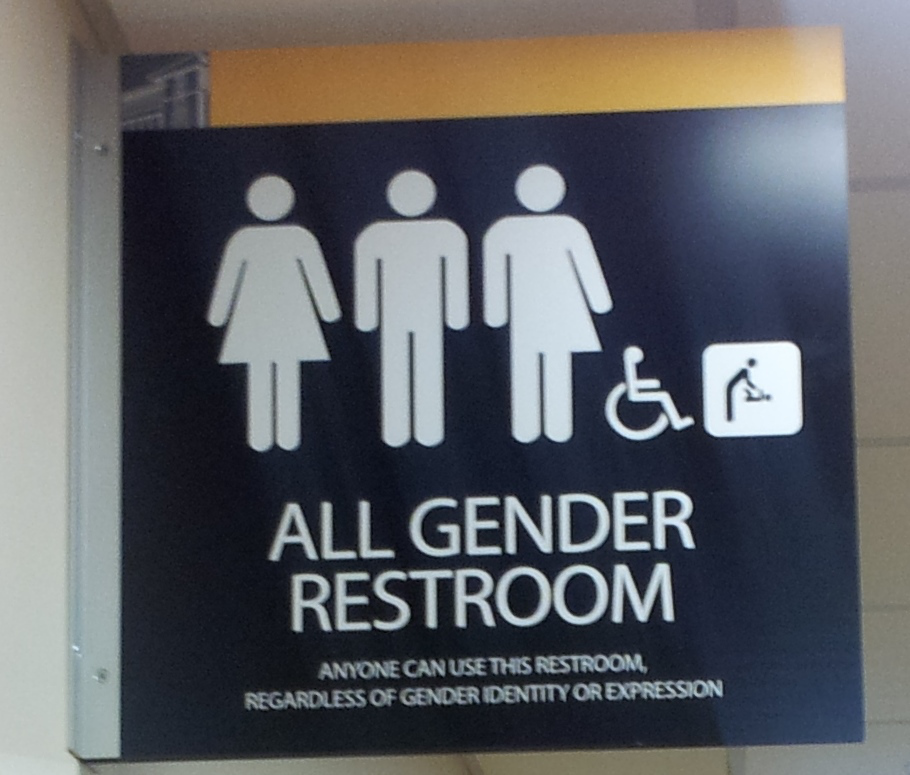
Unisex public toilets (also referred to as gender-inclusive, gender-neutral, mixed-sex or all-gender, or without any prefix at all) are public toilets that are not separated by sex or gender.
Unisex public toilets take different forms: they may be single occupancy facilities where only one single room or enclosure is provided; or multi-user facilities which are open to all and where users may either share sinks in an open area or each have their own sink in their private cubicle, stall or room. Unisex public toilets may either replace single-sex toilets, or may be an addition to single-sex toilets.
Unisex public toilets can be used by people of any sex or gender identity. Such toilet facilities can benefit transgender populations and people outside of the gender binary, and can reduce bathroom queues through more balanced occupation. Sex separation in public toilets (also called sex segregation), as opposed to unisex toilets, is the separation of public toilets into male and female; this separation is sometimes enforced by local laws and building codes. Key differences between male and female public toilets in most Western countries include the presence of urinals for men and boys, and sanitary bins for the disposal of menstrual hygiene products for women. (Sanitary bins may easily be included in the setup of unisex public toilets.)
The historical purposes of sex-separated toilets in the United States and Europe, as well as the timing of their appearance, are disputed amongst scholars. The earliest laws enshrining sex segregation were deeply rooted in the separate spheres movement, which pushed the idea that men belonged in the public sphere and women in the private sphere. However some argue that the informal convention of sex segregation that predates any laws existed to ensure safety and privacy. Some women's groups hold that unisex public toilets will be less safe for women than public toilets that are separated by sex; however, some experts say that with the appropriate design interventions, these spaces can improve the safety of all users and reduce the disproportionately long wait times females face in sex-separated public washrooms.
The push for gender-neutral bathrooms is driven at least in part by the transgender community to protect against harassment and violence against this population. Unisex public toilets may benefit a range of people with or without special needs (e.g. people with disabilities, the elderly, and anyone who needs the help of someone of another gender or sex), as well as parents who need to help their infant or young child with using the toilet.
Several alternative terms are in use for unisex public toilets. Some favor all-gender toilets, gender neutral toilets, gender free toilets or all-user toilets or just toilet. The "Public Toilet Advocacy Toolkit" by the NGO Public Hygiene Lets Us Stay Human (PHLUSH) in Portland, Oregon (United States) from 2015 uses the term "all-gender". More recently, they have changed to the term "all user". However, some[vague] object to the term "gender-neutral" and similar terms, believing that neither the spaces nor the terms are truly neutral. They also object to the replacement of the word "sex" with the word "gender". Such people often express a preference for the term "mixed-sex". But whatever one calls them, these are toilets which can (in theory) be used by anybody, regardless of sex or gender identity or presentation.
The opposite of unisex toilets is referred to as either "sex-separated" or "sex-segregated" toilets, or "conventional public toilets" (since sex separation is currently mostly the norm on the global level). In the United States some scholars have used the term "sex separation".
Some unisex public toilets, whether of single or of multiple capacity, are designed to be used by people with disabilities. They can accommodate not only the physically disabled, but also elderly people who may require assistance from a carer of another gender, and other cases where public sex-segregated facilities might lead to discomfort. Toilet facilities for disabled people, especially those reliant on a wheelchair, may be either unisex or gender-specific.
Hub AI
Unisex public toilet AI simulator
(@Unisex public toilet_simulator)
Unisex public toilet
Unisex public toilets (also referred to as gender-inclusive, gender-neutral, mixed-sex or all-gender, or without any prefix at all) are public toilets that are not separated by sex or gender.
Unisex public toilets take different forms: they may be single occupancy facilities where only one single room or enclosure is provided; or multi-user facilities which are open to all and where users may either share sinks in an open area or each have their own sink in their private cubicle, stall or room. Unisex public toilets may either replace single-sex toilets, or may be an addition to single-sex toilets.
Unisex public toilets can be used by people of any sex or gender identity. Such toilet facilities can benefit transgender populations and people outside of the gender binary, and can reduce bathroom queues through more balanced occupation. Sex separation in public toilets (also called sex segregation), as opposed to unisex toilets, is the separation of public toilets into male and female; this separation is sometimes enforced by local laws and building codes. Key differences between male and female public toilets in most Western countries include the presence of urinals for men and boys, and sanitary bins for the disposal of menstrual hygiene products for women. (Sanitary bins may easily be included in the setup of unisex public toilets.)
The historical purposes of sex-separated toilets in the United States and Europe, as well as the timing of their appearance, are disputed amongst scholars. The earliest laws enshrining sex segregation were deeply rooted in the separate spheres movement, which pushed the idea that men belonged in the public sphere and women in the private sphere. However some argue that the informal convention of sex segregation that predates any laws existed to ensure safety and privacy. Some women's groups hold that unisex public toilets will be less safe for women than public toilets that are separated by sex; however, some experts say that with the appropriate design interventions, these spaces can improve the safety of all users and reduce the disproportionately long wait times females face in sex-separated public washrooms.
The push for gender-neutral bathrooms is driven at least in part by the transgender community to protect against harassment and violence against this population. Unisex public toilets may benefit a range of people with or without special needs (e.g. people with disabilities, the elderly, and anyone who needs the help of someone of another gender or sex), as well as parents who need to help their infant or young child with using the toilet.
Several alternative terms are in use for unisex public toilets. Some favor all-gender toilets, gender neutral toilets, gender free toilets or all-user toilets or just toilet. The "Public Toilet Advocacy Toolkit" by the NGO Public Hygiene Lets Us Stay Human (PHLUSH) in Portland, Oregon (United States) from 2015 uses the term "all-gender". More recently, they have changed to the term "all user". However, some[vague] object to the term "gender-neutral" and similar terms, believing that neither the spaces nor the terms are truly neutral. They also object to the replacement of the word "sex" with the word "gender". Such people often express a preference for the term "mixed-sex". But whatever one calls them, these are toilets which can (in theory) be used by anybody, regardless of sex or gender identity or presentation.
The opposite of unisex toilets is referred to as either "sex-separated" or "sex-segregated" toilets, or "conventional public toilets" (since sex separation is currently mostly the norm on the global level). In the United States some scholars have used the term "sex separation".
Some unisex public toilets, whether of single or of multiple capacity, are designed to be used by people with disabilities. They can accommodate not only the physically disabled, but also elderly people who may require assistance from a carer of another gender, and other cases where public sex-segregated facilities might lead to discomfort. Toilet facilities for disabled people, especially those reliant on a wheelchair, may be either unisex or gender-specific.
Recent media