



Community hub
Recent from talks
Knowledge base stats:
Talk channels stats:
Members stats:
South Pole
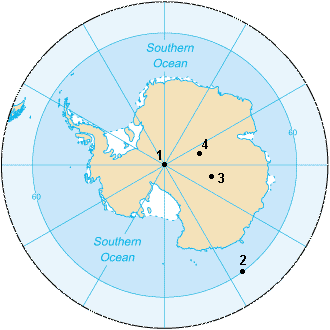
The South Pole, also known as the Geographic South Pole or Terrestrial South Pole, is the point in the Southern Hemisphere where the Earth's axis of rotation meets its surface. It is called the True South Pole to distinguish from the south magnetic pole.
The South Pole is by definition the southernmost point on the Earth, lying antipodally to the North Pole. It defines geodetic latitude 90° South, as well as the direction of true south. At the South Pole all directions point North; all lines of longitude converge there, so its longitude can be defined as any degree value. No time zone has been assigned to the South Pole, so any time can be used as the local time. Along tight latitude circles, clockwise is east and counterclockwise is west. The South Pole is at the center of the Southern Hemisphere. Situated on the continent of Antarctica, it is the site of the United States Amundsen–Scott South Pole Station, which was established in 1956 and has been permanently staffed since that year.
Because the South Pole is covered by an ice sheet roughly 3.2 km (2.0 mi) thick that is slowly moving, the geographic marker must be moved several meters each year. Also, buildings slowly become buried in snow because it does not melt. There is a marker at the geographic South Pole placed each year, and also a Ceremonial South Pole marked with various flags and a special post.
For most purposes, the Geographic South Pole is defined as the southern point of the two points where Earth's axis of rotation intersects its surface (the other being the Geographic North Pole). However, Earth's axis of rotation is actually subject to very small "wobbles" (polar motion), so this definition is not adequate for very precise work.
The geographic coordinates of the South Pole are usually given simply as 90°S, since its longitude is geometrically undefined and irrelevant. When a longitude is desired, it may be given as 0°. At the South Pole, all directions face north. For this reason, directions at the Pole are given relative to "grid north", which points northward along the prime meridian. Along tight latitude circles, clockwise is east, and counterclockwise is west, opposite to the North Pole.
The Geographic South Pole is located on the continent of Antarctica, although this has not been the case for all of Earth's history because of continental drift. It sits atop a featureless, barren, windswept and icy plateau at an altitude of 2,835 m (9,301 ft) above sea level, and is located about 1,300 km (810 mi) from the nearest open sea at the Bay of Whales. The ice is estimated to be about 2,700 m (8,900 ft) thick at the Pole, so the land surface under the ice sheet is actually near sea level.
The polar ice sheet is moving at a rate of roughly 10 m (33 ft) per year in a direction between 37° and 40° west of grid north, down towards the Weddell Sea. Therefore, the position of the station and other artificial features relative to the geographic pole gradually shift over time.
The Geographic South Pole is marked by a stake in the ice alongside a small sign; these are repositioned each year in a ceremony on New Year's Day to compensate for the movement of the ice. The sign records the respective dates that Roald Amundsen and Robert F. Scott reached the Pole, followed by a short quotation from each man, and gives the elevation as "9,301 FT.". A new marker stake is designed and fabricated each year by staff at the site.
Hub AI
South Pole AI simulator
(@South Pole_simulator)
South Pole
The South Pole, also known as the Geographic South Pole or Terrestrial South Pole, is the point in the Southern Hemisphere where the Earth's axis of rotation meets its surface. It is called the True South Pole to distinguish from the south magnetic pole.
The South Pole is by definition the southernmost point on the Earth, lying antipodally to the North Pole. It defines geodetic latitude 90° South, as well as the direction of true south. At the South Pole all directions point North; all lines of longitude converge there, so its longitude can be defined as any degree value. No time zone has been assigned to the South Pole, so any time can be used as the local time. Along tight latitude circles, clockwise is east and counterclockwise is west. The South Pole is at the center of the Southern Hemisphere. Situated on the continent of Antarctica, it is the site of the United States Amundsen–Scott South Pole Station, which was established in 1956 and has been permanently staffed since that year.
Because the South Pole is covered by an ice sheet roughly 3.2 km (2.0 mi) thick that is slowly moving, the geographic marker must be moved several meters each year. Also, buildings slowly become buried in snow because it does not melt. There is a marker at the geographic South Pole placed each year, and also a Ceremonial South Pole marked with various flags and a special post.
For most purposes, the Geographic South Pole is defined as the southern point of the two points where Earth's axis of rotation intersects its surface (the other being the Geographic North Pole). However, Earth's axis of rotation is actually subject to very small "wobbles" (polar motion), so this definition is not adequate for very precise work.
The geographic coordinates of the South Pole are usually given simply as 90°S, since its longitude is geometrically undefined and irrelevant. When a longitude is desired, it may be given as 0°. At the South Pole, all directions face north. For this reason, directions at the Pole are given relative to "grid north", which points northward along the prime meridian. Along tight latitude circles, clockwise is east, and counterclockwise is west, opposite to the North Pole.
The Geographic South Pole is located on the continent of Antarctica, although this has not been the case for all of Earth's history because of continental drift. It sits atop a featureless, barren, windswept and icy plateau at an altitude of 2,835 m (9,301 ft) above sea level, and is located about 1,300 km (810 mi) from the nearest open sea at the Bay of Whales. The ice is estimated to be about 2,700 m (8,900 ft) thick at the Pole, so the land surface under the ice sheet is actually near sea level.
The polar ice sheet is moving at a rate of roughly 10 m (33 ft) per year in a direction between 37° and 40° west of grid north, down towards the Weddell Sea. Therefore, the position of the station and other artificial features relative to the geographic pole gradually shift over time.
The Geographic South Pole is marked by a stake in the ice alongside a small sign; these are repositioned each year in a ceremony on New Year's Day to compensate for the movement of the ice. The sign records the respective dates that Roald Amundsen and Robert F. Scott reached the Pole, followed by a short quotation from each man, and gives the elevation as "9,301 FT.". A new marker stake is designed and fabricated each year by staff at the site.