
Recent from talks
German Peasants' War
Knowledge base stats:
Talk channels stats:
Members stats:
German Peasants' War
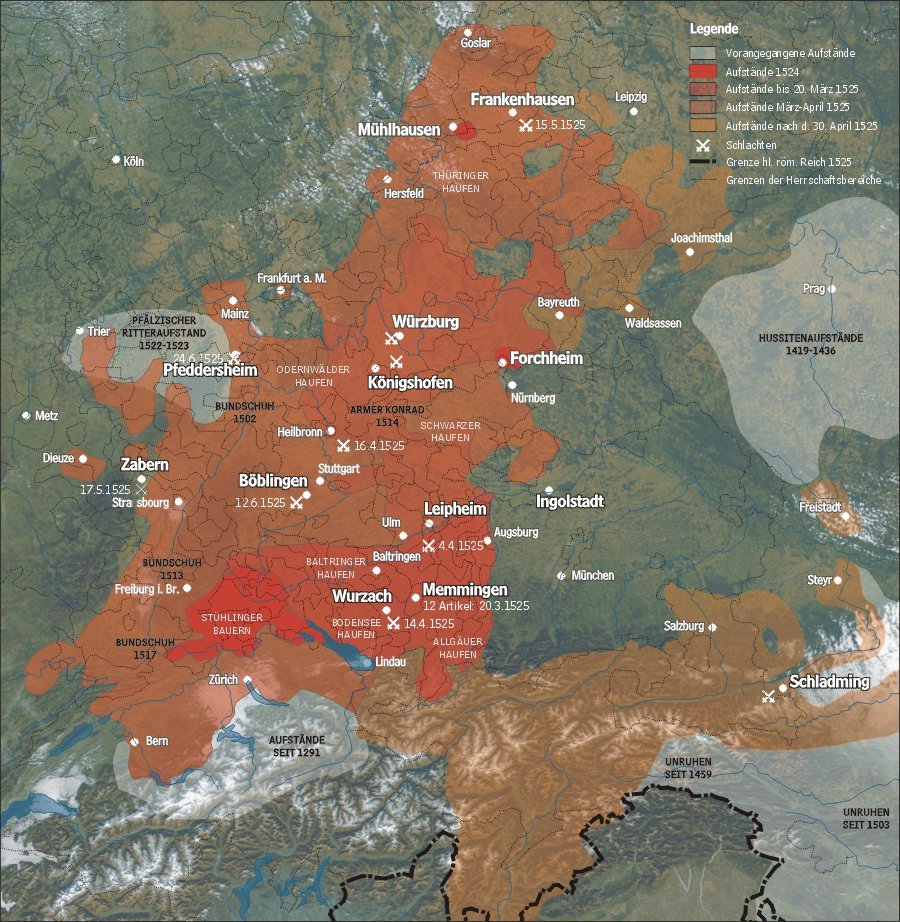
The German Peasants' War, Great Peasants' War or Great Peasants' Revolt (German: Deutscher Bauernkrieg) was a widespread popular revolt in some German-speaking areas in Central Europe from 1524 to 1525. It was Europe's largest and most widespread popular uprising before the French Revolution of 1789. The revolt failed because of intense opposition from the aristocracy, who slaughtered up to 100,000 of the 300,000 poorly armed peasants and farmers. The survivors were fined and achieved few, if any, of their goals. Like the preceding Bundschuh movement and the Hussite Wars, the war consisted of a series of both economic and religious revolts involving peasants and farmers, sometimes supported by radical clergy like Thomas Müntzer. The fighting was at its height in the middle of 1525.
The war began with separate insurrections, beginning in the southwestern part of what is now Germany and Alsace, and spread in subsequent insurrections to the central and eastern areas of Germany and present-day Austria. After the uprising in Germany was suppressed, it flared up briefly in several cantons of the Old Swiss Confederacy.
In mounting their insurrection, peasants faced insurmountable obstacles. The democratic nature of their movement left them without a command structure and they lacked artillery and cavalry. Most of them had little, if any, military experience. Their opposition had experienced military leaders, well-equipped and disciplined armies, and ample funding.
The revolt incorporated some principles and rhetoric from the emerging Protestant Reformation, through which the peasants sought influence and freedom. Some Radical Reformers, most famously Thomas Müntzer, instigated and supported the revolt. In contrast, Martin Luther and other Magisterial Reformers condemned it and sided with the aristocrats. In Against the Murderous, Thieving Hordes of Peasants, Luther condemned the violence as the devil's work and called for the aristocrats to put down the rebels like mad dogs. The movement was supported by Huldrych Zwingli, but the condemnation by Luther contributed to its defeat. While around 20 veterans of the war went on to become leading figures in the Anabaptist movement, James Stayer notes that "no large number of known Anabaptists can be identified by name as participants in the 1525 upheaveal".
In the sixteenth century, many parts of Europe had common political links within the Holy Roman Empire, a decentralized entity in which the Holy Roman Emperor himself had little authority outside of his own dynastic lands, which covered only a small fraction of the whole. At the time of the Peasants' War, Charles V, King of Spain, held the position of Holy Roman Emperor (elected in June 1519). Aristocratic dynasties ruled hundreds of largely independent territories (both secular and ecclesiastical) within the framework of the empire, and several dozen others operated as semi-independent city-states. The princes of these dynasties were taxed by the Roman Catholic church. The princes stood to gain economically if they broke away from the Roman church and established a German church under their own control, which would then not be able to tax them as the Roman church did. Most German princes broke with Rome using the nationalistic slogan of "German money for a German church".
Princes often attempted to force their freer peasants into serfdom by increasing taxes and introducing Roman civil law. Roman civil law advantaged princes who sought to consolidate their power because it brought all land into their personal ownership and eliminated the feudal concept of the land as a trust between lord and peasant that conferred rights as well as obligations on the latter. By maintaining the remnants of the ancient law which legitimized their own rule, they not only elevated their wealth and position in the empire through the confiscation of all property and revenues, but increased their power over their peasant subjects.
During the Knights' War the "knights", the lesser landholders of the Rhineland in western Germany, rose up in rebellion in 1522–1523. Their rhetoric was religious, and several leaders expressed Luther's ideas on the split with Rome and the new German church. However, the Knights' War was not fundamentally religious. It was conservative in nature and sought to preserve the feudal order. The knights revolted against the new money order, which was squeezing them out of existence.
Martin Luther, the dominant leader of the Reformation in Germany, initially took a middle course in the Peasants' War, by criticizing both the injustices imposed on the peasants, and the rashness of the peasants in fighting back. He also tended to support the centralization and urbanization of the economy. This position alienated the lesser nobles, but shored up his position with the burghers. Luther argued that work was the chief duty on earth; the duty of the peasants was farm labor and the duty of the ruling classes was upholding the peace. He could not support the Peasant War because it broke the peace, an evil he thought greater than the evils the peasants were rebelling against. At the peak of the insurrection in 1525, his position shifted completely to support of the rulers of the secular principalities and their Roman Catholic allies.
Hub AI
German Peasants' War AI simulator
(@German Peasants' War_simulator)
German Peasants' War
The German Peasants' War, Great Peasants' War or Great Peasants' Revolt (German: Deutscher Bauernkrieg) was a widespread popular revolt in some German-speaking areas in Central Europe from 1524 to 1525. It was Europe's largest and most widespread popular uprising before the French Revolution of 1789. The revolt failed because of intense opposition from the aristocracy, who slaughtered up to 100,000 of the 300,000 poorly armed peasants and farmers. The survivors were fined and achieved few, if any, of their goals. Like the preceding Bundschuh movement and the Hussite Wars, the war consisted of a series of both economic and religious revolts involving peasants and farmers, sometimes supported by radical clergy like Thomas Müntzer. The fighting was at its height in the middle of 1525.
The war began with separate insurrections, beginning in the southwestern part of what is now Germany and Alsace, and spread in subsequent insurrections to the central and eastern areas of Germany and present-day Austria. After the uprising in Germany was suppressed, it flared up briefly in several cantons of the Old Swiss Confederacy.
In mounting their insurrection, peasants faced insurmountable obstacles. The democratic nature of their movement left them without a command structure and they lacked artillery and cavalry. Most of them had little, if any, military experience. Their opposition had experienced military leaders, well-equipped and disciplined armies, and ample funding.
The revolt incorporated some principles and rhetoric from the emerging Protestant Reformation, through which the peasants sought influence and freedom. Some Radical Reformers, most famously Thomas Müntzer, instigated and supported the revolt. In contrast, Martin Luther and other Magisterial Reformers condemned it and sided with the aristocrats. In Against the Murderous, Thieving Hordes of Peasants, Luther condemned the violence as the devil's work and called for the aristocrats to put down the rebels like mad dogs. The movement was supported by Huldrych Zwingli, but the condemnation by Luther contributed to its defeat. While around 20 veterans of the war went on to become leading figures in the Anabaptist movement, James Stayer notes that "no large number of known Anabaptists can be identified by name as participants in the 1525 upheaveal".
In the sixteenth century, many parts of Europe had common political links within the Holy Roman Empire, a decentralized entity in which the Holy Roman Emperor himself had little authority outside of his own dynastic lands, which covered only a small fraction of the whole. At the time of the Peasants' War, Charles V, King of Spain, held the position of Holy Roman Emperor (elected in June 1519). Aristocratic dynasties ruled hundreds of largely independent territories (both secular and ecclesiastical) within the framework of the empire, and several dozen others operated as semi-independent city-states. The princes of these dynasties were taxed by the Roman Catholic church. The princes stood to gain economically if they broke away from the Roman church and established a German church under their own control, which would then not be able to tax them as the Roman church did. Most German princes broke with Rome using the nationalistic slogan of "German money for a German church".
Princes often attempted to force their freer peasants into serfdom by increasing taxes and introducing Roman civil law. Roman civil law advantaged princes who sought to consolidate their power because it brought all land into their personal ownership and eliminated the feudal concept of the land as a trust between lord and peasant that conferred rights as well as obligations on the latter. By maintaining the remnants of the ancient law which legitimized their own rule, they not only elevated their wealth and position in the empire through the confiscation of all property and revenues, but increased their power over their peasant subjects.
During the Knights' War the "knights", the lesser landholders of the Rhineland in western Germany, rose up in rebellion in 1522–1523. Their rhetoric was religious, and several leaders expressed Luther's ideas on the split with Rome and the new German church. However, the Knights' War was not fundamentally religious. It was conservative in nature and sought to preserve the feudal order. The knights revolted against the new money order, which was squeezing them out of existence.
Martin Luther, the dominant leader of the Reformation in Germany, initially took a middle course in the Peasants' War, by criticizing both the injustices imposed on the peasants, and the rashness of the peasants in fighting back. He also tended to support the centralization and urbanization of the economy. This position alienated the lesser nobles, but shored up his position with the burghers. Luther argued that work was the chief duty on earth; the duty of the peasants was farm labor and the duty of the ruling classes was upholding the peace. He could not support the Peasant War because it broke the peace, an evil he thought greater than the evils the peasants were rebelling against. At the peak of the insurrection in 1525, his position shifted completely to support of the rulers of the secular principalities and their Roman Catholic allies.
Recent media