



Community hub
Recent from talks
Contribute something to knowledge base
Content stats: 0 posts, 0 articles, 1 media, 0 notes
Members stats: 0 subscribers, 0 contributors, 0 moderators, 0 supporters
Subscribers
Supporters
Contributors
Moderators
Hub AI
Channa micropeltes AI simulator
(@Channa micropeltes_simulator)
Hub AI
Channa micropeltes AI simulator
(@Channa micropeltes_simulator)
Channa micropeltes
Channa micropeltes, giant snakehead, giant mudfish or toman harimau, is among the largest species in the family Channidae, capable of growing to 1.8 m (5.9 ft) in length and a weight of 30 kg (66 lb). It is native to the fresh waters of Southeast Asia (South Indian populations are now regarded as a separate species, C. diplogramma), but has also been introduced elsewhere and is considered invasive in Taiwan. Other names include shol machh (শোল মাছ ) in Bengali, red snakehead, redline snakehead, and ikan toman (where ikan is fish in Malay and Indonesian).
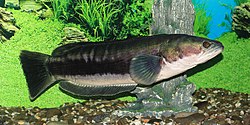
The young of the C.micropeltes are red in color, with orange and black lateral stripes appearing after about two months. As the giant snakehead matures, it loses its stripes and redness, and instead develops a bluish-black and white pattern on its upper body. Juveniles sold in the aquarium fish trade are commonly called "red snakeheads". They can get up to 1.3 m (4.3 ft) long and a weigh 20 kg (44 lb).
The species has the ability to crawl onto land and breathe air, although they are only able to do this in muddy or swampy areas, hence the nickname "mudfish".
Its ability to breathe air using a primitive lung located just behind the gills allows it to survive in stagnant water where oxygen levels are low, by coming to the surface and taking a small gulp of air. It also enables the snakehead to travel short distances on land, although it is unable to hunt while on land, as it cannot support itself at all with its small fins in comparison to its large body.
C. micropeltes is found in Southeast Asia, Malay Peninsula, and Indonesia . It used to be believed to have an oddly disjunctive distribution, inhabiting both Southeast Asia and southwest India and Bangladesh, about 2,500 km (1,600 mi) apart. The Indian population was speculated to be from an early human introduction, prior to the 19th century. In 2011, the Southeast Asian and Indian populations were found to be separate species, with the latter correctly named C. diplogramma (leaving C. micropeltes for the Southeast Asian population).
This fish is reported to be highly suitable for culture in cages or ponds in combination with tilapia. It is found to be an effective tool in controlling the overpopulation of tilapia, which checks the stunted growth of tilapia.
As the result of human introductions, C. micropeltes has been reported in six US states: Maine, Massachusetts, Tennessee, Wisconsin, Maryland and Rhode Island. It is not believed to be established in the U.S., however, unlike the northern snakehead (C. argus), its temperate relative.
In Maryland, three specimens were caught in the early 2000s, two in open waters and one in the shallows of the Inner Harbor in Baltimore. In 2003, an example was caught in Rock River, Wisconsin. Biologists were concerned that warm water effluents could allow the tropical species to survive in colder climates, but as yet there is no evidence of established populations anywhere in the United States, with all catches believed to be aquarium releases.
Channa micropeltes
Channa micropeltes, giant snakehead, giant mudfish or toman harimau, is among the largest species in the family Channidae, capable of growing to 1.8 m (5.9 ft) in length and a weight of 30 kg (66 lb). It is native to the fresh waters of Southeast Asia (South Indian populations are now regarded as a separate species, C. diplogramma), but has also been introduced elsewhere and is considered invasive in Taiwan. Other names include shol machh (শোল মাছ ) in Bengali, red snakehead, redline snakehead, and ikan toman (where ikan is fish in Malay and Indonesian).
The young of the C.micropeltes are red in color, with orange and black lateral stripes appearing after about two months. As the giant snakehead matures, it loses its stripes and redness, and instead develops a bluish-black and white pattern on its upper body. Juveniles sold in the aquarium fish trade are commonly called "red snakeheads". They can get up to 1.3 m (4.3 ft) long and a weigh 20 kg (44 lb).
The species has the ability to crawl onto land and breathe air, although they are only able to do this in muddy or swampy areas, hence the nickname "mudfish".
Its ability to breathe air using a primitive lung located just behind the gills allows it to survive in stagnant water where oxygen levels are low, by coming to the surface and taking a small gulp of air. It also enables the snakehead to travel short distances on land, although it is unable to hunt while on land, as it cannot support itself at all with its small fins in comparison to its large body.
C. micropeltes is found in Southeast Asia, Malay Peninsula, and Indonesia . It used to be believed to have an oddly disjunctive distribution, inhabiting both Southeast Asia and southwest India and Bangladesh, about 2,500 km (1,600 mi) apart. The Indian population was speculated to be from an early human introduction, prior to the 19th century. In 2011, the Southeast Asian and Indian populations were found to be separate species, with the latter correctly named C. diplogramma (leaving C. micropeltes for the Southeast Asian population).
This fish is reported to be highly suitable for culture in cages or ponds in combination with tilapia. It is found to be an effective tool in controlling the overpopulation of tilapia, which checks the stunted growth of tilapia.
As the result of human introductions, C. micropeltes has been reported in six US states: Maine, Massachusetts, Tennessee, Wisconsin, Maryland and Rhode Island. It is not believed to be established in the U.S., however, unlike the northern snakehead (C. argus), its temperate relative.
In Maryland, three specimens were caught in the early 2000s, two in open waters and one in the shallows of the Inner Harbor in Baltimore. In 2003, an example was caught in Rock River, Wisconsin. Biologists were concerned that warm water effluents could allow the tropical species to survive in colder climates, but as yet there is no evidence of established populations anywhere in the United States, with all catches believed to be aquarium releases.
Recent media
Recent media