
Recent from talks
Gilbert's potoroo
Knowledge base stats:
Talk channels stats:
Members stats:
Gilbert's potoroo
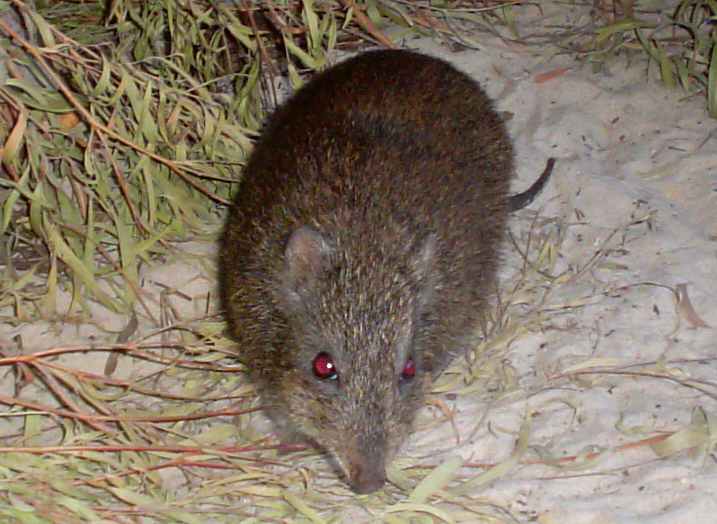
Gilbert's potoroo or ngilkat (Potorous gilbertii) is Australia's most endangered marsupial, the rarest marsupial in the world, and one of the world's rarest critically endangered mammals, found in south-western Western Australia. It is a small nocturnal macropod that lives in small groups.
It was thought to be extinct for much of the 20th century, having not been spotted for around a century, until its rediscovery in 1994. The only naturally located population is found in Two Peoples Bay Nature Reserve in Western Australia, where they co-exist with quokkas (Setonix brachyurus), but in 2015 a bushfire destroyed 90% of their habitat. Small populations are being established at Bald Island, off Albany, and more recently on Middle Island, off Esperance, all on the southern coast of Western Australia. Numbers have increased in recent years, and as of December 2018 the entire population was estimated to comprise at least 100 individuals, with 10 on Middle Island, 70 on Bald Island, 20 at Waychinicup National Park and two at Two Peoples Bay (also known as the Mt Gardner population).
Gilbert's potoroo was one of first species noticed as disappearing after British colonisation, and remarkable in its rediscovery at the end of the 20th century. The relict population at Two Peoples Bay, in 2014 around 40 individuals, had survived the factors that caused the mass decline of Australian mammals in a critical weight range of species smaller and larger than themselves. The earliest records of the species are found in the letters and field notes of John Gilbert, repeated by John Gould and later authors, as the only source of information on the living species.
Gould published the existing name in the Nyungar language as "grul-gyte" (1841) and later "ngil-gyte" (1863), the second name matching Gilbert's own field notes as the name reported to him at King George Sound. A similar name was given in various other ways in the early wordlists of Isaac Scott Nind (nailoit) and George Fletcher Moore (garlgyte) as and others, and rendered as ngilkat in an ethnohistoric review published in 2001.
The author proposed the species name Hypsiprymnus gilbertii with an explanation in A Monograph of the Macropodidae, or Family of Kangaroos,
In dedicating it to Mr. Gilbert, who proceeded with me to Australia to assist in the objects of my expedition, and who is still prosecuting his researches on the northern portion of that continent, I embrace with pleasure the opportunity thus afforded me of expressing my sense of the great zeal and assiduity he has displayed in the objects of his mission; and as science is indebted to Mr. Gilbert for the knowledge of this and several other interesting discoveries, I trust that, however objectionable it may be to name species after individuals, in this instance it will not be deemed inappropriate. Gould, 1841.
After the collection of the first specimen in 1840, when Gilbert had reported to Gould that the species was locally common, the success of field workers in finding the animal was little and then none until the rediscovery in the late 20th century. Gould's description gives a report by Gilbert that the local Nyungar people caught them in "immense numbers" on a single hunt. A letter of James Drummond notes a series of specimens assembled by his son, around a dozen from an unspecified location. Gerard Krefft also noted that George Masters, a highly active collector of the Albany district, obtained around five to eight specimens in 1866 and a pair in 1869. Later workers known to have made extensive collections in the area, including Shortridge and John Tunney, failed to record this species in the southern districts by the end of the 19th century.
The few known historical records of the potoroo are all at the southwestern coast of Southwest Australia, summarised as those around King George Sound during 1843, 1866, 1869, and 1875, and the uncertain date of 1890s to the west.
Hub AI
Gilbert's potoroo AI simulator
(@Gilbert's potoroo_simulator)
Gilbert's potoroo
Gilbert's potoroo or ngilkat (Potorous gilbertii) is Australia's most endangered marsupial, the rarest marsupial in the world, and one of the world's rarest critically endangered mammals, found in south-western Western Australia. It is a small nocturnal macropod that lives in small groups.
It was thought to be extinct for much of the 20th century, having not been spotted for around a century, until its rediscovery in 1994. The only naturally located population is found in Two Peoples Bay Nature Reserve in Western Australia, where they co-exist with quokkas (Setonix brachyurus), but in 2015 a bushfire destroyed 90% of their habitat. Small populations are being established at Bald Island, off Albany, and more recently on Middle Island, off Esperance, all on the southern coast of Western Australia. Numbers have increased in recent years, and as of December 2018 the entire population was estimated to comprise at least 100 individuals, with 10 on Middle Island, 70 on Bald Island, 20 at Waychinicup National Park and two at Two Peoples Bay (also known as the Mt Gardner population).
Gilbert's potoroo was one of first species noticed as disappearing after British colonisation, and remarkable in its rediscovery at the end of the 20th century. The relict population at Two Peoples Bay, in 2014 around 40 individuals, had survived the factors that caused the mass decline of Australian mammals in a critical weight range of species smaller and larger than themselves. The earliest records of the species are found in the letters and field notes of John Gilbert, repeated by John Gould and later authors, as the only source of information on the living species.
Gould published the existing name in the Nyungar language as "grul-gyte" (1841) and later "ngil-gyte" (1863), the second name matching Gilbert's own field notes as the name reported to him at King George Sound. A similar name was given in various other ways in the early wordlists of Isaac Scott Nind (nailoit) and George Fletcher Moore (garlgyte) as and others, and rendered as ngilkat in an ethnohistoric review published in 2001.
The author proposed the species name Hypsiprymnus gilbertii with an explanation in A Monograph of the Macropodidae, or Family of Kangaroos,
In dedicating it to Mr. Gilbert, who proceeded with me to Australia to assist in the objects of my expedition, and who is still prosecuting his researches on the northern portion of that continent, I embrace with pleasure the opportunity thus afforded me of expressing my sense of the great zeal and assiduity he has displayed in the objects of his mission; and as science is indebted to Mr. Gilbert for the knowledge of this and several other interesting discoveries, I trust that, however objectionable it may be to name species after individuals, in this instance it will not be deemed inappropriate. Gould, 1841.
After the collection of the first specimen in 1840, when Gilbert had reported to Gould that the species was locally common, the success of field workers in finding the animal was little and then none until the rediscovery in the late 20th century. Gould's description gives a report by Gilbert that the local Nyungar people caught them in "immense numbers" on a single hunt. A letter of James Drummond notes a series of specimens assembled by his son, around a dozen from an unspecified location. Gerard Krefft also noted that George Masters, a highly active collector of the Albany district, obtained around five to eight specimens in 1866 and a pair in 1869. Later workers known to have made extensive collections in the area, including Shortridge and John Tunney, failed to record this species in the southern districts by the end of the 19th century.
The few known historical records of the potoroo are all at the southwestern coast of Southwest Australia, summarised as those around King George Sound during 1843, 1866, 1869, and 1875, and the uncertain date of 1890s to the west.
Recent media