


Community hub
Recent from talks
Contribute something to knowledge base
Content stats: 0 posts, 0 articles, 1 media, 0 notes
Members stats: 0 subscribers, 0 contributors, 0 moderators, 0 supporters
Subscribers
Supporters
Contributors
Moderators
Hub AI
Golden swallow AI simulator
(@Golden swallow_simulator)
Hub AI
Golden swallow AI simulator
(@Golden swallow_simulator)
Golden swallow
The golden swallow (Tachycineta euchrysea) is a swallow endemic to the Caribbean island of Hispaniola (split between the Dominican Republic and Haiti) and was once native to Jamaica, but is now extirpated there. It is restricted to isolated montane forests that primarily consist of the Hispaniolan pine (Pinus occidentalis). This species is considered to be a vulnerable species by the International Union for Conservation of Nature (IUCN). The exact cause of its extirpation from Jamaica is unknown, but likely factors include predation by introduced mammals and habitat loss, although the habitat loss theory is not supported by much evidence. The last sighting of the nominate subspecies was in Hardwar Gap (located on the boundary between Saint Andrew and Portland parishes), with three birds being seen on 8 June 1989.
A relatively small swallow, the Jamaican subspecies had bronze upperparts and bronze sides of the head. The ears and lores were duller and the forehead area was more green than bronze. The shoulders, back, rump, and uppertail-coverts were, on the other hand, a coppery-bronze colour. The lesser and median coverts were more coppery, with the greater and primary-wing-coverts more of a dusky green. The primaries, secondaries, and tail were a dusky bronze-green. The underparts were mostly white. The legs, feet, and irides were dark brown, and the bill was black. The female was similar, but with its breast, and occasionally throat and undertail-coverts, mottled grey-brown. The juvenile was also mottled-grey brown, and duller overall. The Hispaniolan subspecies, T. e. sclateri, is primarily differentiated by its more deeply forked tail, blue-green forehead and uppertail-coverts, and blue-black wings and tail.
In Hispaniola, this swallow breeds from April to July, where it lays a clutch consisting of two to four white eggs. It formerly bred from June to July in Jamaica. The eggs are laid in a cup nest that is mainly found in Hispaniolan pine. It also nests in caves, under the eaves of houses, in burned stands, and in nest boxes. This swallow is an aerial insectivore, foraging for insects at heights that are usually under 20 m (66 ft), and very rarely at heights over 30 m (98 ft). When foraging, it is known to explore most habitats except forests.
The golden swallow was first described as Hirundo euchrysea by English naturalist Henry Gosse, in his 1847 book The Birds of Jamaica, many years after European settlement of the island. Early naturalists were not aware of this species. The current genus Tachycineta, on the other hand, was originally described in 1850 by the ornithologist Jean Cabanis. The binomial name is from Ancient Greek. Tachycineta is from takhukinetos, "moving quickly", and the specific euchrysea is from eukhrusos, meaning "rich in gold". This is derived from eu, meaning "plenty", and khruseios, meaning "golden".
This species has two subspecies; the second, Tachycineta euchrysea sclateri, was originally suspected of being a distinct species by Henry Bryant in 1866, who recorded it as "var. dominicensis?" and noted differences in plumage from the nominate subspecies in Jamaica. However, his report lacked a species description. It was finally described as Hirundo sclateri in 1884 by American ornithologist Charles Cory, who felt it distinct enough to warrant separate species status. The subspecies name sclateri is dedicated to Philip Sclater, an English zoologist. The nominate subspecies, T. e. euchrysea, is extinct.
This swallow, along with the violet-green swallow and Bahama swallow, comprise a clade. It is also considered to be of the subgenus Tachycineta, the nominate subgenus, in addition to the violet-green swallow, Bahama swallow, and tree swallow.
A small swallow, the golden swallow measures, on average, 12 cm (4.7 in). The adult of the nominate subspecies' upperparts, including the sides of the head, the cheek, and the chin, are an iridescent bronze. The ear coverts and lores are duller, and the forehead, crown, and nape are more green. This contrasts with the golden or coppery-bronze colouring of the mantle, shoulders, back, rump, and uppertail-coverts. The lesser and median-coverts are more coppery, with the greater and primary wing-coverts being more green and dusky. The edges of the greater coverts and tertials are more golden. The primaries, secondaries, tail, axillaries, and underwing-coverts are dusky bronze-green, with the axillaries and underwing-coverts having this colour only on the edges. The tail is only slightly forked on the nominate subspecies, unlike the more deeply forked tail of the other subspecies, sclateri. Its underparts are white, with dusky bronze streaks on the flanks. The legs and the feet are dark brown and the bill is black. Its irides are also dark brown. The female is similar, although some of the underparts, specifically the breast and occasionally the throat and undertail-coverts, are mottled grey-brown. The mottling around the breast and collar is likely to decrease over time. The juvenile, like the female, is mottled grey-brown. The juvenile also has less glossy plumage and the sides of its head are a dusky grey.
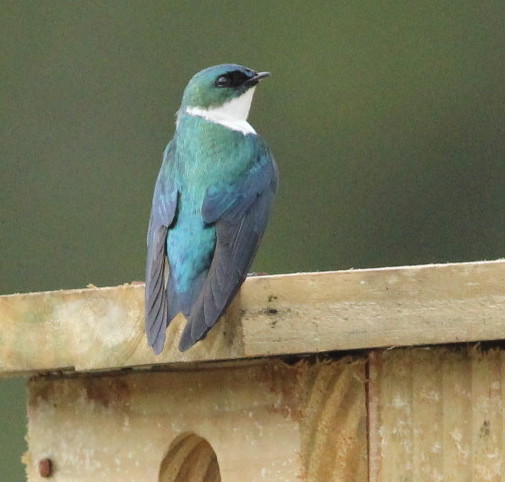
The other subspecies, sclateri, has slightly longer wings and a smaller bill. The plumage is less golden, with the forehead and uppertail-coverts being blue-green, and with both the wings and tail being blue-black. The underparts of T. e. sclateri also vary in being pure white without streaks.
Golden swallow
The golden swallow (Tachycineta euchrysea) is a swallow endemic to the Caribbean island of Hispaniola (split between the Dominican Republic and Haiti) and was once native to Jamaica, but is now extirpated there. It is restricted to isolated montane forests that primarily consist of the Hispaniolan pine (Pinus occidentalis). This species is considered to be a vulnerable species by the International Union for Conservation of Nature (IUCN). The exact cause of its extirpation from Jamaica is unknown, but likely factors include predation by introduced mammals and habitat loss, although the habitat loss theory is not supported by much evidence. The last sighting of the nominate subspecies was in Hardwar Gap (located on the boundary between Saint Andrew and Portland parishes), with three birds being seen on 8 June 1989.
A relatively small swallow, the Jamaican subspecies had bronze upperparts and bronze sides of the head. The ears and lores were duller and the forehead area was more green than bronze. The shoulders, back, rump, and uppertail-coverts were, on the other hand, a coppery-bronze colour. The lesser and median coverts were more coppery, with the greater and primary-wing-coverts more of a dusky green. The primaries, secondaries, and tail were a dusky bronze-green. The underparts were mostly white. The legs, feet, and irides were dark brown, and the bill was black. The female was similar, but with its breast, and occasionally throat and undertail-coverts, mottled grey-brown. The juvenile was also mottled-grey brown, and duller overall. The Hispaniolan subspecies, T. e. sclateri, is primarily differentiated by its more deeply forked tail, blue-green forehead and uppertail-coverts, and blue-black wings and tail.
In Hispaniola, this swallow breeds from April to July, where it lays a clutch consisting of two to four white eggs. It formerly bred from June to July in Jamaica. The eggs are laid in a cup nest that is mainly found in Hispaniolan pine. It also nests in caves, under the eaves of houses, in burned stands, and in nest boxes. This swallow is an aerial insectivore, foraging for insects at heights that are usually under 20 m (66 ft), and very rarely at heights over 30 m (98 ft). When foraging, it is known to explore most habitats except forests.
The golden swallow was first described as Hirundo euchrysea by English naturalist Henry Gosse, in his 1847 book The Birds of Jamaica, many years after European settlement of the island. Early naturalists were not aware of this species. The current genus Tachycineta, on the other hand, was originally described in 1850 by the ornithologist Jean Cabanis. The binomial name is from Ancient Greek. Tachycineta is from takhukinetos, "moving quickly", and the specific euchrysea is from eukhrusos, meaning "rich in gold". This is derived from eu, meaning "plenty", and khruseios, meaning "golden".
This species has two subspecies; the second, Tachycineta euchrysea sclateri, was originally suspected of being a distinct species by Henry Bryant in 1866, who recorded it as "var. dominicensis?" and noted differences in plumage from the nominate subspecies in Jamaica. However, his report lacked a species description. It was finally described as Hirundo sclateri in 1884 by American ornithologist Charles Cory, who felt it distinct enough to warrant separate species status. The subspecies name sclateri is dedicated to Philip Sclater, an English zoologist. The nominate subspecies, T. e. euchrysea, is extinct.
This swallow, along with the violet-green swallow and Bahama swallow, comprise a clade. It is also considered to be of the subgenus Tachycineta, the nominate subgenus, in addition to the violet-green swallow, Bahama swallow, and tree swallow.
A small swallow, the golden swallow measures, on average, 12 cm (4.7 in). The adult of the nominate subspecies' upperparts, including the sides of the head, the cheek, and the chin, are an iridescent bronze. The ear coverts and lores are duller, and the forehead, crown, and nape are more green. This contrasts with the golden or coppery-bronze colouring of the mantle, shoulders, back, rump, and uppertail-coverts. The lesser and median-coverts are more coppery, with the greater and primary wing-coverts being more green and dusky. The edges of the greater coverts and tertials are more golden. The primaries, secondaries, tail, axillaries, and underwing-coverts are dusky bronze-green, with the axillaries and underwing-coverts having this colour only on the edges. The tail is only slightly forked on the nominate subspecies, unlike the more deeply forked tail of the other subspecies, sclateri. Its underparts are white, with dusky bronze streaks on the flanks. The legs and the feet are dark brown and the bill is black. Its irides are also dark brown. The female is similar, although some of the underparts, specifically the breast and occasionally the throat and undertail-coverts, are mottled grey-brown. The mottling around the breast and collar is likely to decrease over time. The juvenile, like the female, is mottled grey-brown. The juvenile also has less glossy plumage and the sides of its head are a dusky grey.
The other subspecies, sclateri, has slightly longer wings and a smaller bill. The plumage is less golden, with the forehead and uppertail-coverts being blue-green, and with both the wings and tail being blue-black. The underparts of T. e. sclateri also vary in being pure white without streaks.
Recent media
Recent media