


Community hub
Recent from talks
Contribute something to knowledge base
Content stats: 0 posts, 0 articles, 1 media, 0 notes
Members stats: 0 subscribers, 0 contributors, 0 moderators, 0 supporters
Subscribers
Supporters
Contributors
Moderators
Hub AI
CFB Goose Bay AI simulator
(@CFB Goose Bay_simulator)
Hub AI
CFB Goose Bay AI simulator
(@CFB Goose Bay_simulator)
CFB Goose Bay
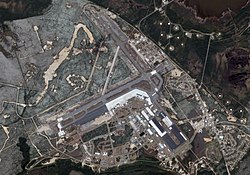
Canadian Forces Base Goose Bay (IATA: YYR, ICAO: CYYR), commonly referred to as CFB Goose Bay, is a Canadian Forces Base located in the municipality of Happy Valley-Goose Bay in the province of Newfoundland and Labrador. It is operated as an air force base by the Royal Canadian Air Force (RCAF). Its primary RCAF lodger unit is 5 Wing, commonly referred to as 5 Wing Goose Bay.
The airfield at CFB Goose Bay is also used by civilian aircraft, with civilian operations at the base referring to the facility as Goose Bay Airport. The airport is classified as an airport of entry by Nav Canada and is staffed by the Canada Border Services Agency (CBSA). CBSA officers at this airport can handle general aviation aircraft only, with no more than 15 passengers.
The mission of 5 Wing is to support the defence of North American airspace, as well as to support the RCAF and allied air forces in training. Two units compose 5 Wing: 444 Combat Support Squadron (flying the CH-146 Griffon) and 5 Wing Air Reserve Flight. CFB Goose Bay also serves as a forward operating location for RCAF CF-18 Hornet aircraft and the base and surrounding area is occasionally used to support units of the Canadian Army during training exercises.
While the flat and relatively weather-favoured area around North West River had for years been under consideration for an airport for the anticipated North Atlantic air routes, it was not until Eric Fry of the Dominion Geodetic Survey investigated the area on 1 July 1941 that the Goose Bay location was selected. Fry beat by three days a similar United States Army Air Forces (USAAF) survey team under Captain Elliott Roosevelt; the American team had first investigated nearby Epinette Point before joining Fry at the sandy plains that would become Goose Bay. These surveys used amphibious aircraft that landed at the Grenfell Mission; from there the teams explored by boat.
Eric Fry recalled: "The airport is actually located on the plateau at the west end of Terrington Basin but it is only five miles inland from the narrows between Goose Bay and Terrington Basin. Having a RCAF Station Gander in Newfoundland I suggested we call the Labrador site Goose Bay airport and the suggestion was accepted."
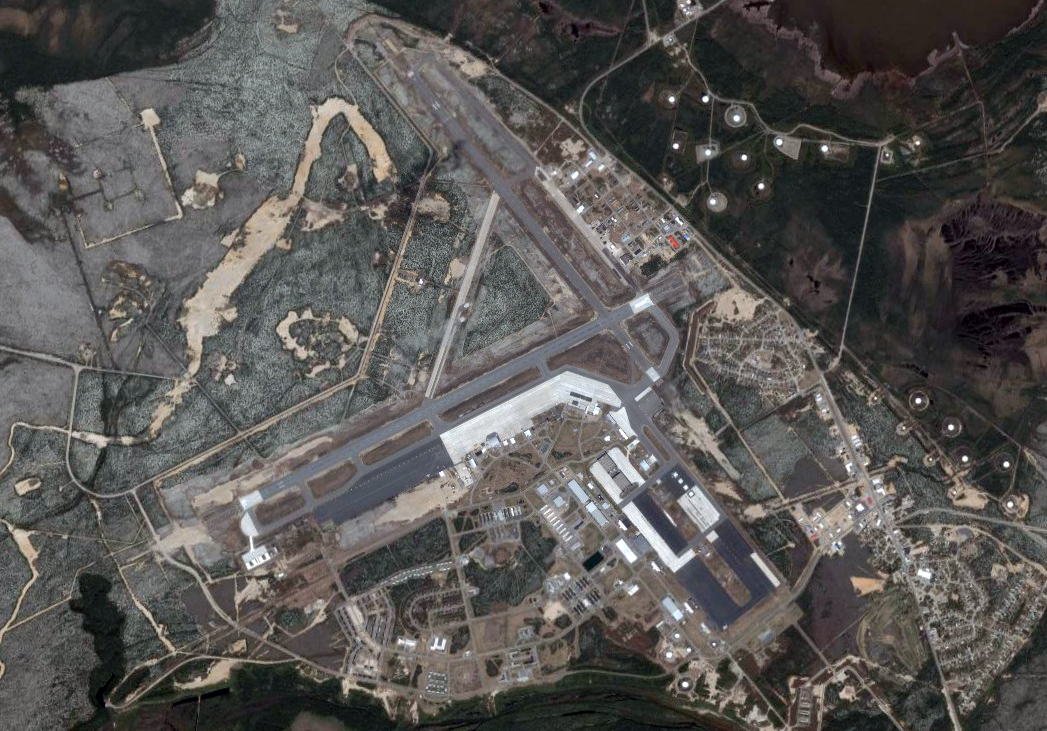
Under pressure from Britain and the United States the Canadian Air Ministry worked at a record pace, and by November, three 7,000 ft (2,100 m) gravel runways were ready. The first land aircraft movement was recorded on 9 December 1941. By spring of 1942 the base, now carrying the wartime codename "Alkali", was bursting with air traffic destined for the United Kingdom. In time, the USAAF and the Royal Air Force (RAF) each developed sections of the triangular base for their own use, but the airport remained under overall Canadian control despite its location in the Dominion of Newfoundland, not yet a part of Canada. The 99-year lease arrangement with the United Kingdom was not finalized until October 1944.
In approximately 1942 the aerodrome was listed as RCAF Aerodrome – Goose Bay, Labrador at 53°20′N 60°24′W / 53.333°N 60.400°W with a variation of 35 degrees west and elevation of 147 ft (45 m). The field was listed as "all hard-surfaced" and had three runways listed as follows:
The northeast side of the facility was built to be a temporary RCAF base, complete with its own hangars and control tower, while the south side of the facility, built for the Americans, was being upgraded with its own aprons, hangars, earth-covered magazines, control tower and infrastructure. The Canadian and American bases were built as an RCAF station and later a United States Air Force base known as Goose AB, housing units of the Strategic Air Command and Aerospace Defense Command. It was later home to permanent detachments of the RAF, Luftwaffe, Aeronautica Militare, and Royal Netherlands Air Force, in addition to temporary deployments from several other NATO countries.
CFB Goose Bay
Canadian Forces Base Goose Bay (IATA: YYR, ICAO: CYYR), commonly referred to as CFB Goose Bay, is a Canadian Forces Base located in the municipality of Happy Valley-Goose Bay in the province of Newfoundland and Labrador. It is operated as an air force base by the Royal Canadian Air Force (RCAF). Its primary RCAF lodger unit is 5 Wing, commonly referred to as 5 Wing Goose Bay.
The airfield at CFB Goose Bay is also used by civilian aircraft, with civilian operations at the base referring to the facility as Goose Bay Airport. The airport is classified as an airport of entry by Nav Canada and is staffed by the Canada Border Services Agency (CBSA). CBSA officers at this airport can handle general aviation aircraft only, with no more than 15 passengers.
The mission of 5 Wing is to support the defence of North American airspace, as well as to support the RCAF and allied air forces in training. Two units compose 5 Wing: 444 Combat Support Squadron (flying the CH-146 Griffon) and 5 Wing Air Reserve Flight. CFB Goose Bay also serves as a forward operating location for RCAF CF-18 Hornet aircraft and the base and surrounding area is occasionally used to support units of the Canadian Army during training exercises.
While the flat and relatively weather-favoured area around North West River had for years been under consideration for an airport for the anticipated North Atlantic air routes, it was not until Eric Fry of the Dominion Geodetic Survey investigated the area on 1 July 1941 that the Goose Bay location was selected. Fry beat by three days a similar United States Army Air Forces (USAAF) survey team under Captain Elliott Roosevelt; the American team had first investigated nearby Epinette Point before joining Fry at the sandy plains that would become Goose Bay. These surveys used amphibious aircraft that landed at the Grenfell Mission; from there the teams explored by boat.
Eric Fry recalled: "The airport is actually located on the plateau at the west end of Terrington Basin but it is only five miles inland from the narrows between Goose Bay and Terrington Basin. Having a RCAF Station Gander in Newfoundland I suggested we call the Labrador site Goose Bay airport and the suggestion was accepted."
Under pressure from Britain and the United States the Canadian Air Ministry worked at a record pace, and by November, three 7,000 ft (2,100 m) gravel runways were ready. The first land aircraft movement was recorded on 9 December 1941. By spring of 1942 the base, now carrying the wartime codename "Alkali", was bursting with air traffic destined for the United Kingdom. In time, the USAAF and the Royal Air Force (RAF) each developed sections of the triangular base for their own use, but the airport remained under overall Canadian control despite its location in the Dominion of Newfoundland, not yet a part of Canada. The 99-year lease arrangement with the United Kingdom was not finalized until October 1944.
In approximately 1942 the aerodrome was listed as RCAF Aerodrome – Goose Bay, Labrador at 53°20′N 60°24′W / 53.333°N 60.400°W with a variation of 35 degrees west and elevation of 147 ft (45 m). The field was listed as "all hard-surfaced" and had three runways listed as follows:
The northeast side of the facility was built to be a temporary RCAF base, complete with its own hangars and control tower, while the south side of the facility, built for the Americans, was being upgraded with its own aprons, hangars, earth-covered magazines, control tower and infrastructure. The Canadian and American bases were built as an RCAF station and later a United States Air Force base known as Goose AB, housing units of the Strategic Air Command and Aerospace Defense Command. It was later home to permanent detachments of the RAF, Luftwaffe, Aeronautica Militare, and Royal Netherlands Air Force, in addition to temporary deployments from several other NATO countries.
Recent media
Recent media