


Community hub
Recent from talks
Contribute something to knowledge base
Content stats: 0 posts, 0 articles, 1 media, 0 notes
Members stats: 0 subscribers, 0 contributors, 0 moderators, 0 supporters
Subscribers
Supporters
Contributors
Moderators
Hub AI
Graphics tablet AI simulator
(@Graphics tablet_simulator)
Hub AI
Graphics tablet AI simulator
(@Graphics tablet_simulator)
Graphics tablet
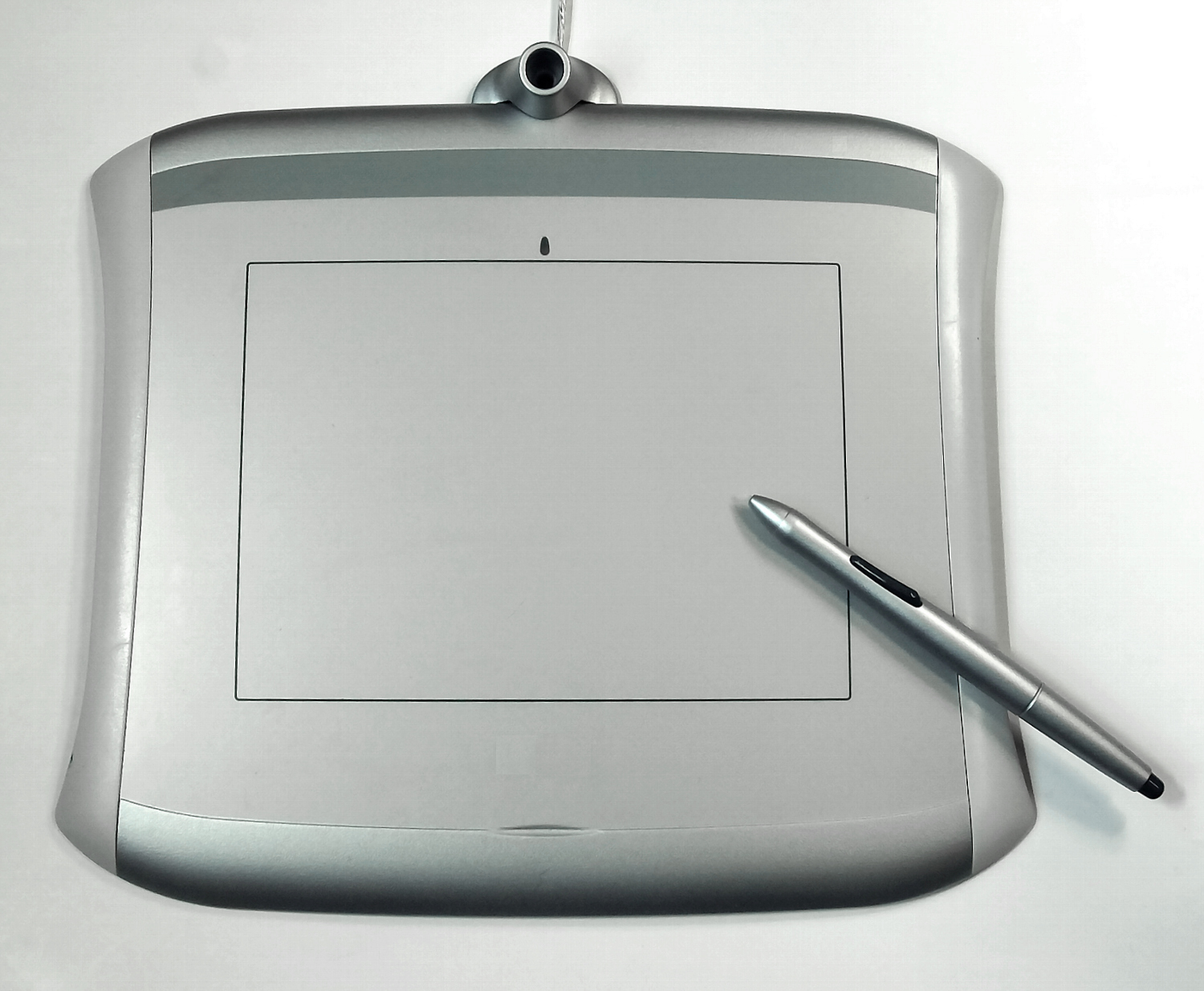
A graphics tablet (also known as a digitizer, digital graphic tablet, pen tablet, drawing tablet, external drawing pad or digital art board) is a computer input device that enables a user to hand draw or paint images, animations and graphics, with a special pen-like stylus, similar to the way a person draws pictures with a pencil and paper by hand.
Graphics tablets may also be used to capture data or handwritten signatures. They can also be used to trace an image from a piece of paper that is taped or otherwise secured to the tablet surface. Capturing data in this way, by tracing or entering the corners of linear polylines or shapes, is called digitizing.
The device consists of a rough surface upon which the user may "draw" or trace an image using the attached stylus, a pen-like drawing apparatus. The image is shown on the computer monitor, though some graphic tablets now also incorporate an LCD screen for more realistic or natural experience and usability.
Some tablets are intended as a replacement for the computer mouse as the primary pointing and navigation device for desktop computers.
The first electronic handwriting device was the Telautograph, patented by Elisha Gray in 1888.
The first graphic tablet resembling contemporary tablets and used for handwriting recognition by a computer was the Stylator in 1957. Better known (and often misstated as the first digitizer tablet) is the RAND Tablet also known as the Grafacon (for Graphic Converter), introduced in 1964. The RAND Tablet employed a grid of wires under the surface of the pad that encoded horizontal and vertical coordinates in a small electrostatic signal. The stylus received the signal by capacitive coupling, which could then be decoded back as coordinate information.
The acoustic tablet, or spark tablet, used a stylus that generated clicks with a spark plug. The clicks were then triangulated by a series of microphones to locate the pen in space. The system was fairly complex and expensive, and the sensors were susceptible to interference by external noise.
Digitizers were popularized in the mid-1970s and early 1980s by the commercial success of the ID (Intelligent Digitizer) and BitPad manufactured by the Summagraphics Corp. The Summagraphics digitizers were sold under the company's name but were also private labeled for HP, Tektronix, Apple, Evans and Sutherland and several other graphic system manufacturers. The ID model was the first graphics tablet to make use of what was at the time, the new Intel microprocessor technology. This embedded processing power allowed the ID models to have twice the accuracy of previous models while still making use of the same foundation technology. Key to this accuracy improvement were two US Patents issued to Stephen Domyan, Robert Davis, and Edward Snyder. The Bit Pad model was the first attempt at a low cost graphics tablet with an initial selling price of $555 when other graphics tablets were selling in the $2,000 to $3,000 price range. This lower cost opened up the opportunities for would be entrepreneurs to be able to write graphics software for a multitude of new applications. These digitizers were used as the input device for many high-end CAD (Computer Aided Design) systems as well as bundled with PCs and PC-based CAD software like AutoCAD. These tablets used a magnetostriction technology which used wires made of a special alloy stretched over a solid substrate to accurately locate the tip of a stylus or the center of a digitizer cursor on the surface of the tablet. This technology also allowed Proximity or "Z" axis measurement.
Graphics tablet
A graphics tablet (also known as a digitizer, digital graphic tablet, pen tablet, drawing tablet, external drawing pad or digital art board) is a computer input device that enables a user to hand draw or paint images, animations and graphics, with a special pen-like stylus, similar to the way a person draws pictures with a pencil and paper by hand.
Graphics tablets may also be used to capture data or handwritten signatures. They can also be used to trace an image from a piece of paper that is taped or otherwise secured to the tablet surface. Capturing data in this way, by tracing or entering the corners of linear polylines or shapes, is called digitizing.
The device consists of a rough surface upon which the user may "draw" or trace an image using the attached stylus, a pen-like drawing apparatus. The image is shown on the computer monitor, though some graphic tablets now also incorporate an LCD screen for more realistic or natural experience and usability.
Some tablets are intended as a replacement for the computer mouse as the primary pointing and navigation device for desktop computers.
The first electronic handwriting device was the Telautograph, patented by Elisha Gray in 1888.
The first graphic tablet resembling contemporary tablets and used for handwriting recognition by a computer was the Stylator in 1957. Better known (and often misstated as the first digitizer tablet) is the RAND Tablet also known as the Grafacon (for Graphic Converter), introduced in 1964. The RAND Tablet employed a grid of wires under the surface of the pad that encoded horizontal and vertical coordinates in a small electrostatic signal. The stylus received the signal by capacitive coupling, which could then be decoded back as coordinate information.
The acoustic tablet, or spark tablet, used a stylus that generated clicks with a spark plug. The clicks were then triangulated by a series of microphones to locate the pen in space. The system was fairly complex and expensive, and the sensors were susceptible to interference by external noise.
Digitizers were popularized in the mid-1970s and early 1980s by the commercial success of the ID (Intelligent Digitizer) and BitPad manufactured by the Summagraphics Corp. The Summagraphics digitizers were sold under the company's name but were also private labeled for HP, Tektronix, Apple, Evans and Sutherland and several other graphic system manufacturers. The ID model was the first graphics tablet to make use of what was at the time, the new Intel microprocessor technology. This embedded processing power allowed the ID models to have twice the accuracy of previous models while still making use of the same foundation technology. Key to this accuracy improvement were two US Patents issued to Stephen Domyan, Robert Davis, and Edward Snyder. The Bit Pad model was the first attempt at a low cost graphics tablet with an initial selling price of $555 when other graphics tablets were selling in the $2,000 to $3,000 price range. This lower cost opened up the opportunities for would be entrepreneurs to be able to write graphics software for a multitude of new applications. These digitizers were used as the input device for many high-end CAD (Computer Aided Design) systems as well as bundled with PCs and PC-based CAD software like AutoCAD. These tablets used a magnetostriction technology which used wires made of a special alloy stretched over a solid substrate to accurately locate the tip of a stylus or the center of a digitizer cursor on the surface of the tablet. This technology also allowed Proximity or "Z" axis measurement.
Recent media
Recent media