


Community hub
Recent from talks
Contribute something to knowledge base
Content stats: 0 posts, 0 articles, 1 media, 0 notes
Members stats: 0 subscribers, 0 contributors, 0 moderators, 0 supporters
Subscribers
Supporters
Contributors
Moderators
Hub AI
East African Rift AI simulator
(@East African Rift_simulator)
Hub AI
East African Rift AI simulator
(@East African Rift_simulator)
East African Rift
The East African Rift (EAR) or East African Rift System (EARS) is an active continental rift zone in East Africa. The EAR began developing around the onset of the Miocene, 22–25 million years ago. It was formerly considered to be part of a larger Great Rift Valley that extended north to Asia Minor.
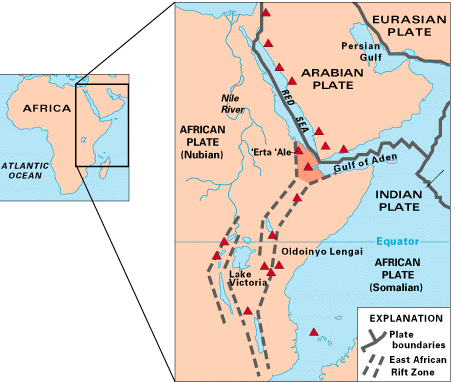
A narrow zone, the rift is a developing divergent tectonic plate boundary where the African plate is in the process of splitting into two tectonic plates, called the Somali plate and the Nubian plate, at a rate of 6–7 mm (0.24–0.28 in) per year. The rift system consists of three microplates, the Victoria microplate to the north, and the Rovuma and Lwandle microplates to the south. The Victoria microplate is rotating anti-clockwise with respect to the African plate. Its rotation is caused by the configuration of mechanically weaker and stronger lithospheric regions in the EARS.
Many of the African Great Lakes lie within the Rift Valley.
A series of distinct rift basins, the East African Rift System extends over thousands of kilometers. North of the Afar triple junction, the rift follows two paths: west to the Red Sea Rift and east to the Aden Ridge in the Gulf of Aden.
Southward from the Afar triple junction, the EAR consists of two main branches. The Eastern Rift Valley (also known as Gregory Rift) includes the Main Ethiopian Rift, runs southward from the Afar triple junction, and continues south as the Kenyan Rift Valley, into northern Tanzania. The Western Rift Valley includes the Albertine Rift, which transects Congo DR, Uganda, Rwanda, Burundi, and farther south Tanzania, Zambia, the valley of Lake Malawi and Mozambique.
The rift also continues offshore from the coast of Mozambique along the Kerimba and Lacerda grabens, which are joined by the Davie Ridge, a 2,200 km-long (1,400 mi) relic fracture zone that cuts across the West Somali basin, straddling the boundary between Tanzania and Mozambique. The Davie Ridge ranges between 30–120 km (19–75 mi) wide, with a west-facing scarp (east-plunging arch) along the southern half of its length that rises to 2,300 m (7,500 ft) above the sea floor. Its movement is concurrent with the EAR.
Over time, many theories have tried to clarify the evolution of the East African Rift. In 1972 it was proposed that the EAR was not caused by tectonic activity, but rather by differences in crustal density. Since the 1990s, evidence has been found in favor of mantle plumes beneath the EAR. Others proposed an African superplume causing mantle deformation. Although the effects of deep-rooted mantle plumes are an important hypothesis, their location and dynamics are poorly understood, and a matter of active research. The question is still debated.
The most recent and accepted view is the theory put forth in 2009: that magmatism and plate tectonics have a feedback with one another, controlled by oblique rifting conditions. According to this theory, lithospheric thinning generates volcanic activity, further increasing magmatic processes such as intrusions and numerous small plumes. These processes further thin the lithosphere in saturated areas, making the thinning lithosphere behave like a mid-ocean ridge. According to marine geologist Kathleen Crane, the rift could eventually cause eastern Africa to separate from the mainland, although this potential event could take tens of millions of years.
East African Rift
The East African Rift (EAR) or East African Rift System (EARS) is an active continental rift zone in East Africa. The EAR began developing around the onset of the Miocene, 22–25 million years ago. It was formerly considered to be part of a larger Great Rift Valley that extended north to Asia Minor.
A narrow zone, the rift is a developing divergent tectonic plate boundary where the African plate is in the process of splitting into two tectonic plates, called the Somali plate and the Nubian plate, at a rate of 6–7 mm (0.24–0.28 in) per year. The rift system consists of three microplates, the Victoria microplate to the north, and the Rovuma and Lwandle microplates to the south. The Victoria microplate is rotating anti-clockwise with respect to the African plate. Its rotation is caused by the configuration of mechanically weaker and stronger lithospheric regions in the EARS.
Many of the African Great Lakes lie within the Rift Valley.
A series of distinct rift basins, the East African Rift System extends over thousands of kilometers. North of the Afar triple junction, the rift follows two paths: west to the Red Sea Rift and east to the Aden Ridge in the Gulf of Aden.
Southward from the Afar triple junction, the EAR consists of two main branches. The Eastern Rift Valley (also known as Gregory Rift) includes the Main Ethiopian Rift, runs southward from the Afar triple junction, and continues south as the Kenyan Rift Valley, into northern Tanzania. The Western Rift Valley includes the Albertine Rift, which transects Congo DR, Uganda, Rwanda, Burundi, and farther south Tanzania, Zambia, the valley of Lake Malawi and Mozambique.
The rift also continues offshore from the coast of Mozambique along the Kerimba and Lacerda grabens, which are joined by the Davie Ridge, a 2,200 km-long (1,400 mi) relic fracture zone that cuts across the West Somali basin, straddling the boundary between Tanzania and Mozambique. The Davie Ridge ranges between 30–120 km (19–75 mi) wide, with a west-facing scarp (east-plunging arch) along the southern half of its length that rises to 2,300 m (7,500 ft) above the sea floor. Its movement is concurrent with the EAR.
Over time, many theories have tried to clarify the evolution of the East African Rift. In 1972 it was proposed that the EAR was not caused by tectonic activity, but rather by differences in crustal density. Since the 1990s, evidence has been found in favor of mantle plumes beneath the EAR. Others proposed an African superplume causing mantle deformation. Although the effects of deep-rooted mantle plumes are an important hypothesis, their location and dynamics are poorly understood, and a matter of active research. The question is still debated.
The most recent and accepted view is the theory put forth in 2009: that magmatism and plate tectonics have a feedback with one another, controlled by oblique rifting conditions. According to this theory, lithospheric thinning generates volcanic activity, further increasing magmatic processes such as intrusions and numerous small plumes. These processes further thin the lithosphere in saturated areas, making the thinning lithosphere behave like a mid-ocean ridge. According to marine geologist Kathleen Crane, the rift could eventually cause eastern Africa to separate from the mainland, although this potential event could take tens of millions of years.
Recent media
Recent media