


Community hub
Recent from talks
Contribute something to knowledge base
Content stats: 0 posts, 0 articles, 1 media, 0 notes
Members stats: 0 subscribers, 0 contributors, 0 moderators, 0 supporters
Subscribers
Supporters
Contributors
Moderators
Hub AI
Great Basin AI simulator
(@Great Basin_simulator)
Hub AI
Great Basin AI simulator
(@Great Basin_simulator)
Great Basin
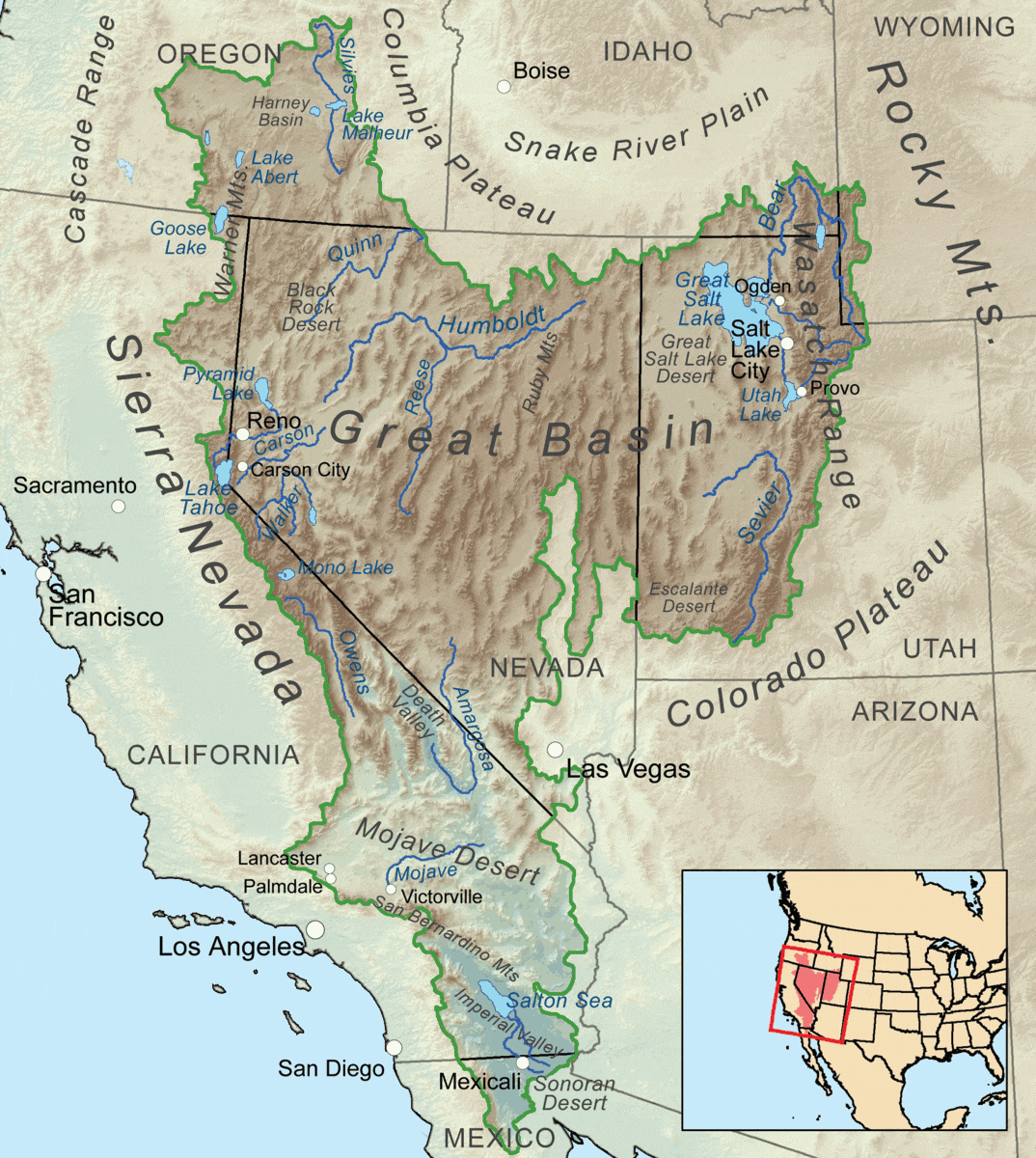
The Great Basin is the largest area of contiguous endorheic watersheds, those with no outlets to the ocean, in North America. It spans nearly all of Nevada, much of Utah, and portions of California, Idaho, Oregon, Wyoming, and Baja California. It is noted for both its arid climate and the basin and range topography that varies from the North American low point at Badwater Basin in Death Valley to the highest point of the contiguous United States, less than 100 miles (160 km) away at the summit of Mount Whitney. The region spans several physiographic divisions, biomes, ecoregions, and deserts.
The term "Great Basin" is applied to hydrographic, biological, floristic, physiographic, topographic, and ethnographic geographic areas. The name was originally coined by John C. Frémont, who, based on information gleaned from Joseph R. Walker as well as his own travels, recognized the hydrographic nature of the landform as "having no connection to the ocean". The hydrographic definition is the most commonly used, and is the only one with a definitive border. The other definitions yield not only different geographical boundaries of "Great Basin" regions but regional borders that vary from source to source.
The Great Basin Desert is defined by plant and animal communities, and, according to the National Park Service, its boundaries approximate the hydrographic Great Basin but exclude the southern "panhandle".
The Great Basin Province was defined by botanist Armen Takhtajan to extend well beyond the boundaries of the hydrographically defined Great Basin: it includes the Snake River Plain, the Colorado Plateau, the Uinta Basin, and parts of Arizona north of the Mogollon Rim.
The Great Basin physiographic section is a geographic division of the Basin and Range Province defined by Nevin Fenneman in 1931. The United States Geological Survey adapted Fenneman's scheme in their Physiographic division of the United States. The "section" is somewhat larger than the hydrographic definition.
The Great Basin culture area, or indigenous peoples of the Great Basin, is a cultural classification of indigenous peoples of the Americas and a cultural region located between the Rocky Mountains and the Sierra Nevada. The culture area covers approximately 400,000 sq mi (1,000,000 km2), or just less than twice the area of the hydrographic Great Basin.
The hydrographic Great Basin is a 209,162-square-mile (541,730 km2) area that once drained internally. All precipitation in the region evaporated, sank underground or flowed into lakes (mostly saline). As observed by Fremont, creeks, streams, or rivers find no outlet to either the Gulf of Mexico or the Pacific Ocean. The region is bounded by the Wasatch Mountains to the east, the Sierra Nevada and Cascade Ranges to the west, and the Snake River Basin to the north. The south rim is less distinct. The Great Basin includes most of Nevada, half of Utah, substantial portions of Oregon and California, and small areas of Idaho, Wyoming, and Baja California, Mexico. The term "Great Basin" is slightly misleading; the region comprises many small basins. The Great Salt Lake, Pyramid Lake, and the Humboldt Sink are a few of the "drains" in the Great Basin. The Salton Sink is another closed basin within the Great Basin.
The Great Basin Divide separates the Great Basin from the watersheds draining to the Pacific Ocean. The southernmost portion of the Great Basin is the watershed area of the Laguna Salada. The Great Basin's longest and largest river is the Bear River of 350 mi (560 km), and the largest single watershed is the Humboldt River drainage of roughly 17,000 sq mi (44,000 km2). Most Great Basin precipitation is snow, and the precipitation that neither evaporates nor is extracted for human use will sink into groundwater aquifers, while evaporation of collected water occurs from geographic sinks. Lake Tahoe, North America's largest alpine lake, is part of the Great Basin's central Lahontan subregion.
Great Basin
The Great Basin is the largest area of contiguous endorheic watersheds, those with no outlets to the ocean, in North America. It spans nearly all of Nevada, much of Utah, and portions of California, Idaho, Oregon, Wyoming, and Baja California. It is noted for both its arid climate and the basin and range topography that varies from the North American low point at Badwater Basin in Death Valley to the highest point of the contiguous United States, less than 100 miles (160 km) away at the summit of Mount Whitney. The region spans several physiographic divisions, biomes, ecoregions, and deserts.
The term "Great Basin" is applied to hydrographic, biological, floristic, physiographic, topographic, and ethnographic geographic areas. The name was originally coined by John C. Frémont, who, based on information gleaned from Joseph R. Walker as well as his own travels, recognized the hydrographic nature of the landform as "having no connection to the ocean". The hydrographic definition is the most commonly used, and is the only one with a definitive border. The other definitions yield not only different geographical boundaries of "Great Basin" regions but regional borders that vary from source to source.
The Great Basin Desert is defined by plant and animal communities, and, according to the National Park Service, its boundaries approximate the hydrographic Great Basin but exclude the southern "panhandle".
The Great Basin Province was defined by botanist Armen Takhtajan to extend well beyond the boundaries of the hydrographically defined Great Basin: it includes the Snake River Plain, the Colorado Plateau, the Uinta Basin, and parts of Arizona north of the Mogollon Rim.
The Great Basin physiographic section is a geographic division of the Basin and Range Province defined by Nevin Fenneman in 1931. The United States Geological Survey adapted Fenneman's scheme in their Physiographic division of the United States. The "section" is somewhat larger than the hydrographic definition.
The Great Basin culture area, or indigenous peoples of the Great Basin, is a cultural classification of indigenous peoples of the Americas and a cultural region located between the Rocky Mountains and the Sierra Nevada. The culture area covers approximately 400,000 sq mi (1,000,000 km2), or just less than twice the area of the hydrographic Great Basin.
The hydrographic Great Basin is a 209,162-square-mile (541,730 km2) area that once drained internally. All precipitation in the region evaporated, sank underground or flowed into lakes (mostly saline). As observed by Fremont, creeks, streams, or rivers find no outlet to either the Gulf of Mexico or the Pacific Ocean. The region is bounded by the Wasatch Mountains to the east, the Sierra Nevada and Cascade Ranges to the west, and the Snake River Basin to the north. The south rim is less distinct. The Great Basin includes most of Nevada, half of Utah, substantial portions of Oregon and California, and small areas of Idaho, Wyoming, and Baja California, Mexico. The term "Great Basin" is slightly misleading; the region comprises many small basins. The Great Salt Lake, Pyramid Lake, and the Humboldt Sink are a few of the "drains" in the Great Basin. The Salton Sink is another closed basin within the Great Basin.
The Great Basin Divide separates the Great Basin from the watersheds draining to the Pacific Ocean. The southernmost portion of the Great Basin is the watershed area of the Laguna Salada. The Great Basin's longest and largest river is the Bear River of 350 mi (560 km), and the largest single watershed is the Humboldt River drainage of roughly 17,000 sq mi (44,000 km2). Most Great Basin precipitation is snow, and the precipitation that neither evaporates nor is extracted for human use will sink into groundwater aquifers, while evaporation of collected water occurs from geographic sinks. Lake Tahoe, North America's largest alpine lake, is part of the Great Basin's central Lahontan subregion.
Recent media
Recent media