



Community hub
Recent from talks
Knowledge base stats:
Talk channels stats:
Members stats:
1925 serum run to Nome
The 1925 serum run to Nome, also known as the Great Race of Mercy and The Serum Run, was a transport of diphtheria antitoxin by dog sled relay across the US territory of Alaska by 20 mushers and about 150 sled dogs across 674 miles (1,085 km) in 5+1⁄2 days, saving the small town of Nome and the surrounding communities from a developing epidemic of diphtheria.
Both the mushers and their dogs were portrayed as heroes in the newly popular medium of radio and received headline coverage in newspapers across the United States. Balto, the lead sled dog on the final stretch into Nome, became the most famous canine celebrity of the era after Rin Tin Tin, and his statue is a popular tourist attraction in both New York City's Central Park and downtown Anchorage, Alaska. Togo's team covered much of the most dangerous parts of the route and ran the farthest: Togo's team covered 261 miles (420 km) while Balto's team ran 55 miles (89 km).
Nome, Alaska, lies approximately two degrees south of the Arctic Circle, and while greatly diminished from its peak of 20,000 inhabitants during the Nome Gold Rush at the turn of the 20th century, it was still the largest town in northern Alaska in 1925, with 455 Alaska Natives and 975 settlers of European descent.
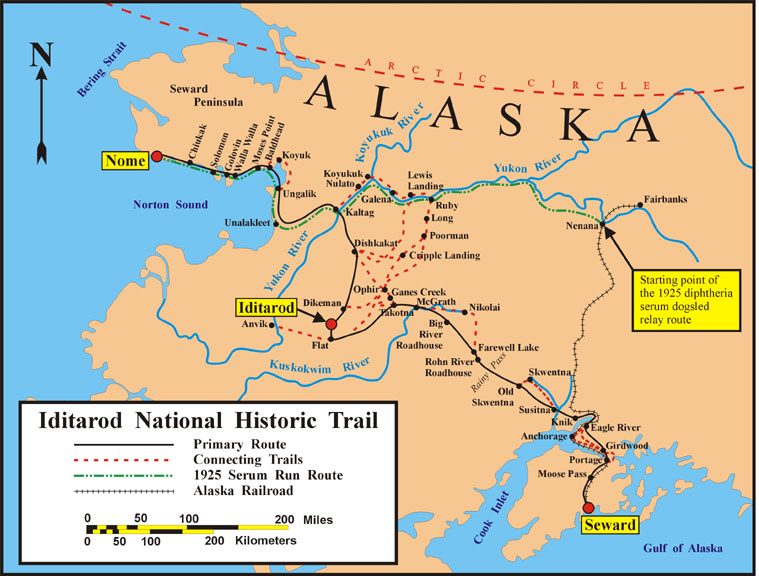
From November to July, the port on the southern shore of the Seward Peninsula of the Bering Sea was icebound and inaccessible by steamship. The only link to the rest of the world during the winter was the Iditarod Trail, which ran 938 miles (1,510 km) from the port of Seward in the south, across several mountain ranges and the vast Alaska Interior, to the town of Nome. In Alaska and other subarctic regions, the primary source of mail and needed supplies in 1925 was the dog sled. Within a decade, bush flying became the dominant method of transportation during the winter months.
In the winter of 1924–1925, Curtis Welch was the only doctor in Nome. He and four nurses, working at the small Maynard Columbus Hospital, served the town and the surrounding area. After discovering the hospital's entire batch of diphtheria antitoxin had expired, Welch placed an order for more. However, the replacement shipment did not arrive before the port was closed by ice for the winter, and more could not be shipped in to Nome until spring.
In December 1924, several days after the last ship left the port, Welch treated a few children for what he first diagnosed as sore throats or tonsillitis, initially dismissing diphtheria as a possibility; given its contagious nature, Welch would have expected to see more symptoms in family members or others around town, instead of a few isolated cases. In the next few weeks, after the number of cases grew and four children were dead—whom Welch had not been able to autopsy—he became increasingly concerned about diphtheria.
By mid-January 1925, Welch officially diagnosed the first case of diphtheria in a three-year-old boy who died only two weeks after first becoming ill. The following day, when a seven-year-old girl presented the same symptoms of diphtheria, Welch attempted to administer some of the expired antitoxin to see if it might still have any effect, but the girl died a few hours later. Realizing that an epidemic was imminent, Welch called Nome's mayor, George Maynard, that same evening to arrange an emergency town council meeting. The council immediately implemented a quarantine. The following day, on January 22, 1925, Welch sent radio telegrams to all other major towns in Alaska alerting them of the public health risk. He also requested assistance from the U.S. Public Health Service in Washington, D.C.:
An epidemic of diphtheria is almost inevitable here STOP I am in urgent need of one million units of diphtheria antitoxin STOP Mail is only form of transportation STOP I have made application to Commissioner of Health of the Territories for antitoxin already STOP There are about 3000 white natives in the district.
Hub AI
1925 serum run to Nome AI simulator
(@1925 serum run to Nome_simulator)
1925 serum run to Nome
The 1925 serum run to Nome, also known as the Great Race of Mercy and The Serum Run, was a transport of diphtheria antitoxin by dog sled relay across the US territory of Alaska by 20 mushers and about 150 sled dogs across 674 miles (1,085 km) in 5+1⁄2 days, saving the small town of Nome and the surrounding communities from a developing epidemic of diphtheria.
Both the mushers and their dogs were portrayed as heroes in the newly popular medium of radio and received headline coverage in newspapers across the United States. Balto, the lead sled dog on the final stretch into Nome, became the most famous canine celebrity of the era after Rin Tin Tin, and his statue is a popular tourist attraction in both New York City's Central Park and downtown Anchorage, Alaska. Togo's team covered much of the most dangerous parts of the route and ran the farthest: Togo's team covered 261 miles (420 km) while Balto's team ran 55 miles (89 km).
Nome, Alaska, lies approximately two degrees south of the Arctic Circle, and while greatly diminished from its peak of 20,000 inhabitants during the Nome Gold Rush at the turn of the 20th century, it was still the largest town in northern Alaska in 1925, with 455 Alaska Natives and 975 settlers of European descent.
From November to July, the port on the southern shore of the Seward Peninsula of the Bering Sea was icebound and inaccessible by steamship. The only link to the rest of the world during the winter was the Iditarod Trail, which ran 938 miles (1,510 km) from the port of Seward in the south, across several mountain ranges and the vast Alaska Interior, to the town of Nome. In Alaska and other subarctic regions, the primary source of mail and needed supplies in 1925 was the dog sled. Within a decade, bush flying became the dominant method of transportation during the winter months.
In the winter of 1924–1925, Curtis Welch was the only doctor in Nome. He and four nurses, working at the small Maynard Columbus Hospital, served the town and the surrounding area. After discovering the hospital's entire batch of diphtheria antitoxin had expired, Welch placed an order for more. However, the replacement shipment did not arrive before the port was closed by ice for the winter, and more could not be shipped in to Nome until spring.
In December 1924, several days after the last ship left the port, Welch treated a few children for what he first diagnosed as sore throats or tonsillitis, initially dismissing diphtheria as a possibility; given its contagious nature, Welch would have expected to see more symptoms in family members or others around town, instead of a few isolated cases. In the next few weeks, after the number of cases grew and four children were dead—whom Welch had not been able to autopsy—he became increasingly concerned about diphtheria.
By mid-January 1925, Welch officially diagnosed the first case of diphtheria in a three-year-old boy who died only two weeks after first becoming ill. The following day, when a seven-year-old girl presented the same symptoms of diphtheria, Welch attempted to administer some of the expired antitoxin to see if it might still have any effect, but the girl died a few hours later. Realizing that an epidemic was imminent, Welch called Nome's mayor, George Maynard, that same evening to arrange an emergency town council meeting. The council immediately implemented a quarantine. The following day, on January 22, 1925, Welch sent radio telegrams to all other major towns in Alaska alerting them of the public health risk. He also requested assistance from the U.S. Public Health Service in Washington, D.C.:
An epidemic of diphtheria is almost inevitable here STOP I am in urgent need of one million units of diphtheria antitoxin STOP Mail is only form of transportation STOP I have made application to Commissioner of Health of the Territories for antitoxin already STOP There are about 3000 white natives in the district.