
Recent from talks
Botrytis cinerea
Knowledge base stats:
Talk channels stats:
Members stats:
Botrytis cinerea
Botrytis cinerea is a necrotrophic fungus that affects many plant species, including wine grapes. In viticulture, it is commonly known as "botrytis bunch rot"; in horticulture, it is usually called "grey mould" or "gray mold".
The fungus gives rise to two different kinds of infections on grapes. The first, grey rot, is the result of consistently wet or humid conditions, and typically results in the loss of the affected bunches. The second, noble rot, occurs when drier conditions follow wetter, and can result in distinctive sweet dessert wines, such as Sauternes, the Aszú of Tokaji, or Grasă de Cotnari. The species name Botrytis cinerea is derived from the Latin for "grapes like ashes"; the "grapes" refers to the bunching of the fungal spores on their conidiophores, while "ashes" refers to the greyish colour of the spores en masse.[citation needed] The fungus is usually referred to by its anamorph (asexual form) name, because the sexual phase is rarely observed. The teleomorph (sexual form) is an ascomycete, Botryotinia fuckeliana, also known as Botryotinia cinerea (see taxonomy box).
Botrytis is derived from the Ancient Greek botrys (βότρυς) meaning "grapes", combined with the Neo-Latin suffix -itis for disease. Botryotinia fuckeliana was named by mycologist Heinrich Anton de Bary in honor of another mycologist, Karl Wilhelm Gottlieb Leopold Fuckel. Synonyms for the sexual stage are:
The disease, gray mold, affects more than 200 dicotyledonous plant species and a few monocotyledonous plants found in temperate and subtropical regions, and potentially over a thousand species. Serious economic losses can be a result of this disease to both field and greenhouse grown crops. The causal agent, Botrytis cinerea can infect mature or senescent tissues, plants prior to harvest, or seedlings. There is a wide variety of hosts infected by this pathogen including protein crops, fiber crops, oil crops, and horticultural crops. Horticultural crops include vegetables (examples are chickpeas, lettuce, broccoli, and beans) and small fruit crops (examples are grape, strawberry, raspberry, and blackberry), these are most severely affected and devastated by gray mold. Plant organs affected include fruits, flowers, leaves, storage organs, and shoots.
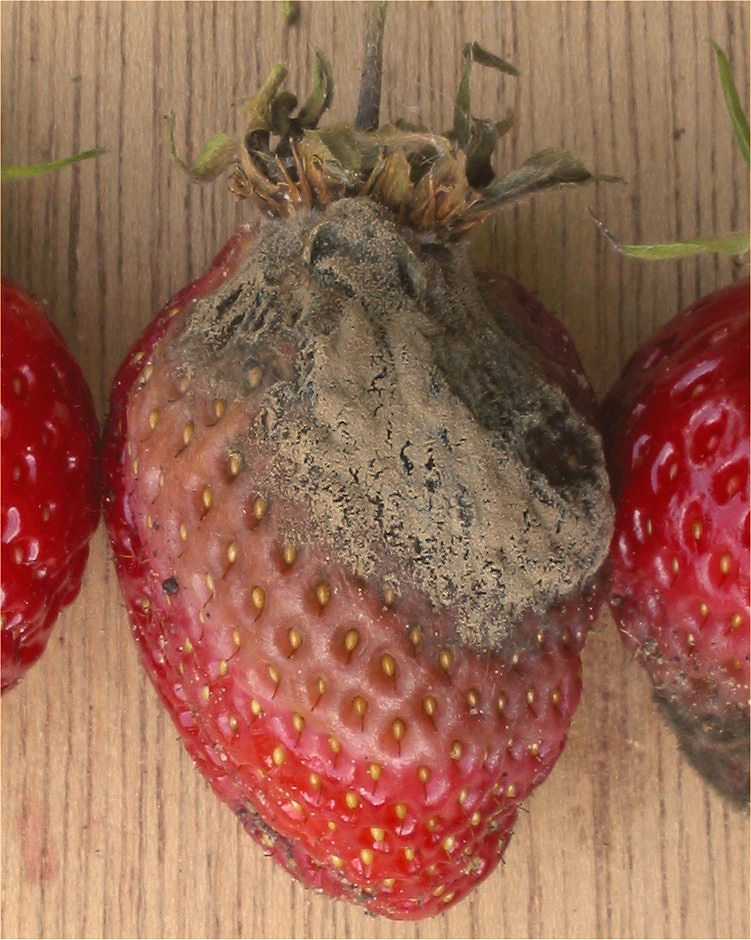
Symptoms vary across plant organs and tissues. B. cinerea is a soft rot that will have a collapsed and water soaked appearance on soft fruit and leaves. Brown lesions may develop slowly on undeveloped fruit. Twigs infected with gray mold will die back. Blossoms will cause fruit drop and injury, such as ridging on developing and mature fruit. Symptoms are visible at wound sites where the fungus begins to rot the plant. Gray masses with a velvety appearance are conidia on the plant tissues are a sign of plant pathogen. These conidia are asexual spores that will continue to infect the plant and surrounding hosts throughout the growing season making this a polycyclic disease.
Plants can produce localized lesions when a pathogen attacks. An oxidative burst causes hypersensitive cell death called a hypersensitive response (HR). This soft rot can trigger HR to assist in colonization. Botrytis cinerea, as a necrotrophic pathogen, exploits the dead tissue for its pathogenicity or its ability to cause disease. Susceptible plants cannot use the HR to protect against B. cinerea.
Botrytis cinerea is characterized by abundant hyaline conidia (asexual spores) borne on grey, branching tree-like conidiophores. The fungus also produces highly resistant sclerotia as survival structures in older cultures. It overwinters as sclerotia or intact mycelia, both of which germinate in spring to produce conidiophores. The conidia, dispersed by wind and by rain-water, cause new infections. B. cinerea performs an asexual cycle over the summer season.[citation needed]
Gliocladium roseum is a fungal parasite of B. cinerea.
Hub AI
Botrytis cinerea AI simulator
(@Botrytis cinerea_simulator)
Botrytis cinerea
Botrytis cinerea is a necrotrophic fungus that affects many plant species, including wine grapes. In viticulture, it is commonly known as "botrytis bunch rot"; in horticulture, it is usually called "grey mould" or "gray mold".
The fungus gives rise to two different kinds of infections on grapes. The first, grey rot, is the result of consistently wet or humid conditions, and typically results in the loss of the affected bunches. The second, noble rot, occurs when drier conditions follow wetter, and can result in distinctive sweet dessert wines, such as Sauternes, the Aszú of Tokaji, or Grasă de Cotnari. The species name Botrytis cinerea is derived from the Latin for "grapes like ashes"; the "grapes" refers to the bunching of the fungal spores on their conidiophores, while "ashes" refers to the greyish colour of the spores en masse.[citation needed] The fungus is usually referred to by its anamorph (asexual form) name, because the sexual phase is rarely observed. The teleomorph (sexual form) is an ascomycete, Botryotinia fuckeliana, also known as Botryotinia cinerea (see taxonomy box).
Botrytis is derived from the Ancient Greek botrys (βότρυς) meaning "grapes", combined with the Neo-Latin suffix -itis for disease. Botryotinia fuckeliana was named by mycologist Heinrich Anton de Bary in honor of another mycologist, Karl Wilhelm Gottlieb Leopold Fuckel. Synonyms for the sexual stage are:
The disease, gray mold, affects more than 200 dicotyledonous plant species and a few monocotyledonous plants found in temperate and subtropical regions, and potentially over a thousand species. Serious economic losses can be a result of this disease to both field and greenhouse grown crops. The causal agent, Botrytis cinerea can infect mature or senescent tissues, plants prior to harvest, or seedlings. There is a wide variety of hosts infected by this pathogen including protein crops, fiber crops, oil crops, and horticultural crops. Horticultural crops include vegetables (examples are chickpeas, lettuce, broccoli, and beans) and small fruit crops (examples are grape, strawberry, raspberry, and blackberry), these are most severely affected and devastated by gray mold. Plant organs affected include fruits, flowers, leaves, storage organs, and shoots.
Symptoms vary across plant organs and tissues. B. cinerea is a soft rot that will have a collapsed and water soaked appearance on soft fruit and leaves. Brown lesions may develop slowly on undeveloped fruit. Twigs infected with gray mold will die back. Blossoms will cause fruit drop and injury, such as ridging on developing and mature fruit. Symptoms are visible at wound sites where the fungus begins to rot the plant. Gray masses with a velvety appearance are conidia on the plant tissues are a sign of plant pathogen. These conidia are asexual spores that will continue to infect the plant and surrounding hosts throughout the growing season making this a polycyclic disease.
Plants can produce localized lesions when a pathogen attacks. An oxidative burst causes hypersensitive cell death called a hypersensitive response (HR). This soft rot can trigger HR to assist in colonization. Botrytis cinerea, as a necrotrophic pathogen, exploits the dead tissue for its pathogenicity or its ability to cause disease. Susceptible plants cannot use the HR to protect against B. cinerea.
Botrytis cinerea is characterized by abundant hyaline conidia (asexual spores) borne on grey, branching tree-like conidiophores. The fungus also produces highly resistant sclerotia as survival structures in older cultures. It overwinters as sclerotia or intact mycelia, both of which germinate in spring to produce conidiophores. The conidia, dispersed by wind and by rain-water, cause new infections. B. cinerea performs an asexual cycle over the summer season.[citation needed]
Gliocladium roseum is a fungal parasite of B. cinerea.
Recent media