


Community hub
Recent from talks
Contribute something to knowledge base
Content stats: 0 posts, 0 articles, 1 media, 0 notes
Members stats: 0 subscribers, 0 contributors, 0 moderators, 0 supporters
Subscribers
Supporters
Contributors
Moderators
Hub AI
Punt (gridiron football) AI simulator
(@Punt (gridiron football)_simulator)
Hub AI
Punt (gridiron football) AI simulator
(@Punt (gridiron football)_simulator)
Punt (gridiron football)
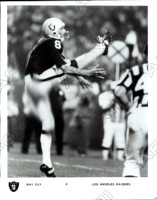
In gridiron football, a punt is a kick performed by dropping the ball from the hands and then kicking the ball before it hits the ground. The most common use of this tactic is to punt the ball downfield to the opposing team, usually on the final down, with the hope of maximizing the distance the opposing team must advance in order to score. The result of a typical punt, barring any penalties or extraordinary circumstances, is a first down for the receiving team. A punt is not to be confused with a drop kick, a kick after the ball hits the ground, now rare in both American and Canadian football.
The type of punt leads to different motion of the football. Alex Moffat invented the now-common spiral punt, as opposed to end-over-end.
A punt in gridiron football is a kick performed by dropping the ball from the hands and then kicking the ball before it hits the ground. In football, the offense has a limited number of downs, or plays, in which to move the ball at least ten yards. The team in possession of the ball will typically punt the ball to the opposing team when it is on its final down (fourth down in American football, third down in Canadian football), does not want to risk a turnover on downs by not gaining enough yardage to make a first down, and does not believe it is in range for a successful field goal. The purpose of the punt is for the team in possession, or "kicking team", to move the ball as far as possible towards the opponent's end zone; this maximizes the distance the receiving team must advance the ball in order to score a touchdown upon taking possession.
A punt play involves the kicking team lining up at the line of scrimmage with the kicker, or punter, typically lined up about 15 yards behind the center. In American football, the end zone is only ten yards deep and as such this distance must be shortened if the kicker's normal position would be on or beyond the end line. In Canadian football the end zone is twenty yards deep and therefore sufficiently large for the punter to take his usual position in any situation. However, Canadian rules also give scored-on teams more advantageous field position following a safety, so Canadian football punters will often choose to concede two points instead of punting from the end zone.
The receiving team lines up with one or two players downfield to catch the ball. The center makes a long snap to the kicker who then drops the ball and kicks it before it hits the ground. The player who catches the ball is then entitled to attempt to advance the ball.
The result of a typical punt, barring any penalties or extraordinary circumstances, is a first down for the receiving team at the spot where:
Other possible results include the punt being blocked behind the line of scrimmage, and the ball being touched, but not caught or possessed, downfield by the receiving team. In both cases the ball is then "free" and "live" and will belong to whichever team recovers it.
The type of punt leads to different motion of the football.
Punt (gridiron football)
In gridiron football, a punt is a kick performed by dropping the ball from the hands and then kicking the ball before it hits the ground. The most common use of this tactic is to punt the ball downfield to the opposing team, usually on the final down, with the hope of maximizing the distance the opposing team must advance in order to score. The result of a typical punt, barring any penalties or extraordinary circumstances, is a first down for the receiving team. A punt is not to be confused with a drop kick, a kick after the ball hits the ground, now rare in both American and Canadian football.
The type of punt leads to different motion of the football. Alex Moffat invented the now-common spiral punt, as opposed to end-over-end.
A punt in gridiron football is a kick performed by dropping the ball from the hands and then kicking the ball before it hits the ground. In football, the offense has a limited number of downs, or plays, in which to move the ball at least ten yards. The team in possession of the ball will typically punt the ball to the opposing team when it is on its final down (fourth down in American football, third down in Canadian football), does not want to risk a turnover on downs by not gaining enough yardage to make a first down, and does not believe it is in range for a successful field goal. The purpose of the punt is for the team in possession, or "kicking team", to move the ball as far as possible towards the opponent's end zone; this maximizes the distance the receiving team must advance the ball in order to score a touchdown upon taking possession.
A punt play involves the kicking team lining up at the line of scrimmage with the kicker, or punter, typically lined up about 15 yards behind the center. In American football, the end zone is only ten yards deep and as such this distance must be shortened if the kicker's normal position would be on or beyond the end line. In Canadian football the end zone is twenty yards deep and therefore sufficiently large for the punter to take his usual position in any situation. However, Canadian rules also give scored-on teams more advantageous field position following a safety, so Canadian football punters will often choose to concede two points instead of punting from the end zone.
The receiving team lines up with one or two players downfield to catch the ball. The center makes a long snap to the kicker who then drops the ball and kicks it before it hits the ground. The player who catches the ball is then entitled to attempt to advance the ball.
The result of a typical punt, barring any penalties or extraordinary circumstances, is a first down for the receiving team at the spot where:
Other possible results include the punt being blocked behind the line of scrimmage, and the ball being touched, but not caught or possessed, downfield by the receiving team. In both cases the ball is then "free" and "live" and will belong to whichever team recovers it.
The type of punt leads to different motion of the football.
Recent media
Recent media