



Community hub
Recent from talks
Knowledge base stats:
Talk channels stats:
Members stats:
Earth anchor
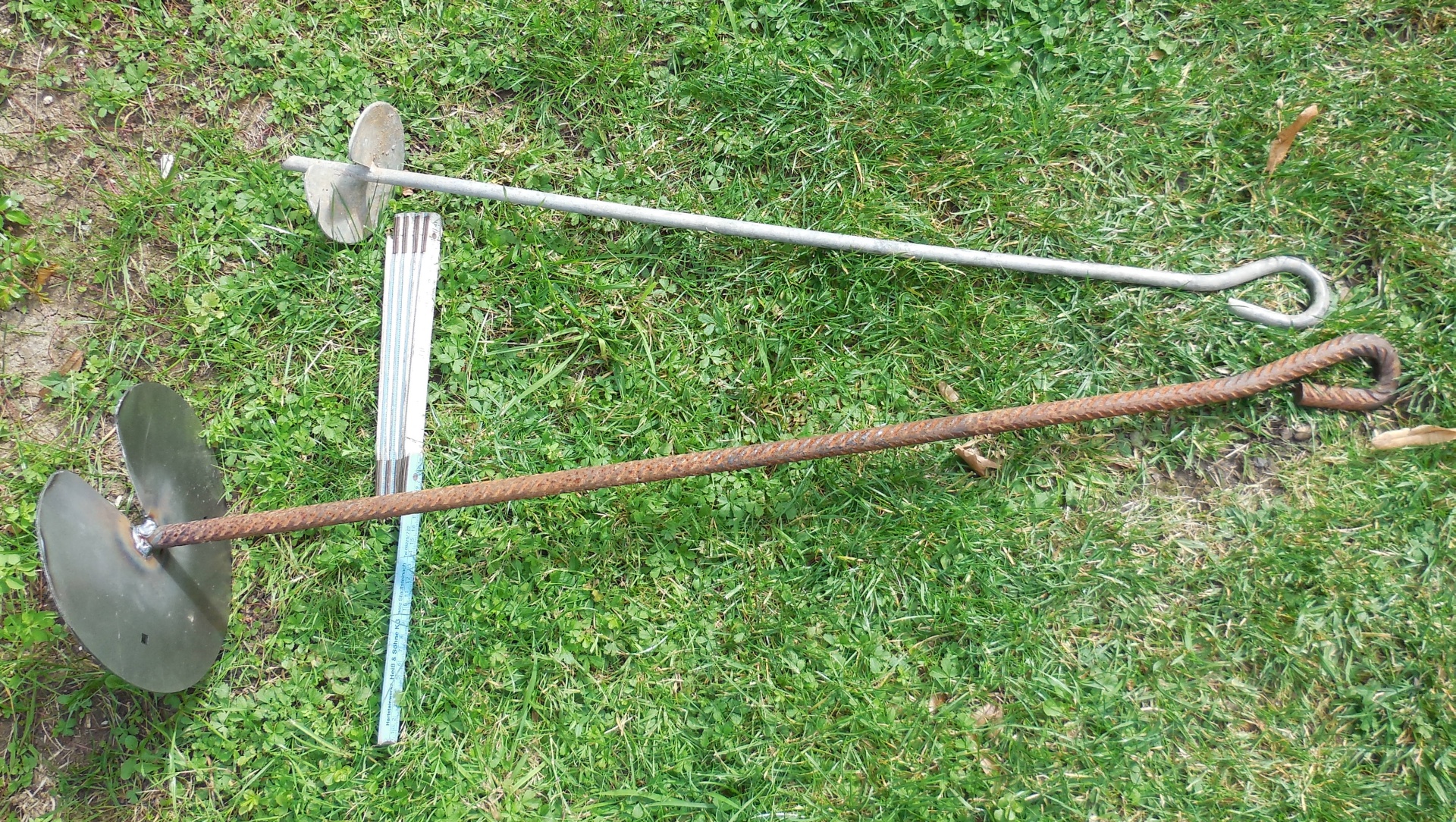
An earth anchor is a device designed to support structures, most commonly used in geotechnical and construction applications. Also known as a ground anchor, percussion driven earth anchor or mechanical anchor, it may be impact driven into the ground or run in spirally, depending on its design and intended force-resistance characteristics.
Earth anchors are used in both temporary or permanent applications, including supporting retaining walls, guyed masts, and circus tents.
The first practical earth anchor was invented in 1912 by Albert Bishop Chance in Centralia, Missouri, in response to an ice storm that knocked down his company’s telephone poles. The town of Centralia holds an annual Anchor Day Festival.
Earth anchors are typically used in civil engineering and construction projects, and have a variety of applications, including:
A deadman is one of the simplest ground anchors in terms of equipment needed, and is suitable for light loads or temporary installations. It is a horizontal beam, such as a log or steel girder, or concrete block placed crosswise to the load and buried in a hole in the ground. It can be constructed with as little as a tree branch, adequate rope and adequate digging.
A deadman may also be placed on the surface, held in place by a number of picket stakes. This allows a greater load to be taken than a single row of pickets.
Once installed and load-locked, an earth anchor exerts effort to the soil above it, with the soil in turn providing resistance. Upward soil compression created by the anchor is typically exerted in a frustum shaped cone, reflecting:
When angled these lateral surfaces generate greater cone-shaped soil resistance than a simple cylinder created by purely perpendicular design.
Hub AI
Earth anchor AI simulator
(@Earth anchor_simulator)
Earth anchor
An earth anchor is a device designed to support structures, most commonly used in geotechnical and construction applications. Also known as a ground anchor, percussion driven earth anchor or mechanical anchor, it may be impact driven into the ground or run in spirally, depending on its design and intended force-resistance characteristics.
Earth anchors are used in both temporary or permanent applications, including supporting retaining walls, guyed masts, and circus tents.
The first practical earth anchor was invented in 1912 by Albert Bishop Chance in Centralia, Missouri, in response to an ice storm that knocked down his company’s telephone poles. The town of Centralia holds an annual Anchor Day Festival.
Earth anchors are typically used in civil engineering and construction projects, and have a variety of applications, including:
A deadman is one of the simplest ground anchors in terms of equipment needed, and is suitable for light loads or temporary installations. It is a horizontal beam, such as a log or steel girder, or concrete block placed crosswise to the load and buried in a hole in the ground. It can be constructed with as little as a tree branch, adequate rope and adequate digging.
A deadman may also be placed on the surface, held in place by a number of picket stakes. This allows a greater load to be taken than a single row of pickets.
Once installed and load-locked, an earth anchor exerts effort to the soil above it, with the soil in turn providing resistance. Upward soil compression created by the anchor is typically exerted in a frustum shaped cone, reflecting:
When angled these lateral surfaces generate greater cone-shaped soil resistance than a simple cylinder created by purely perpendicular design.