
Recent from talks
Guachichil
Knowledge base stats:
Talk channels stats:
Members stats:
Guachichil
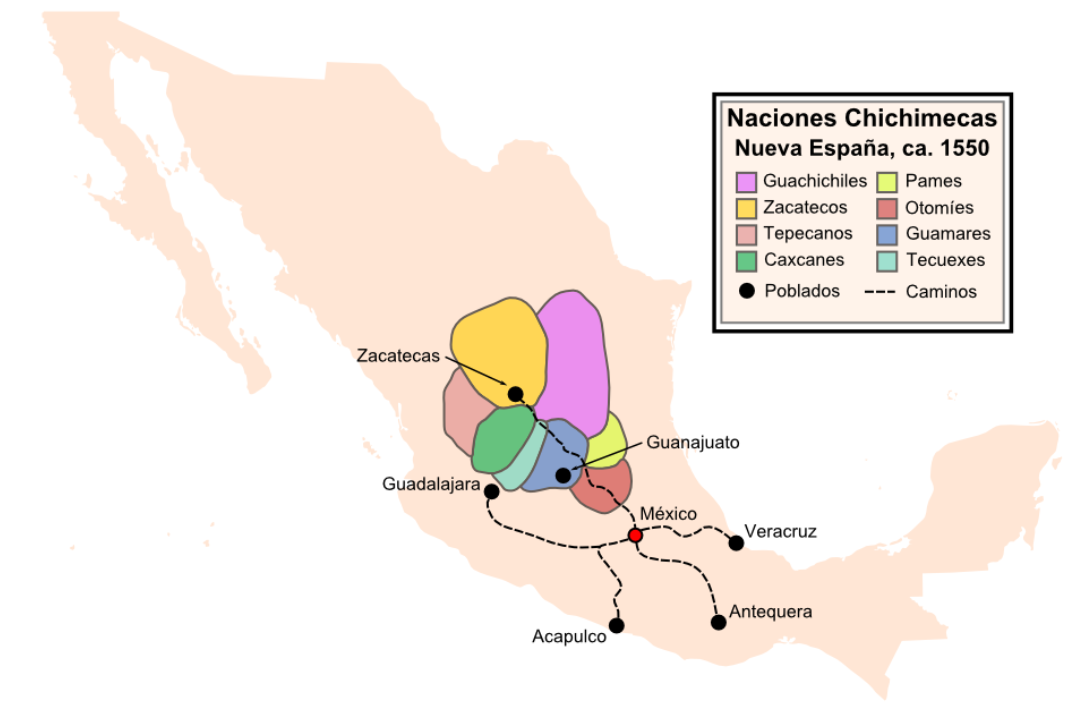
The Guachichil, Cuauchichil, or Quauhchichitl are an exonym for an Indigenous people of Mexico. Prior to European contact, they occupied the most extensive territory of all the Indigenous Chichimeca tribes in pre-Columbian central Mexico.
The Guachichiles settled a large region of Zacatecas; as well as portions of San Luis Potosí, Guanajuato, and northeastern Jalisco; south to the northern corners of Michoacán; and north to Saltillo in Coahuila.
Considered both warlike and brave, the Guachichiles played a major role in provoking the other Chichimeca tribes to resist the Spanish settlement. The historian Philip Wayne Powell wrote:
These warriors were known to fight fiercely even if mortally wounded and were a key component in the Spanish defeat during the Chichimeca Wars. The children learned to use the bow at walking age and the hunters were such good shots that if they missed the eye and hit the eyebrow they would be extremely disappointed. The Chichimeca bow and arrow was expertly crafted allowing for penetration of Spanish armor.
Two Spanish accounts of the Chichimeca's archery skill: "On one occasion I saw them throw an orange into the air, and they shot into it so many arrows that, having held it in the air for much time, it finally fell in minute pieces” (Powell 48). “One of don Alonso de Castilla’s soldiers had an arrow pass through the head of his horse, including a crownpiece of double buckskin and metal, and into his chest, so he fell with the horse dead on the ground ‘this was seen by many who are still living’ (Powell 48).
The Chichimeca were nomadic making them very mobile and experts of the rough vegetation filled (mostly cactus) land in which they always looked for hiding spots. “His long use of the food native to the Gran Chichimeca gave him far greater mobility than the sedentary invader, who was tied to domesticated livestock, agriculture, and imported supplies. The nomad could and did cut off these supplies, destroy the livestock, and thus paralyze the economic and military vitality of the invaders; this was seldom possible in reverse” (Powell 44). They attacked in small groups ranging from five up to two-hundred braves. They highly valued animal furs and highly treasured European scalps. The most valued of those being red hair due to their cultural importance of the color red. The Chichimeca were easily willing to trade seized gold and silver for red haired women as noted by an extremely small percentage of the population in that territory today having brownish-reddish hair, more noticeably when mixed with whites of non-red haired origin. Red haired women and children were a large incentive used to obtain peace within the region.
The Guachichil would outsmart/deceive their adversaries instead of relying on brute force. “He sent spies into Spanish-Indian towns for appraisal of the enemy’s plans and strength; he developed a far-flung system of lookouts and scouts (atalays); and, in major attacks, settlements were softened by preliminary and apparently systematic killing and stealing of horses and other livestock, this being an attempt, sometimes successful, to change his intended victim from horseman to foot soldier” (Powell 46). When they attacked they used a very good tactic that terrified the animals and scared the Spanish. The Guachichil would disguise themselves as grotesque animals using animal heads and red paint then yelled like crazed beasts making the Spanish lose control of the livestock. The 50-mile (80-km) mountain range, from currently La Montesa to Milagros, Zacatecas, was known as "El Camino Del Infierno" or "The Path of Hell" by the Spanish. The caravans were required to pass through that 50-mile mountain range because a detour would be very lengthy. Within "The Path of Hell" the most ferocious attacks took place. Ancient Guachichil murals of the region paint the indigenous accounts of these events.
The chieftain of the tribe was also the military leader. The Spaniards observed that they attacked in gangs of few members who differed from the other Chichimecas by painting their heads and hair red.
Hub AI
Guachichil AI simulator
(@Guachichil_simulator)
Guachichil
The Guachichil, Cuauchichil, or Quauhchichitl are an exonym for an Indigenous people of Mexico. Prior to European contact, they occupied the most extensive territory of all the Indigenous Chichimeca tribes in pre-Columbian central Mexico.
The Guachichiles settled a large region of Zacatecas; as well as portions of San Luis Potosí, Guanajuato, and northeastern Jalisco; south to the northern corners of Michoacán; and north to Saltillo in Coahuila.
Considered both warlike and brave, the Guachichiles played a major role in provoking the other Chichimeca tribes to resist the Spanish settlement. The historian Philip Wayne Powell wrote:
These warriors were known to fight fiercely even if mortally wounded and were a key component in the Spanish defeat during the Chichimeca Wars. The children learned to use the bow at walking age and the hunters were such good shots that if they missed the eye and hit the eyebrow they would be extremely disappointed. The Chichimeca bow and arrow was expertly crafted allowing for penetration of Spanish armor.
Two Spanish accounts of the Chichimeca's archery skill: "On one occasion I saw them throw an orange into the air, and they shot into it so many arrows that, having held it in the air for much time, it finally fell in minute pieces” (Powell 48). “One of don Alonso de Castilla’s soldiers had an arrow pass through the head of his horse, including a crownpiece of double buckskin and metal, and into his chest, so he fell with the horse dead on the ground ‘this was seen by many who are still living’ (Powell 48).
The Chichimeca were nomadic making them very mobile and experts of the rough vegetation filled (mostly cactus) land in which they always looked for hiding spots. “His long use of the food native to the Gran Chichimeca gave him far greater mobility than the sedentary invader, who was tied to domesticated livestock, agriculture, and imported supplies. The nomad could and did cut off these supplies, destroy the livestock, and thus paralyze the economic and military vitality of the invaders; this was seldom possible in reverse” (Powell 44). They attacked in small groups ranging from five up to two-hundred braves. They highly valued animal furs and highly treasured European scalps. The most valued of those being red hair due to their cultural importance of the color red. The Chichimeca were easily willing to trade seized gold and silver for red haired women as noted by an extremely small percentage of the population in that territory today having brownish-reddish hair, more noticeably when mixed with whites of non-red haired origin. Red haired women and children were a large incentive used to obtain peace within the region.
The Guachichil would outsmart/deceive their adversaries instead of relying on brute force. “He sent spies into Spanish-Indian towns for appraisal of the enemy’s plans and strength; he developed a far-flung system of lookouts and scouts (atalays); and, in major attacks, settlements were softened by preliminary and apparently systematic killing and stealing of horses and other livestock, this being an attempt, sometimes successful, to change his intended victim from horseman to foot soldier” (Powell 46). When they attacked they used a very good tactic that terrified the animals and scared the Spanish. The Guachichil would disguise themselves as grotesque animals using animal heads and red paint then yelled like crazed beasts making the Spanish lose control of the livestock. The 50-mile (80-km) mountain range, from currently La Montesa to Milagros, Zacatecas, was known as "El Camino Del Infierno" or "The Path of Hell" by the Spanish. The caravans were required to pass through that 50-mile mountain range because a detour would be very lengthy. Within "The Path of Hell" the most ferocious attacks took place. Ancient Guachichil murals of the region paint the indigenous accounts of these events.
The chieftain of the tribe was also the military leader. The Spaniards observed that they attacked in gangs of few members who differed from the other Chichimecas by painting their heads and hair red.
Recent media