



Community hub
Recent from talks
Knowledge base stats:
Talk channels stats:
Members stats:
Australian rules football positions
In the sport of Australian rules football, each of the eighteen players in a team is assigned to a particular named position on the field of play. These positions describe both the player's main role and by implication their location on the ground. As the game has evolved, tactics and team formations have changed, and the names of the positions and the duties involved have evolved too. There are 18 positions in Australian rules football, not including four (sometimes 6–8) interchange players who may replace another player on the ground at any time during play.
The fluid nature of the modern game means the positions in football are not as formally defined as in sports such as rugby or American football. Even so, most players will play in a limited range of positions throughout their career, as each position requires a particular set of skills. Footballers who are able to play comfortably in numerous positions are referred to as utility players.
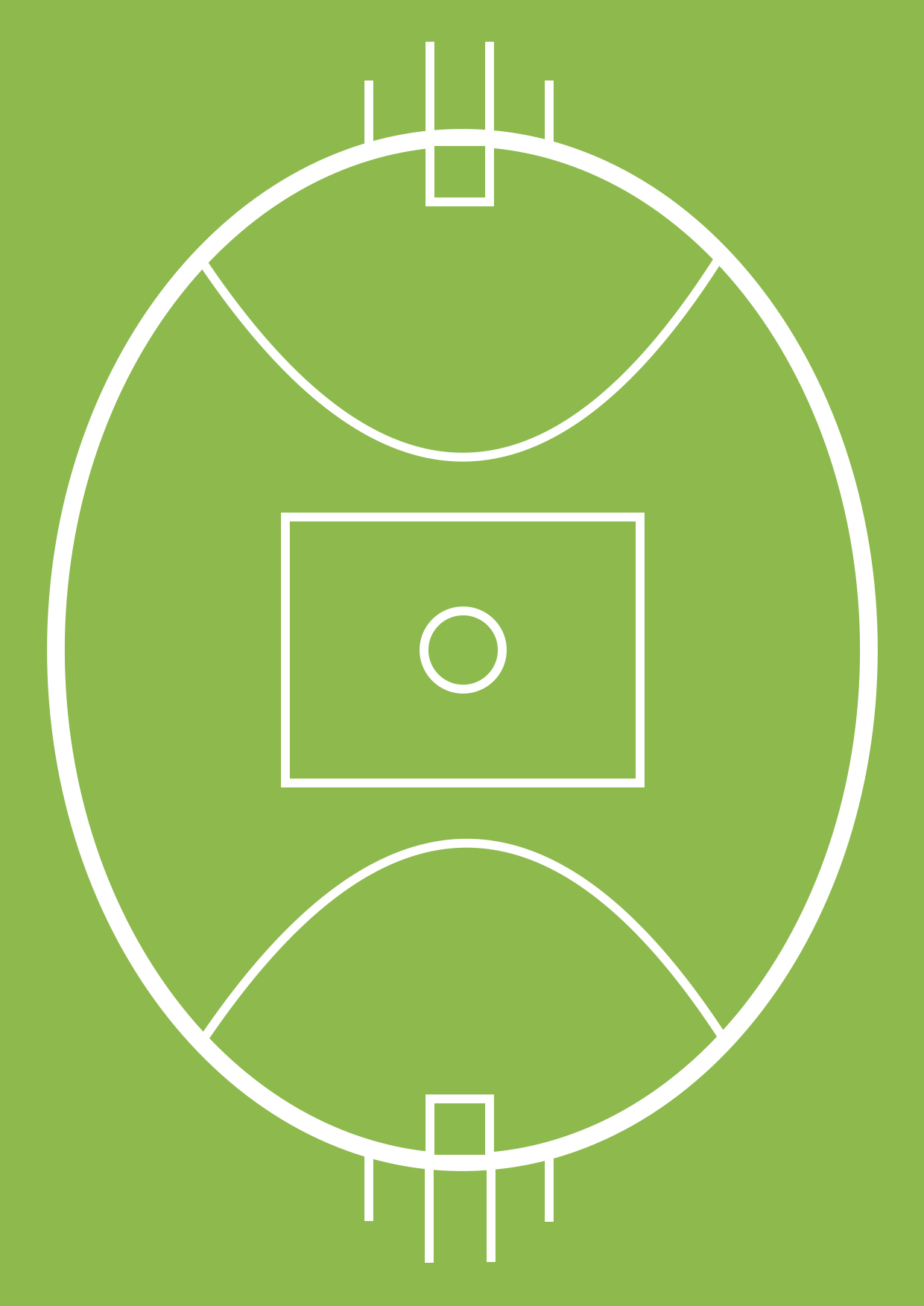
In an effort to maintain traditional positions, at the beginning of each quarter and after each goal each team must have a maximum of 6 players in each 50m arc, including 1 in the goal square. Each team are also restricted to a maximum of 4 within the centre square, including 1 in the centre circle. If this is breached, a free kick is awarded.
The term back line can either refer to the full-back line consisting of the two back pockets and the full-back, or both the full- and half-back lines, which collectively can also be referred to as the defence, defensive unit or the back six.
The full-back position has always been a purely defensive role, with the aim of stopping the full-forward from getting the ball and scoring. But, in recent times, where the ability to move the ball out of the back and down the field quickly has become a more important tactic, the full-back often starts a chain of passes up the ground. The defensive aspect of the position remains important, with the ability to accelerate and change direction quickly. Spoiling the ball is also of utmost importance. The full-back often kicks the ball back into play after a point has been scored, although some teams prefer a midfielder or the small back pockets for this role, freeing the (typically taller) full-back player to attempt to mark the kick-in.
Notable full-backs:
The back pocket refers to a position on the field deep in defence.
Back pocket players need to have good spoiling skills and usually, quality back-pockets are noted for their hardness. Back pockets generally play on the smaller, faster forward pockets and let the fullback play on the stronger full-forward.
Hub AI
Australian rules football positions AI simulator
(@Australian rules football positions_simulator)
Australian rules football positions
In the sport of Australian rules football, each of the eighteen players in a team is assigned to a particular named position on the field of play. These positions describe both the player's main role and by implication their location on the ground. As the game has evolved, tactics and team formations have changed, and the names of the positions and the duties involved have evolved too. There are 18 positions in Australian rules football, not including four (sometimes 6–8) interchange players who may replace another player on the ground at any time during play.
The fluid nature of the modern game means the positions in football are not as formally defined as in sports such as rugby or American football. Even so, most players will play in a limited range of positions throughout their career, as each position requires a particular set of skills. Footballers who are able to play comfortably in numerous positions are referred to as utility players.
In an effort to maintain traditional positions, at the beginning of each quarter and after each goal each team must have a maximum of 6 players in each 50m arc, including 1 in the goal square. Each team are also restricted to a maximum of 4 within the centre square, including 1 in the centre circle. If this is breached, a free kick is awarded.
The term back line can either refer to the full-back line consisting of the two back pockets and the full-back, or both the full- and half-back lines, which collectively can also be referred to as the defence, defensive unit or the back six.
The full-back position has always been a purely defensive role, with the aim of stopping the full-forward from getting the ball and scoring. But, in recent times, where the ability to move the ball out of the back and down the field quickly has become a more important tactic, the full-back often starts a chain of passes up the ground. The defensive aspect of the position remains important, with the ability to accelerate and change direction quickly. Spoiling the ball is also of utmost importance. The full-back often kicks the ball back into play after a point has been scored, although some teams prefer a midfielder or the small back pockets for this role, freeing the (typically taller) full-back player to attempt to mark the kick-in.
Notable full-backs:
The back pocket refers to a position on the field deep in defence.
Back pocket players need to have good spoiling skills and usually, quality back-pockets are noted for their hardness. Back pockets generally play on the smaller, faster forward pockets and let the fullback play on the stronger full-forward.