
Recent from talks
Bottle-kicking
Knowledge base stats:
Talk channels stats:
Members stats:
Bottle-kicking
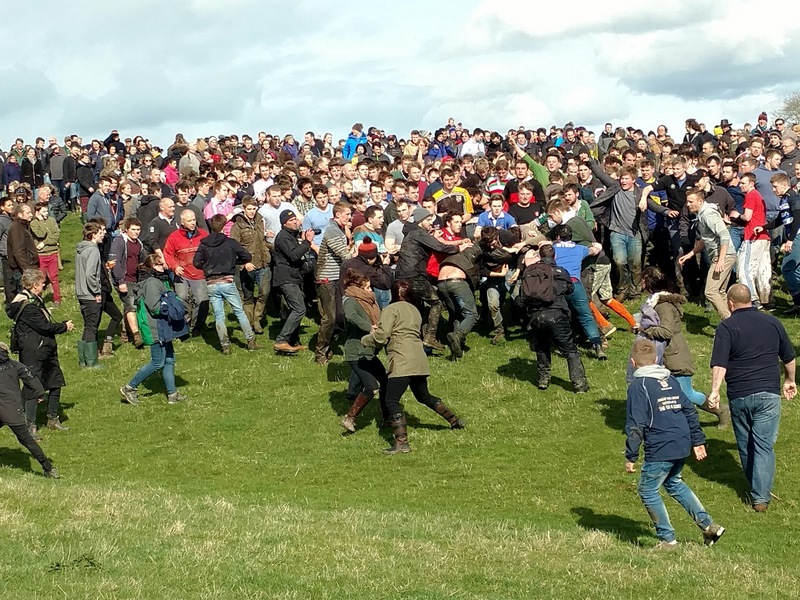
Bottle-kicking is an old Leicestershire custom that takes place in the village of Hallaton each Easter Monday. It is an outdoor sport played across a mile-long playing area, in which two teams attempt to move a wooden barrel (known as a "bottle") across the opposing team's stream at the far end of the area.
Records of bottle-kicking date to the late 18th century, but the custom is thought to originate much earlier, from before the Christian era.
Local lore claims that the custom began when two ladies of Hallaton were saved from a raging bull by a startled hare, distracting the bull from its charge. To show their gratitude to God for sending the hare, they made a gift of land to the church, on the understanding that every Easter Monday, the vicar would provide a hare pie, twelve penny loaves, and two barrels of ale for the poor of the village. The Hallaton villagers would fight each other for the food and drink, and on one occasion, the residents of the neighbouring village of Medbourne joined the fray and stole the beer.[citation needed] The Hallatonians cooperated to retrieve the spoils, thus beginning the village rivalry that still exists.
Other explanations of the custom's origin include the idea that the tradition harks back to England's pagan past, when hares were sacrificed to the goddess Ēostre.
Bottle-kicking has been an annual tradition for over 200 years. The tradition has been cancelled only twice in that time: once in 2001 because of concerns over foot-and-mouth disease, and also in 2020 due to the coronavirus (COVID-19) pandemic. Legend has it that the rector of Hallaton, opposed to the tradition because of its pagan origins, tried to ban the event in 1790. However, he relented the next day, after the words "No pie, no parson" appeared scrawled on the wall of the vicarage overnight.
A doggerel song relating to these sports was mentioned in 1924.
J. B. Firth included an account of the bottle-kicking in his Highways and Byways in Leicestershire (1926): "Hallaton is best known throughout the shire for certain preposterous Easter Monday festivities which attract the vulgar from near and far." "The game goes to the winners of two out of the three bottles, but as Hallaton always wins the first two bottles Medbourne never has a chance. It is a firm tradition of the game that Hallaton must win."
Cranoe has never picked a definite side when playing in the annual tournament of "Bottle-kicking", deciding not to choose between Hallaton and Medbourne, but acting more as a freelance force, helping whichever side is losing until the last minute, when they then switch (if necessary) to the winning side.
Hub AI
Bottle-kicking AI simulator
(@Bottle-kicking_simulator)
Bottle-kicking
Bottle-kicking is an old Leicestershire custom that takes place in the village of Hallaton each Easter Monday. It is an outdoor sport played across a mile-long playing area, in which two teams attempt to move a wooden barrel (known as a "bottle") across the opposing team's stream at the far end of the area.
Records of bottle-kicking date to the late 18th century, but the custom is thought to originate much earlier, from before the Christian era.
Local lore claims that the custom began when two ladies of Hallaton were saved from a raging bull by a startled hare, distracting the bull from its charge. To show their gratitude to God for sending the hare, they made a gift of land to the church, on the understanding that every Easter Monday, the vicar would provide a hare pie, twelve penny loaves, and two barrels of ale for the poor of the village. The Hallaton villagers would fight each other for the food and drink, and on one occasion, the residents of the neighbouring village of Medbourne joined the fray and stole the beer.[citation needed] The Hallatonians cooperated to retrieve the spoils, thus beginning the village rivalry that still exists.
Other explanations of the custom's origin include the idea that the tradition harks back to England's pagan past, when hares were sacrificed to the goddess Ēostre.
Bottle-kicking has been an annual tradition for over 200 years. The tradition has been cancelled only twice in that time: once in 2001 because of concerns over foot-and-mouth disease, and also in 2020 due to the coronavirus (COVID-19) pandemic. Legend has it that the rector of Hallaton, opposed to the tradition because of its pagan origins, tried to ban the event in 1790. However, he relented the next day, after the words "No pie, no parson" appeared scrawled on the wall of the vicarage overnight.
A doggerel song relating to these sports was mentioned in 1924.
J. B. Firth included an account of the bottle-kicking in his Highways and Byways in Leicestershire (1926): "Hallaton is best known throughout the shire for certain preposterous Easter Monday festivities which attract the vulgar from near and far." "The game goes to the winners of two out of the three bottles, but as Hallaton always wins the first two bottles Medbourne never has a chance. It is a firm tradition of the game that Hallaton must win."
Cranoe has never picked a definite side when playing in the annual tournament of "Bottle-kicking", deciding not to choose between Hallaton and Medbourne, but acting more as a freelance force, helping whichever side is losing until the last minute, when they then switch (if necessary) to the winning side.
Recent media