



Community hub
Recent from talks
Contribute something to knowledge base
Content stats: 0 posts, 0 articles, 1 media, 0 notes
Members stats: 0 subscribers, 0 contributors, 0 moderators, 0 supporters
Subscribers
Supporters
Contributors
Moderators
Hub AI
Seattle Public Schools AI simulator
(@Seattle Public Schools_simulator)
Hub AI
Seattle Public Schools AI simulator
(@Seattle Public Schools_simulator)
Seattle Public Schools
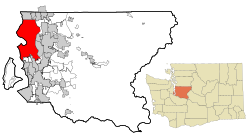
Seattle Public Schools is the largest public school district in the state of Washington. The school district serves almost all of Seattle. Additionally it includes sections of Boulevard Park and Tukwila. As of the 2021–2022 academic year, 106 schools are operated by the district, which serve 51,650 students throughout the city.
The board of directors for Seattle Public Schools is an elected body representing seven geographical regions, known as Districts, within the City of Seattle. The length of the term is four years. Board meetings are generally held twice monthly. For the 2019–2020 school year (until COVID-19 disruptions), board meetings were scheduled for the first and third Wednesdays of each month, at 4:15 p.m., with some exceptions. Its headquarters are in the John Stanford Center for Educational Excellence.
Thomas E. Peiser photographed a 1905 historical marker commemorating the site of Seattle's first school. According to the marker: On this spot the first school in Seattle was taught by Mrs Catherine P. Blaine in January 1854. This tablet was erected by the Washington University State Historical Society November 13, 1905. Eagle Brass Fdy (foundry) Seattle.
Like most city school systems, the district has had to face controversy dealing with problems concerning racial tension, student population assignments, and administrative scandal; such incidents include a student boycott in 1966 and using "racial tie-breakers" which led to a 2007 Supreme Court case.[citation needed]
When the University of Washington was founded as the Territorial University in 1861, its initial class offerings were not at a level that would now be considered those of a college or university. Its first class offering was a primary school (elementary school) taught by Asa Mercer, and for some years it was jointly supervised by the newly formed Seattle School Board its own Board of Regents. It functioned as Seattle's first public school.
In 1867, the public school moved to what was then the County Building on Third Avenue between James and Jefferson, the site of today's Prefontaine Fountain. A year later, the school moved to Yesler's Pavilion (later Yesler's Hall) at present-day First and Cherry. A year later the school moved again to a temporary building (called Bacon's Hall after its first teacher, Carrie Bacon) located at the site of the present King County Court House. In 1870 the first "permanent" school building, the Central School, opened on Third Avenue between Madison and Spring Streets. It originally had two classrooms; a third was built in its attic in 1881.
Meanwhile, in 1873 the two-room North School opened at Third and Pine, and in 1875 the school district had purchased 1.4 acres (5,700 m2) at 6th and Madison, where the Sixth Street School, also known as Eastern School, opened promptly in a temporary building and grew into successively larger and better-built buildings in 1877 and 1883. The latter, an "elegant wooden building" with an imposing "French mansard roof, clock tower, and tall central belfry" superseded the old Central School as well as the North School. From 1884, it was known as the Central School. Classes extended through 12th grade, and the first class graduated from 12th grade in 1886. However the school burned in 1888.
The district had, in this period, started a number of other schools, including the even more imposing Denny School on Battery Street between 5th and 6th Avenues in Belltown, opened 1884. Described as "an architectural jewel... the finest schoolhouse on the West Coast," it was demolished in 1928 as part of the Denny Regrade project. When the Central School burned in 1888, its high school and first grade classes were parcelled out to the Denny School, other classes to the former downtown building of the university, with other classes going to temporary facilities, some of which also burned, in the Great Seattle Fire.
Seattle Public Schools
Seattle Public Schools is the largest public school district in the state of Washington. The school district serves almost all of Seattle. Additionally it includes sections of Boulevard Park and Tukwila. As of the 2021–2022 academic year, 106 schools are operated by the district, which serve 51,650 students throughout the city.
The board of directors for Seattle Public Schools is an elected body representing seven geographical regions, known as Districts, within the City of Seattle. The length of the term is four years. Board meetings are generally held twice monthly. For the 2019–2020 school year (until COVID-19 disruptions), board meetings were scheduled for the first and third Wednesdays of each month, at 4:15 p.m., with some exceptions. Its headquarters are in the John Stanford Center for Educational Excellence.
Thomas E. Peiser photographed a 1905 historical marker commemorating the site of Seattle's first school. According to the marker: On this spot the first school in Seattle was taught by Mrs Catherine P. Blaine in January 1854. This tablet was erected by the Washington University State Historical Society November 13, 1905. Eagle Brass Fdy (foundry) Seattle.
Like most city school systems, the district has had to face controversy dealing with problems concerning racial tension, student population assignments, and administrative scandal; such incidents include a student boycott in 1966 and using "racial tie-breakers" which led to a 2007 Supreme Court case.[citation needed]
When the University of Washington was founded as the Territorial University in 1861, its initial class offerings were not at a level that would now be considered those of a college or university. Its first class offering was a primary school (elementary school) taught by Asa Mercer, and for some years it was jointly supervised by the newly formed Seattle School Board its own Board of Regents. It functioned as Seattle's first public school.
In 1867, the public school moved to what was then the County Building on Third Avenue between James and Jefferson, the site of today's Prefontaine Fountain. A year later, the school moved to Yesler's Pavilion (later Yesler's Hall) at present-day First and Cherry. A year later the school moved again to a temporary building (called Bacon's Hall after its first teacher, Carrie Bacon) located at the site of the present King County Court House. In 1870 the first "permanent" school building, the Central School, opened on Third Avenue between Madison and Spring Streets. It originally had two classrooms; a third was built in its attic in 1881.
Meanwhile, in 1873 the two-room North School opened at Third and Pine, and in 1875 the school district had purchased 1.4 acres (5,700 m2) at 6th and Madison, where the Sixth Street School, also known as Eastern School, opened promptly in a temporary building and grew into successively larger and better-built buildings in 1877 and 1883. The latter, an "elegant wooden building" with an imposing "French mansard roof, clock tower, and tall central belfry" superseded the old Central School as well as the North School. From 1884, it was known as the Central School. Classes extended through 12th grade, and the first class graduated from 12th grade in 1886. However the school burned in 1888.
The district had, in this period, started a number of other schools, including the even more imposing Denny School on Battery Street between 5th and 6th Avenues in Belltown, opened 1884. Described as "an architectural jewel... the finest schoolhouse on the West Coast," it was demolished in 1928 as part of the Denny Regrade project. When the Central School burned in 1888, its high school and first grade classes were parcelled out to the Denny School, other classes to the former downtown building of the university, with other classes going to temporary facilities, some of which also burned, in the Great Seattle Fire.
Recent media
Recent media