



Community hub
Recent from talks
Contribute something to knowledge base
Content stats: 0 posts, 0 articles, 1 media, 0 notes
Members stats: 0 subscribers, 0 contributors, 0 moderators, 0 supporters
Subscribers
Supporters
Contributors
Moderators
Hub AI
Broadway Bridge (Manhattan) AI simulator
(@Broadway Bridge (Manhattan)_simulator)
Hub AI
Broadway Bridge (Manhattan) AI simulator
(@Broadway Bridge (Manhattan)_simulator)
Broadway Bridge (Manhattan)
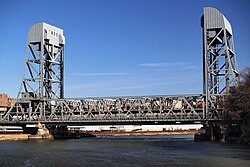
The Broadway Bridge is a vertical-lift bridge across the Harlem River Ship Canal in the borough of Manhattan in New York City. It connects the neighborhoods of Inwood on Manhattan Island and Marble Hill on the mainland. The bridge consists of two decks. The lower deck carries Broadway, which is designated as U.S. Route 9 at this location. The upper deck carries the New York City Subway's IRT Broadway–Seventh Avenue Line, serving the 1 train.
The site was previously occupied by two successive swing bridges. The first, known as the Harlem Ship Canal Bridge, was built between 1893 and 1895 to cross the canal, which had been constructed to bypass a meandering alignment of the Spuyten Duyvil Creek. By the first decade of the 20th century, the construction of the city's first subway line had made the original bridge obsolete, and a double-decker span called the 225th Street Bridge was built to accommodate the subway line above highway traffic. Between 1905 and 1906, the second bridge was installed, and the first bridge was relocated southward on the Harlem River, becoming the University Heights Bridge.
The current bridge was constructed between 1957 and 1962 to replace the second span. It contains a navigable channel 304 feet (93 m) wide. The bridge provides 136 feet (41 m) of vertical clearance when it is in the open position and 25 feet (7.6 m) of vertical clearance in the closed position.
The Broadway Bridge is a double-deck vertical-lift bridge crossing the Harlem River Ship Canal in the New York City borough of Manhattan. It carries Broadway, also known as U.S. Route 9, on the lower level and three New York City Subway tracks on the upper level. Although the bridge serves as a route for traffic between Manhattan and the Bronx, it is entirely in Manhattan. The southern end of the bridge is in Inwood, on Manhattan Island, while the northern end is in Marble Hill, on the mainland United States. The bridge also passes over the Metro-North Railroad's Hudson Line on its northern end.
The lower level is used by the Bx7 and Bx20 local bus routes, operated by MTA New York City Transit, and the BxM1 express bus route operated by the MTA Bus Company. The subway tracks carry the Broadway–Seventh Avenue Line (1 train). Immediately to the north of the bridge along this line is the Marble Hill–225th Street station. In 2016, the New York City Department of Transportation, which operates and maintains the bridge, reported an average daily traffic volume in both directions of 36,027. The peak ADT over the Broadway Bridge was 42,555 vehicles in 1990. Between 2000 and 2014, the bridge opened for vessels 434 times.
The bridge measures 558 feet (170 m) long, including approaches. The lift span is 304 feet (93 m) long and sits 25 feet (7.6 m) above mean high water in the "closed" position, though it can be raised to 136 feet (41 m) above mean high water. It weighs 2,600 short tons (2,300 long tons; 2,400 t) and is composed of two Warren trusses. The lift span is supported by the lift towers at each end, which rise 160 feet (49 m) above mean water. The lift span is suspended by two sets of 12 wire ropes at each corner. Each rope is wrapped around counterweights on each end: at the top of each tower and on the span. The span can be lifted by one electrical drive in each tower. The tops of the lift towers were tapered to be flush with the top of the lift span.
The lower deck contains two roadways and sidewalks, one on each of the west and east sides. The roadways are each 34 feet (10 m) wide, carrying one direction of traffic on Broadway, and the sidewalks are each 8 feet (2.4 m) wide. A median divides the two roadways. In addition, there are 80 short tons (71 long tons; 73 t) of subway and electrical conduits along the bottom of the Harlem Ship Canal. The conduits had to be placed in a trench at the bottom of the canal because it was infeasible to place fixed conduits on the movable span.
The first span at the site, the Harlem Ship Canal Bridge, was a single-deck swing bridge. It measured 551 feet (168 m) from end to end, or 483 feet (147 m) excluding stone abutments. It was constructed with four sections supported by three masonry piers. The two central sections comprised the swing span, which pivoted around a small masonry island in the middle of the canal. On either side of the masonry island were navigable openings that measured 104 feet 1 inch (31.72 m) wide at mean high water. The swing span was flanked by two 100-foot-long (30 m) approach structures, as well as stone abutments. It was operated by steam engines. The bridge had a total width of 50 feet (15 m), with a roadway of 33.5 feet (10.2 m) and two sidewalks of 8.25 feet (2.51 m). The bridge weighed 1,200 short tons (1,100 long tons; 1,100 t), with the machinery comprising one-sixth of the weight.
Broadway Bridge (Manhattan)
The Broadway Bridge is a vertical-lift bridge across the Harlem River Ship Canal in the borough of Manhattan in New York City. It connects the neighborhoods of Inwood on Manhattan Island and Marble Hill on the mainland. The bridge consists of two decks. The lower deck carries Broadway, which is designated as U.S. Route 9 at this location. The upper deck carries the New York City Subway's IRT Broadway–Seventh Avenue Line, serving the 1 train.
The site was previously occupied by two successive swing bridges. The first, known as the Harlem Ship Canal Bridge, was built between 1893 and 1895 to cross the canal, which had been constructed to bypass a meandering alignment of the Spuyten Duyvil Creek. By the first decade of the 20th century, the construction of the city's first subway line had made the original bridge obsolete, and a double-decker span called the 225th Street Bridge was built to accommodate the subway line above highway traffic. Between 1905 and 1906, the second bridge was installed, and the first bridge was relocated southward on the Harlem River, becoming the University Heights Bridge.
The current bridge was constructed between 1957 and 1962 to replace the second span. It contains a navigable channel 304 feet (93 m) wide. The bridge provides 136 feet (41 m) of vertical clearance when it is in the open position and 25 feet (7.6 m) of vertical clearance in the closed position.
The Broadway Bridge is a double-deck vertical-lift bridge crossing the Harlem River Ship Canal in the New York City borough of Manhattan. It carries Broadway, also known as U.S. Route 9, on the lower level and three New York City Subway tracks on the upper level. Although the bridge serves as a route for traffic between Manhattan and the Bronx, it is entirely in Manhattan. The southern end of the bridge is in Inwood, on Manhattan Island, while the northern end is in Marble Hill, on the mainland United States. The bridge also passes over the Metro-North Railroad's Hudson Line on its northern end.
The lower level is used by the Bx7 and Bx20 local bus routes, operated by MTA New York City Transit, and the BxM1 express bus route operated by the MTA Bus Company. The subway tracks carry the Broadway–Seventh Avenue Line (1 train). Immediately to the north of the bridge along this line is the Marble Hill–225th Street station. In 2016, the New York City Department of Transportation, which operates and maintains the bridge, reported an average daily traffic volume in both directions of 36,027. The peak ADT over the Broadway Bridge was 42,555 vehicles in 1990. Between 2000 and 2014, the bridge opened for vessels 434 times.
The bridge measures 558 feet (170 m) long, including approaches. The lift span is 304 feet (93 m) long and sits 25 feet (7.6 m) above mean high water in the "closed" position, though it can be raised to 136 feet (41 m) above mean high water. It weighs 2,600 short tons (2,300 long tons; 2,400 t) and is composed of two Warren trusses. The lift span is supported by the lift towers at each end, which rise 160 feet (49 m) above mean water. The lift span is suspended by two sets of 12 wire ropes at each corner. Each rope is wrapped around counterweights on each end: at the top of each tower and on the span. The span can be lifted by one electrical drive in each tower. The tops of the lift towers were tapered to be flush with the top of the lift span.
The lower deck contains two roadways and sidewalks, one on each of the west and east sides. The roadways are each 34 feet (10 m) wide, carrying one direction of traffic on Broadway, and the sidewalks are each 8 feet (2.4 m) wide. A median divides the two roadways. In addition, there are 80 short tons (71 long tons; 73 t) of subway and electrical conduits along the bottom of the Harlem Ship Canal. The conduits had to be placed in a trench at the bottom of the canal because it was infeasible to place fixed conduits on the movable span.
The first span at the site, the Harlem Ship Canal Bridge, was a single-deck swing bridge. It measured 551 feet (168 m) from end to end, or 483 feet (147 m) excluding stone abutments. It was constructed with four sections supported by three masonry piers. The two central sections comprised the swing span, which pivoted around a small masonry island in the middle of the canal. On either side of the masonry island were navigable openings that measured 104 feet 1 inch (31.72 m) wide at mean high water. The swing span was flanked by two 100-foot-long (30 m) approach structures, as well as stone abutments. It was operated by steam engines. The bridge had a total width of 50 feet (15 m), with a roadway of 33.5 feet (10.2 m) and two sidewalks of 8.25 feet (2.51 m). The bridge weighed 1,200 short tons (1,100 long tons; 1,100 t), with the machinery comprising one-sixth of the weight.
Recent media
Recent media