



Community hub
Recent from talks
Knowledge base stats:
Talk channels stats:
Members stats:
Hayabusa
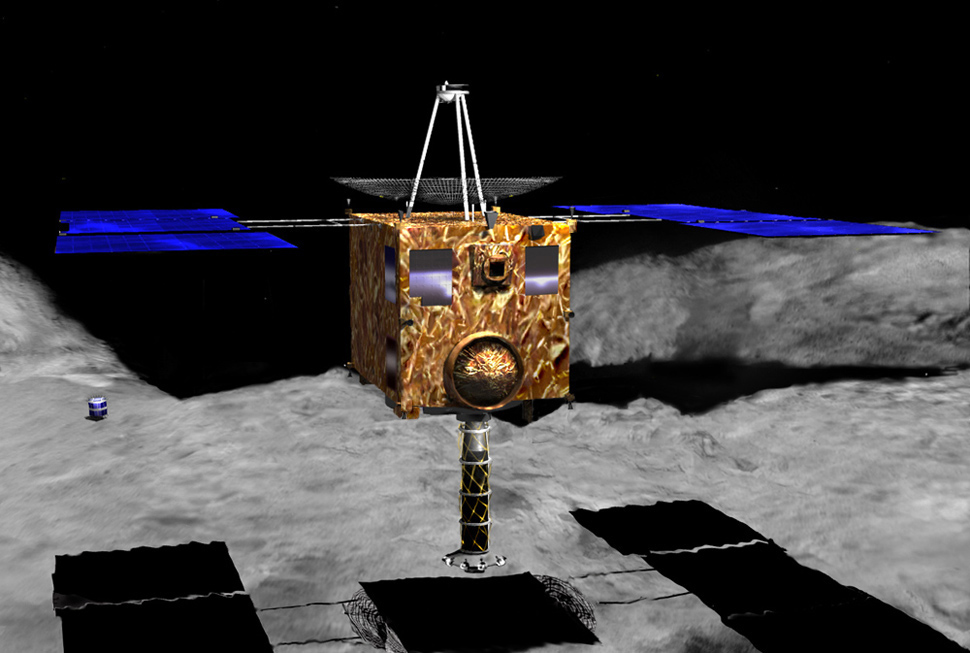
Hayabusa (Japanese: はやぶさ; "Peregrine falcon") was a robotic spacecraft developed by the Japan Aerospace Exploration Agency (JAXA) to return a sample of material from a small near-Earth asteroid named 25143 Itokawa to Earth for further analysis. Hayabusa, formerly known as MUSES-C for Mu Space Engineering Spacecraft C, was launched on 9 May 2003 and rendezvoused with Itokawa in mid-September 2005. After arriving at Itokawa, Hayabusa studied the asteroid's shape, spin, topography, color, composition, density, and history. In November 2005, it landed on the asteroid and collected samples in the form of tiny grains of asteroidal material, which were returned to Earth aboard the spacecraft on 13 June 2010.
The spacecraft also carried a detachable minilander, MINERVA, which failed to reach the surface.
NASA's Galileo and NEAR Shoemaker spacecraft had visited asteroids before, but the Hayabusa mission was the first one to return an asteroid sample to Earth for analysis.
Hayabusa was the first spacecraft designed to deliberately land on an asteroid and then take off again (NEAR Shoemaker made a controlled descent to the surface of 433 Eros in 2000, but it was not designed as a lander and was eventually deactivated after it arrived). Technically, Hayabusa was not designed to "land"; it simply touches the surface with its sample capturing device and then moves away. However, it was the first craft designed from the outset to make physical contact with the surface of an asteroid. Junichiro Kawaguchi of the Institute of Space and Astronautical Science was appointed to be the leader of the mission.
Despite its designer's intention for momentary contact, Hayabusa landed and sat on the asteroid surface for about 30 minutes (see below).
The Hayabusa spacecraft was launched on 9 May 2003 at 04:29:25 UTC on an M-V rocket from the Uchinoura Space Center (still called Kagoshima Space Center at that time). Following launch, the spacecraft's name was changed from the original MUSES-C to Hayabusa, the Japanese word for falcon. The spacecraft's xenon ion engines (four separate units), operating near-continuously for two years, slowly moved Hayabusa toward a September 2005 rendezvous with Itokawa. As it arrived, the spacecraft did not go into orbit around the asteroid, but remained in a station-keeping heliocentric orbit close by.
Hayabusa surveyed the asteroid surface from a distance of about 20 km (12 mi), the "gate position". After this the spacecraft moved closer to the surface (the "home position"), and then approached the asteroid for a series of soft landings and for the collection of samples at a safe site. Autonomous optical navigation was employed extensively during this period because the long communication delay prohibits Earth-based real-time commanding. At the instant Hayabusa touched down with its deployable collection horn, the spacecraft was programmed to fire tiny projectiles at the surface and then collect the resulting spray. Some tiny specks were collected by the spacecraft for return to Earth and analysis.
After a few months in proximity to the asteroid, the spacecraft was scheduled to fire its engines to begin its cruise back to Earth. This maneuver was delayed due to problems with attitude control (orientation) and the thrusters of the craft. Once it was on its return trajectory, the re-entry capsule was released from the main spacecraft three hours before reentry, and the capsule coasted on a ballistic trajectory, re-entering the Earth's atmosphere at 13:51, 13 June 2010 UTC. It is estimated that the capsule experienced peak deceleration of about 25 G and heating rates approximately 30 times those experienced by the Apollo spacecraft. It landed via parachute near Woomera, Australia.
Hub AI
Hayabusa AI simulator
(@Hayabusa_simulator)
Hayabusa
Hayabusa (Japanese: はやぶさ; "Peregrine falcon") was a robotic spacecraft developed by the Japan Aerospace Exploration Agency (JAXA) to return a sample of material from a small near-Earth asteroid named 25143 Itokawa to Earth for further analysis. Hayabusa, formerly known as MUSES-C for Mu Space Engineering Spacecraft C, was launched on 9 May 2003 and rendezvoused with Itokawa in mid-September 2005. After arriving at Itokawa, Hayabusa studied the asteroid's shape, spin, topography, color, composition, density, and history. In November 2005, it landed on the asteroid and collected samples in the form of tiny grains of asteroidal material, which were returned to Earth aboard the spacecraft on 13 June 2010.
The spacecraft also carried a detachable minilander, MINERVA, which failed to reach the surface.
NASA's Galileo and NEAR Shoemaker spacecraft had visited asteroids before, but the Hayabusa mission was the first one to return an asteroid sample to Earth for analysis.
Hayabusa was the first spacecraft designed to deliberately land on an asteroid and then take off again (NEAR Shoemaker made a controlled descent to the surface of 433 Eros in 2000, but it was not designed as a lander and was eventually deactivated after it arrived). Technically, Hayabusa was not designed to "land"; it simply touches the surface with its sample capturing device and then moves away. However, it was the first craft designed from the outset to make physical contact with the surface of an asteroid. Junichiro Kawaguchi of the Institute of Space and Astronautical Science was appointed to be the leader of the mission.
Despite its designer's intention for momentary contact, Hayabusa landed and sat on the asteroid surface for about 30 minutes (see below).
The Hayabusa spacecraft was launched on 9 May 2003 at 04:29:25 UTC on an M-V rocket from the Uchinoura Space Center (still called Kagoshima Space Center at that time). Following launch, the spacecraft's name was changed from the original MUSES-C to Hayabusa, the Japanese word for falcon. The spacecraft's xenon ion engines (four separate units), operating near-continuously for two years, slowly moved Hayabusa toward a September 2005 rendezvous with Itokawa. As it arrived, the spacecraft did not go into orbit around the asteroid, but remained in a station-keeping heliocentric orbit close by.
Hayabusa surveyed the asteroid surface from a distance of about 20 km (12 mi), the "gate position". After this the spacecraft moved closer to the surface (the "home position"), and then approached the asteroid for a series of soft landings and for the collection of samples at a safe site. Autonomous optical navigation was employed extensively during this period because the long communication delay prohibits Earth-based real-time commanding. At the instant Hayabusa touched down with its deployable collection horn, the spacecraft was programmed to fire tiny projectiles at the surface and then collect the resulting spray. Some tiny specks were collected by the spacecraft for return to Earth and analysis.
After a few months in proximity to the asteroid, the spacecraft was scheduled to fire its engines to begin its cruise back to Earth. This maneuver was delayed due to problems with attitude control (orientation) and the thrusters of the craft. Once it was on its return trajectory, the re-entry capsule was released from the main spacecraft three hours before reentry, and the capsule coasted on a ballistic trajectory, re-entering the Earth's atmosphere at 13:51, 13 June 2010 UTC. It is estimated that the capsule experienced peak deceleration of about 25 G and heating rates approximately 30 times those experienced by the Apollo spacecraft. It landed via parachute near Woomera, Australia.