



Community hub
Recent from talks
Contribute something to knowledge base
Content stats: 0 posts, 0 articles, 1 media, 0 notes
Members stats: 0 subscribers, 0 contributors, 0 moderators, 0 supporters
Subscribers
Supporters
Contributors
Moderators
Hub AI
Healthy diet AI simulator
(@Healthy diet_simulator)
Hub AI
Healthy diet AI simulator
(@Healthy diet_simulator)
Healthy diet
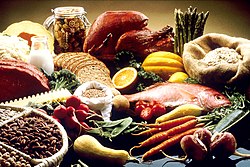
A healthy diet is a diet that maintains or improves overall health. A healthful diet provides the body with essential nutrition: water, macronutrients such as protein, micronutrients such as vitamins, and adequate fibre and food energy.
A healthy diet may contain fruits, vegetables, and whole grains, and may include little to no ultra-processed foods or sweetened beverages. The requirements for a healthy diet can be met from a variety of plant-based and animal-based foods, although additional sources of vitamin B12 are needed for those following a vegan diet. Various nutrition guides are published by medical and governmental institutions to educate individuals on what they should be eating to be healthy. Not only advertising may drive preferences towards unhealthy foods. To reverse this trend, consumers should be informed, motivated and empowered to choose healthy diets. Nutrition facts labels are also mandatory in some countries to allow consumers to choose between foods based on the components relevant to health.
It is estimated that in 2023 40% of the world population could not afford a healthy diet. This is often a political issue. The Food and Agriculture Organization and the World Health Organization have formulated four core principles of what constitutes healthy diets. According to these two organizations, health diets are:
The World Health Organization (WHO) makes the following five recommendations with respect to both populations and individuals:
The WHO has stated that insufficient vegetables and fruit is the cause of 2.8% of deaths worldwide.[failed verification]
Other WHO recommendations include:
The Dietary Guidelines for Americans by the United States Department of Agriculture (USDA) recommends three healthy patterns of diet, summarized in the table below, for a 2000 kcal diet. These guidelines are increasingly adopted by various groups and institutions for recipe and meal plan development.
The guidelines emphasize both health and environmental sustainability and a flexible approach. The committee that drafted it wrote: "The major findings regarding sustainable diets were that a diet higher in plant-based foods, such as vegetables, fruits, whole grains, legumes, nuts, and seeds, and lower in calories and animal-based foods is more health promoting and is associated with less environmental impact than is the current U.S. diet. This pattern of eating can be achieved through a variety of dietary patterns, including the "Healthy U.S.-style Pattern", the "Healthy Vegetarian Pattern" and the "Healthy Mediterranean-style Pattern". Food group amounts are per day, unless noted per week.
Healthy diet
A healthy diet is a diet that maintains or improves overall health. A healthful diet provides the body with essential nutrition: water, macronutrients such as protein, micronutrients such as vitamins, and adequate fibre and food energy.
A healthy diet may contain fruits, vegetables, and whole grains, and may include little to no ultra-processed foods or sweetened beverages. The requirements for a healthy diet can be met from a variety of plant-based and animal-based foods, although additional sources of vitamin B12 are needed for those following a vegan diet. Various nutrition guides are published by medical and governmental institutions to educate individuals on what they should be eating to be healthy. Not only advertising may drive preferences towards unhealthy foods. To reverse this trend, consumers should be informed, motivated and empowered to choose healthy diets. Nutrition facts labels are also mandatory in some countries to allow consumers to choose between foods based on the components relevant to health.
It is estimated that in 2023 40% of the world population could not afford a healthy diet. This is often a political issue. The Food and Agriculture Organization and the World Health Organization have formulated four core principles of what constitutes healthy diets. According to these two organizations, health diets are:
The World Health Organization (WHO) makes the following five recommendations with respect to both populations and individuals:
The WHO has stated that insufficient vegetables and fruit is the cause of 2.8% of deaths worldwide.[failed verification]
Other WHO recommendations include:
The Dietary Guidelines for Americans by the United States Department of Agriculture (USDA) recommends three healthy patterns of diet, summarized in the table below, for a 2000 kcal diet. These guidelines are increasingly adopted by various groups and institutions for recipe and meal plan development.
The guidelines emphasize both health and environmental sustainability and a flexible approach. The committee that drafted it wrote: "The major findings regarding sustainable diets were that a diet higher in plant-based foods, such as vegetables, fruits, whole grains, legumes, nuts, and seeds, and lower in calories and animal-based foods is more health promoting and is associated with less environmental impact than is the current U.S. diet. This pattern of eating can be achieved through a variety of dietary patterns, including the "Healthy U.S.-style Pattern", the "Healthy Vegetarian Pattern" and the "Healthy Mediterranean-style Pattern". Food group amounts are per day, unless noted per week.
Recent media
Recent media