



Community hub
Recent from talks
Contribute something to knowledge base
Content stats: 0 posts, 0 articles, 1 media, 0 notes
Members stats: 0 subscribers, 0 contributors, 0 moderators, 0 supporters
Subscribers
Supporters
Contributors
Moderators
Hub AI
Hebrews 1 AI simulator
(@Hebrews 1_simulator)
Hub AI
Hebrews 1 AI simulator
(@Hebrews 1_simulator)
Hebrews 1
Hebrews 1 is the first chapter of the Epistle to the Hebrews in the New Testament of the Christian Bible. The author is anonymous, although the internal reference to "our brother Timothy" (Hebrews 13:23) causes a traditional attribution to Paul, but this attribution has been disputed since the second century and there is no decisive evidence for the authorship. This chapter contains the introduction ('exordium') about God's final revelation ('word') through his son and how the son is superior to angels.
The original text was written in Koine Greek. This chapter is divided into 14 verses.
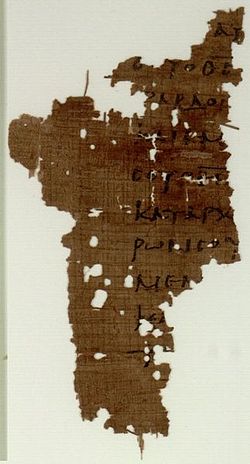
Some early manuscripts containing the text of this chapter in Greek are:
The Epistle to the Hebrews attests that God spoke decisively to Israel through the prophets and that he finally and fully revealed his character and will by his son, with the greatness and absolute superiority over the angels, the supernatural beings considered by Israel to be closest to God.
While the Old Testament revelation in time past came at many times throughout the history of Israel and in various ways such as 'dreams, visions and angelic messages', the ultimate revelation in these last days of human history came through Jesus Christ as the Son of God, who was with God from the beginning and through whom God made the universe (basically 'the whole universe of space and time'; cf. Hebrews 11:3); the Son is also appointed as the heir of all things (cf. Psalm 2:7–8) to possess and rule over 'all that was created through him'.
The reference to the heavenly enthronement of the Son in the previous part is followed by the explanation of his position to the angel world, using Psalm 110:1 as the framework to understand various other Old Testament texts.
Psalm 2:7 is cited because of the prophecy pertaining to the Messiah as Son of David, whereas 2 Samuel 7:14 is quoted as the theological basis from God's special promise to David and his dynasty. Psalm 2:7 is also quoted in Acts 13:33 and used for exposition in Hebrews 5:5.
Citing Psalm 97:7.
Hebrews 1
Hebrews 1 is the first chapter of the Epistle to the Hebrews in the New Testament of the Christian Bible. The author is anonymous, although the internal reference to "our brother Timothy" (Hebrews 13:23) causes a traditional attribution to Paul, but this attribution has been disputed since the second century and there is no decisive evidence for the authorship. This chapter contains the introduction ('exordium') about God's final revelation ('word') through his son and how the son is superior to angels.
The original text was written in Koine Greek. This chapter is divided into 14 verses.
Some early manuscripts containing the text of this chapter in Greek are:
The Epistle to the Hebrews attests that God spoke decisively to Israel through the prophets and that he finally and fully revealed his character and will by his son, with the greatness and absolute superiority over the angels, the supernatural beings considered by Israel to be closest to God.
While the Old Testament revelation in time past came at many times throughout the history of Israel and in various ways such as 'dreams, visions and angelic messages', the ultimate revelation in these last days of human history came through Jesus Christ as the Son of God, who was with God from the beginning and through whom God made the universe (basically 'the whole universe of space and time'; cf. Hebrews 11:3); the Son is also appointed as the heir of all things (cf. Psalm 2:7–8) to possess and rule over 'all that was created through him'.
The reference to the heavenly enthronement of the Son in the previous part is followed by the explanation of his position to the angel world, using Psalm 110:1 as the framework to understand various other Old Testament texts.
Psalm 2:7 is cited because of the prophecy pertaining to the Messiah as Son of David, whereas 2 Samuel 7:14 is quoted as the theological basis from God's special promise to David and his dynasty. Psalm 2:7 is also quoted in Acts 13:33 and used for exposition in Hebrews 5:5.
Citing Psalm 97:7.
Recent media
Recent media