
Recent from talks
Hedonic game
Knowledge base stats:
Talk channels stats:
Members stats:
Hedonic game
In cooperative game theory, a hedonic game (also known as a hedonic coalition formation game) is a game that models the formation of coalitions (groups) of players when players have preferences over which group they belong to. A hedonic game is specified by giving a finite set of players, and, for each player, a preference ranking over all coalitions (subsets) of players that the player belongs to. The outcome of a hedonic game consists of a partition of the players into disjoint coalitions, that is, each player is assigned a unique group. Such partitions are often referred to as coalition structures.
Hedonic games are a type of non-transferable utility game. Their distinguishing feature (the "hedonic aspect") is that players only care about the identity of the players in their coalition, but do not care about how the remaining players are partitioned, and do not care about anything other than which players are in their coalition. Thus, in contrast to other cooperative games, a coalition does not choose how to allocate profit among its members, and it does not choose a particular action to play. Some well-known subclasses of hedonic games are given by matching problems, such as the stable marriage, stable roommates, and the hospital/residents problems.
The players in hedonic games are typically understood to be self-interested, and thus hedonic games are usually analyzed in terms of the stability of coalition structures, where several notions of stability are used, including the core and Nash stability. Hedonic games are studied both in economics, where the focus lies on identifying sufficient conditions for the existence of stable outcomes, and in multi-agent systems, where the focus lies on identifying concise representations of hedonic games and on the computational complexity of finding stable outcomes.
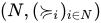
Formally, a hedonic game is a pair of a finite set of players (or agents), and, for each player a complete and transitive preference relation over the set of coalitions that player belongs to. A coalition is a subset of the set of players. The coalition is typically called the grand coalition.





A coalition structure is a partition of . Thus, every player belongs to a unique coalition in .


Like in other areas of game theory, the outcomes of hedonic games are evaluated using solution concepts. Many of these concepts refer to a notion of game-theoretic stability: an outcome is stable if no player (or possibly no coalition of players) can deviate from the outcome so as to reach a subjectively better outcome. Here we give definitions of several solution concepts from the literature.
One can also define Pareto optimality of a coalition structure. In the case that the preference relations are represented by utility functions, one can also consider coalition structures that maximize social welfare.
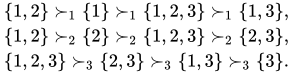
The following three-player game has been named "an undesired guest".From these preferences, we can see that and like each other, but dislike the presence of player .


Hub AI
Hedonic game AI simulator
(@Hedonic game_simulator)
Hedonic game
In cooperative game theory, a hedonic game (also known as a hedonic coalition formation game) is a game that models the formation of coalitions (groups) of players when players have preferences over which group they belong to. A hedonic game is specified by giving a finite set of players, and, for each player, a preference ranking over all coalitions (subsets) of players that the player belongs to. The outcome of a hedonic game consists of a partition of the players into disjoint coalitions, that is, each player is assigned a unique group. Such partitions are often referred to as coalition structures.
Hedonic games are a type of non-transferable utility game. Their distinguishing feature (the "hedonic aspect") is that players only care about the identity of the players in their coalition, but do not care about how the remaining players are partitioned, and do not care about anything other than which players are in their coalition. Thus, in contrast to other cooperative games, a coalition does not choose how to allocate profit among its members, and it does not choose a particular action to play. Some well-known subclasses of hedonic games are given by matching problems, such as the stable marriage, stable roommates, and the hospital/residents problems.
The players in hedonic games are typically understood to be self-interested, and thus hedonic games are usually analyzed in terms of the stability of coalition structures, where several notions of stability are used, including the core and Nash stability. Hedonic games are studied both in economics, where the focus lies on identifying sufficient conditions for the existence of stable outcomes, and in multi-agent systems, where the focus lies on identifying concise representations of hedonic games and on the computational complexity of finding stable outcomes.
Formally, a hedonic game is a pair of a finite set of players (or agents), and, for each player a complete and transitive preference relation over the set of coalitions that player belongs to. A coalition is a subset of the set of players. The coalition is typically called the grand coalition.
A coalition structure is a partition of . Thus, every player belongs to a unique coalition in .
Like in other areas of game theory, the outcomes of hedonic games are evaluated using solution concepts. Many of these concepts refer to a notion of game-theoretic stability: an outcome is stable if no player (or possibly no coalition of players) can deviate from the outcome so as to reach a subjectively better outcome. Here we give definitions of several solution concepts from the literature.
One can also define Pareto optimality of a coalition structure. In the case that the preference relations are represented by utility functions, one can also consider coalition structures that maximize social welfare.
The following three-player game has been named "an undesired guest".From these preferences, we can see that and like each other, but dislike the presence of player .