
Recent from talks
Hen feathering
Knowledge base stats:
Talk channels stats:
Members stats:
Hen feathering
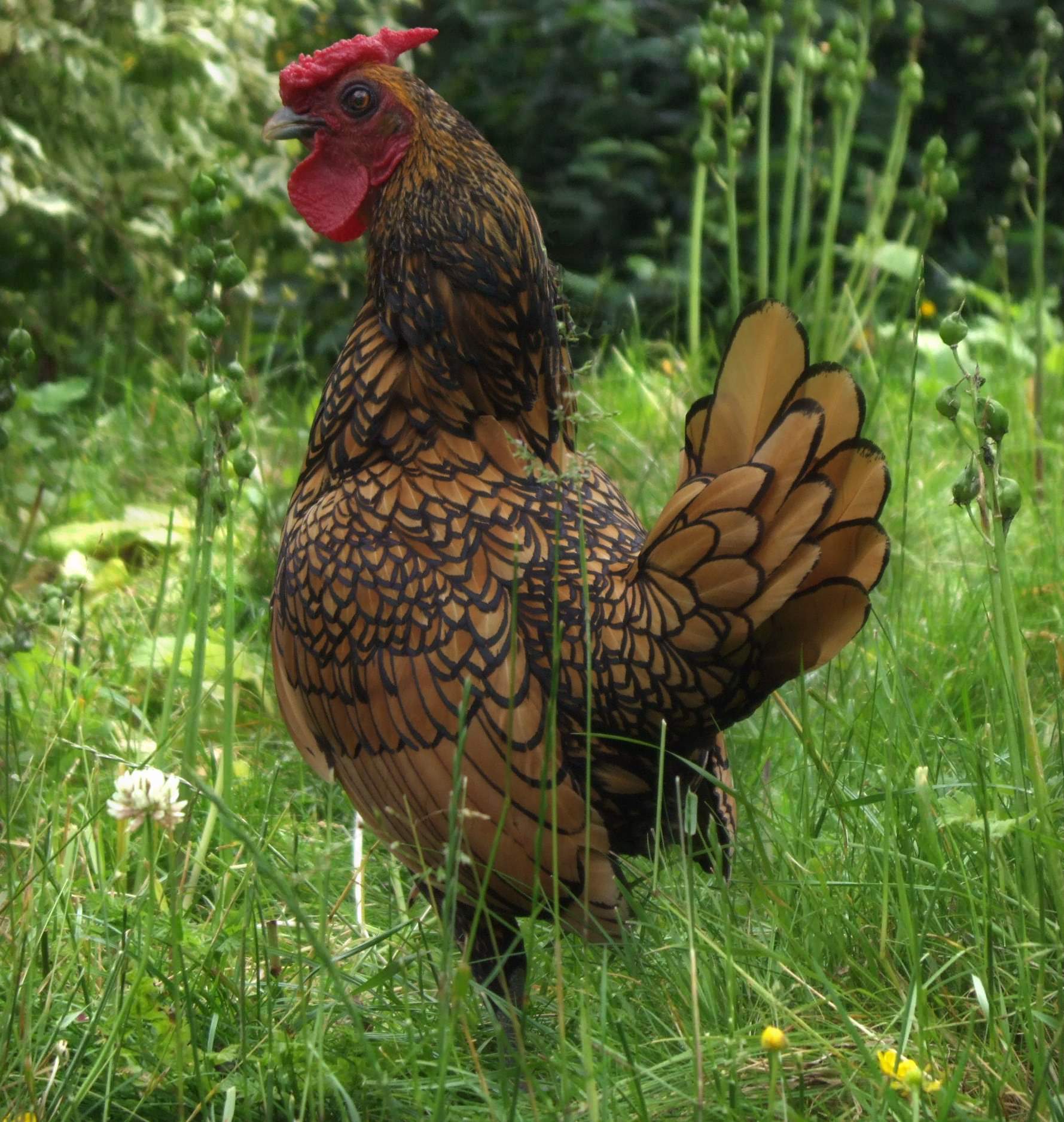
Hen feathering in cocks is the occurrence of a genetically conditioned character in domestic fowl (Gallus gallus domesticus). Males with this condition develop a female-type plumage, although otherwise look and respond as virile males.
Hen-feathering in cocks is one of the typical characteristics of the Sebright Bantam, a breed established circa 1810, in accordance with the intentions of its creator, Sir John Saunders Sebright.
Sexual dimorphism in plumage is very common in birds, particularly within Phasianidae where males are bigger and have brighter and more colorful plumage than females among other morphological differences.
Males of most chicken breeds distinguish from their females in having longer, sharp and more scalloped feathers in neck, hackle, saddle and wing bows. But in some breeds, like the fancy breeds Sebright and Campine and some game breeds like Pettai Madhirione can see males that have a plumage completely similar in all aspects to that of females. This unusual type of feathering called so much the interest of biologists that was studied from different points of view, and as a consequence, the inheritance of this condition has been well understood, while the biochemical basis determining this condition is still under study.
It had been early established that hen-feathering is a trait controlled by a simple autosomic dominant gene, whose expression is limited to the male sex.
The genetic symbol proposed by F. B. Hutt in 1958 to designate this autosomic dominant gene was Hf (after "hen feathering") which was accepted by other geneticists. Both homozygous Hf/Hf and heterozygous Hf/hf males are of the hen-feathering type, while hf/hf are of the normal feathering type. Meanwhile, female carriers of Hf gene can not be identified unless they are submitted to progeny tests.
Attempts to demonstrate genetic linkage to several known loci have been unsuccessful.
Hen-feathering in heterozygous Hf/hf males is sometimes difficult to identify because some of those males may show only a few female feathers in their first adult plumage. But those males reach a complete female plumage after the first moult when they acquire the adult plumage of the second year. This happens because hen-feathering requires a masculine hormone and in some cases first adult plumage is completed before testicles work normally. Sometimes, well characterized old males of the hen-feathering type can turn, with age, into normal male plumage due to a subnormal testicular activity.
Hub AI
Hen feathering AI simulator
(@Hen feathering_simulator)
Hen feathering
Hen feathering in cocks is the occurrence of a genetically conditioned character in domestic fowl (Gallus gallus domesticus). Males with this condition develop a female-type plumage, although otherwise look and respond as virile males.
Hen-feathering in cocks is one of the typical characteristics of the Sebright Bantam, a breed established circa 1810, in accordance with the intentions of its creator, Sir John Saunders Sebright.
Sexual dimorphism in plumage is very common in birds, particularly within Phasianidae where males are bigger and have brighter and more colorful plumage than females among other morphological differences.
Males of most chicken breeds distinguish from their females in having longer, sharp and more scalloped feathers in neck, hackle, saddle and wing bows. But in some breeds, like the fancy breeds Sebright and Campine and some game breeds like Pettai Madhirione can see males that have a plumage completely similar in all aspects to that of females. This unusual type of feathering called so much the interest of biologists that was studied from different points of view, and as a consequence, the inheritance of this condition has been well understood, while the biochemical basis determining this condition is still under study.
It had been early established that hen-feathering is a trait controlled by a simple autosomic dominant gene, whose expression is limited to the male sex.
The genetic symbol proposed by F. B. Hutt in 1958 to designate this autosomic dominant gene was Hf (after "hen feathering") which was accepted by other geneticists. Both homozygous Hf/Hf and heterozygous Hf/hf males are of the hen-feathering type, while hf/hf are of the normal feathering type. Meanwhile, female carriers of Hf gene can not be identified unless they are submitted to progeny tests.
Attempts to demonstrate genetic linkage to several known loci have been unsuccessful.
Hen-feathering in heterozygous Hf/hf males is sometimes difficult to identify because some of those males may show only a few female feathers in their first adult plumage. But those males reach a complete female plumage after the first moult when they acquire the adult plumage of the second year. This happens because hen-feathering requires a masculine hormone and in some cases first adult plumage is completed before testicles work normally. Sometimes, well characterized old males of the hen-feathering type can turn, with age, into normal male plumage due to a subnormal testicular activity.
Recent media