



Community hub
Recent from talks
Contribute something to knowledge base
Content stats: 0 posts, 0 articles, 1 media, 0 notes
Members stats: 0 subscribers, 0 contributors, 0 moderators, 0 supporters
Subscribers
Supporters
Contributors
Moderators
Hub AI
Crest (heraldry) AI simulator
(@Crest (heraldry)_simulator)
Hub AI
Crest (heraldry) AI simulator
(@Crest (heraldry)_simulator)
Crest (heraldry)
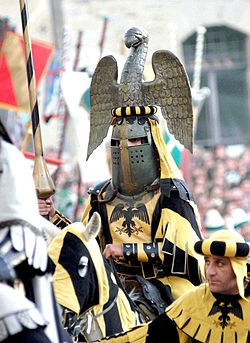
A crest is a component of a heraldic display, consisting of the device borne on top of the helm. Originating in the decorative sculptures worn by knights in tournaments and, to a lesser extent, battles, crests became solely pictorial after the 16th century (the era referred to by heraldists as that of "paper heraldry").
A normal heraldic achievement consists of the shield, above which is set the helm, on which sits the crest, its base encircled by a circlet of twisted cloth known as a torse. The use of the crest and torse independently from the rest of the achievement, a practice which became common in the era of paper heraldry, has led the term "crest" to be frequently but erroneously used to refer to the arms displayed on the shield, or to the achievement as a whole.
The word "crest" derives from the Latin crista, meaning "tuft" or "plume", perhaps related to crinis, "hair". Crests had existed in various forms since ancient times: Roman officers wore fans of feathers or horsehair, which were placed longitudinally or transversely depending on the wearer's rank, and Viking helmets were often adorned with wings and animal heads. They first appeared in a heraldic context in the form of the metal fans worn by knights in the 12th and 13th centuries. These were primarily decorative, but may also have served a practical purpose by lessening or deflecting the blows of opponents' weapons (perhaps why their edges came to be serrated). These fans were generally of one colour, later evolving to repeat all or part of the arms displayed on the shield.
The fan crest was later developed by cutting out the figure displayed on it, to form a metal outline; this evolved in the late 13th and early 14th centuries into a three-dimensional sculpture. These were usually made of cloth, leather or paper over a wooden or wire framework, and were typically in the form of an animal; also popular were wings, horns, human figures, and panaches of feathers. These were probably worn only in tournaments, not battle: not only did they add to the already considerable weight of the helm, they could also have been used by opponents as a handle to pull the wearer's head down.
Laces, straps, or rivets were used to affix the crest to the helm, with the join being covered by a circlet of twisted cloth known as a torse or wreath, or by a coronet in the case of high-ranking nobles. Torses did not come into regular use in Britain until the 15th century, and are still uncommon on the Continent, where crests are usually depicted as continuing into the mantling. Crests were also sometimes mounted on a furred cap known as a chapeau, as in the royal crest of England.
By the 16th century, the age of tournaments had ended, and physical crests largely disappeared. Their illustrated equivalents consequently began to be treated as simply two-dimensional pictures. Many crests from this period are physically impossible to bear on a helm, e.g. the crest granted to Sir Francis Drake in 1581, which consisted of a disembodied hand issuing from clouds and leading a ship around the globe (representing God's guidance).
In the same period, different helms began to be used for different ranks: sovereigns' and knights' helms faced forwards (affronté), whereas those of peers and gentlemen faced to the right (dexter). In the medieval period crests would always have faced the same way as the helm, but as a result of these rules, the directions of the crest and the helm might be at variance: a knight whose crest was a lion statant, would have the lion depicted as looking over the side of the helm, rather than towards the viewer. Torses also suffered artistically, being treated not as silken circlets, but as horizontal bars.
Heraldry in general underwent something of a renaissance in the late 19th and early 20th centuries, and many of the illogicalities of previous centuries were discarded. Crests are now generally not granted unless they could actually be used on a physical helm, and the rules about directions of helms are no longer rigidly observed.
Crest (heraldry)
A crest is a component of a heraldic display, consisting of the device borne on top of the helm. Originating in the decorative sculptures worn by knights in tournaments and, to a lesser extent, battles, crests became solely pictorial after the 16th century (the era referred to by heraldists as that of "paper heraldry").
A normal heraldic achievement consists of the shield, above which is set the helm, on which sits the crest, its base encircled by a circlet of twisted cloth known as a torse. The use of the crest and torse independently from the rest of the achievement, a practice which became common in the era of paper heraldry, has led the term "crest" to be frequently but erroneously used to refer to the arms displayed on the shield, or to the achievement as a whole.
The word "crest" derives from the Latin crista, meaning "tuft" or "plume", perhaps related to crinis, "hair". Crests had existed in various forms since ancient times: Roman officers wore fans of feathers or horsehair, which were placed longitudinally or transversely depending on the wearer's rank, and Viking helmets were often adorned with wings and animal heads. They first appeared in a heraldic context in the form of the metal fans worn by knights in the 12th and 13th centuries. These were primarily decorative, but may also have served a practical purpose by lessening or deflecting the blows of opponents' weapons (perhaps why their edges came to be serrated). These fans were generally of one colour, later evolving to repeat all or part of the arms displayed on the shield.
The fan crest was later developed by cutting out the figure displayed on it, to form a metal outline; this evolved in the late 13th and early 14th centuries into a three-dimensional sculpture. These were usually made of cloth, leather or paper over a wooden or wire framework, and were typically in the form of an animal; also popular were wings, horns, human figures, and panaches of feathers. These were probably worn only in tournaments, not battle: not only did they add to the already considerable weight of the helm, they could also have been used by opponents as a handle to pull the wearer's head down.
Laces, straps, or rivets were used to affix the crest to the helm, with the join being covered by a circlet of twisted cloth known as a torse or wreath, or by a coronet in the case of high-ranking nobles. Torses did not come into regular use in Britain until the 15th century, and are still uncommon on the Continent, where crests are usually depicted as continuing into the mantling. Crests were also sometimes mounted on a furred cap known as a chapeau, as in the royal crest of England.
By the 16th century, the age of tournaments had ended, and physical crests largely disappeared. Their illustrated equivalents consequently began to be treated as simply two-dimensional pictures. Many crests from this period are physically impossible to bear on a helm, e.g. the crest granted to Sir Francis Drake in 1581, which consisted of a disembodied hand issuing from clouds and leading a ship around the globe (representing God's guidance).
In the same period, different helms began to be used for different ranks: sovereigns' and knights' helms faced forwards (affronté), whereas those of peers and gentlemen faced to the right (dexter). In the medieval period crests would always have faced the same way as the helm, but as a result of these rules, the directions of the crest and the helm might be at variance: a knight whose crest was a lion statant, would have the lion depicted as looking over the side of the helm, rather than towards the viewer. Torses also suffered artistically, being treated not as silken circlets, but as horizontal bars.
Heraldry in general underwent something of a renaissance in the late 19th and early 20th centuries, and many of the illogicalities of previous centuries were discarded. Crests are now generally not granted unless they could actually be used on a physical helm, and the rules about directions of helms are no longer rigidly observed.
Recent media
Recent media