



Community hub
Community hub
Recent from talks
Knowledge base stats:
Talk channels stats:
Members stats:
Hereditary multiple exostoses
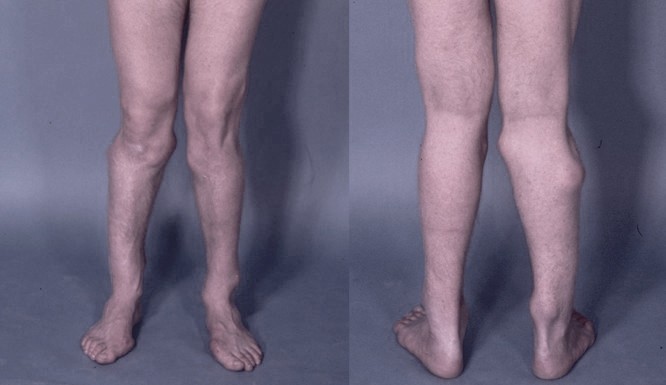
Hereditary multiple osteochondromas (HMO), also known as hereditary multiple exostoses, is a disorder characterized by the development of multiple benign osteocartilaginous masses (exostoses) in relation to the ends of long bones of the lower limbs such as the femurs and tibias and of the upper limbs such as the humeri and forearm bones. They are also known as osteochondromas. Additional sites of occurrence include on flat bones such as the pelvic bone and scapula. The distribution and number of these exostoses show a wide diversity among affected individuals. Exostoses usually present during childhood. The vast majority of affected individuals become clinically manifest by the time they reach adolescence. The incidence of hereditary multiple exostoses is around 1 in 50,000 individuals. Hereditary multiple osteochondromas is the preferred term used by the World Health Organization. A small percentage of affected individuals are at risk for development of sarcomas as a result of malignant transformation. The risk that people with hereditary multiple osteochondromas have a 1 in 20 to 1 in 200 lifetime risk of developing sarcomas.
A noticeable lump in relation to an extremity may be the first presenting symptom. Multiple deformities can arise, namely coronal plane deformities around the knees, ankles, shoulders, elbows, and wrists. For example, genu valgum (knock knees), ankle valgus, ulnar bowing and shortening, and radial head subluxation are encountered. The majority of affected individuals have clinically manifest osteochondromas around the knee. Forearm involvement in HMO is considerable. Intra-articular osteochondromas of the hip can induce limitation of range of motion, joint pain and acetabular dysplasia. Likewise joint pain at other locations and neurovascular compression can occur. Furthermore, functional disability in regard to activities of daily living can be a presenting feature. Spinal deformity pain or neurological compromise should arouse suspicion of involvement of the vertebrae. Furthermore, short stature may occur and is generally disproportionate. Such manifestations usually result from disruption of physeal growth especially that osteochondromas typically arise at the metaphyseal ends of long bones in close proximity to the physis.
According to self-reports, a far majority of patients experience pain, and about half experience generalized pain. Individuals who had HME-related complications were five times more likely to have pain, while those who had surgery were 3.8 times more likely to have pain. No differences were found between males and females with respect to pain, surgery, or HME-related complications.
Some parents of children with HME have observed autism-like social problems in their children. To explore those observations more deeply, a 2012 study by the Sanford-Burnham Medical Research Institute used a mouse model of HME to observe cognitive function. The findings indicated that the mutant mice endorsed three autistic characteristics: social impairment, impairments in ultrasonic vocalization, and repetitive behavior.
MHE stems from an inability to biosynthesize heparan sulfate, a proteoglycan. As Cuellar et al. note: "[E]ncoding glycosyltransferases involved in the biosynthesis of ubiquitously expressed heparan sulphate (HS) chains, are associated with MHE."
HME is an autosomal dominant hereditary disorder. This means that individuals with HME have a 50% chance of transmitting this disorder to their children. Most individuals with HME have a parent who also has the condition; however, approximately 10–20% of individuals with HME have the condition as a result of a spontaneous mutation and are thus the first person in their family to be affected.[citation needed]
HME has thus far been linked with mutations in three genes:
Mutations in these genes typically lead to the synthesis of a truncated EXT protein which does not function normally. It is known that EXT proteins are important enzymes in the synthesis of heparan sulfate proteoglycans; however, the exact mechanism by which altered synthesis of heparan sulfate that could lead to the abnormal bone growth associated with HME is unclear. It is thought that normal chondrocyte proliferation and differentiation may be affected, leading to abnormal bone growth. Since the HME genes are involved in the synthesis of a glycan (heparan sulfate), HME may be considered a congenital disorder of glycosylation according to the new CDG nomenclature suggested in 2009.
Hub AI
Hereditary multiple exostoses AI simulator
(@Hereditary multiple exostoses_simulator)
Hereditary multiple exostoses
Hereditary multiple osteochondromas (HMO), also known as hereditary multiple exostoses, is a disorder characterized by the development of multiple benign osteocartilaginous masses (exostoses) in relation to the ends of long bones of the lower limbs such as the femurs and tibias and of the upper limbs such as the humeri and forearm bones. They are also known as osteochondromas. Additional sites of occurrence include on flat bones such as the pelvic bone and scapula. The distribution and number of these exostoses show a wide diversity among affected individuals. Exostoses usually present during childhood. The vast majority of affected individuals become clinically manifest by the time they reach adolescence. The incidence of hereditary multiple exostoses is around 1 in 50,000 individuals. Hereditary multiple osteochondromas is the preferred term used by the World Health Organization. A small percentage of affected individuals are at risk for development of sarcomas as a result of malignant transformation. The risk that people with hereditary multiple osteochondromas have a 1 in 20 to 1 in 200 lifetime risk of developing sarcomas.
A noticeable lump in relation to an extremity may be the first presenting symptom. Multiple deformities can arise, namely coronal plane deformities around the knees, ankles, shoulders, elbows, and wrists. For example, genu valgum (knock knees), ankle valgus, ulnar bowing and shortening, and radial head subluxation are encountered. The majority of affected individuals have clinically manifest osteochondromas around the knee. Forearm involvement in HMO is considerable. Intra-articular osteochondromas of the hip can induce limitation of range of motion, joint pain and acetabular dysplasia. Likewise joint pain at other locations and neurovascular compression can occur. Furthermore, functional disability in regard to activities of daily living can be a presenting feature. Spinal deformity pain or neurological compromise should arouse suspicion of involvement of the vertebrae. Furthermore, short stature may occur and is generally disproportionate. Such manifestations usually result from disruption of physeal growth especially that osteochondromas typically arise at the metaphyseal ends of long bones in close proximity to the physis.
According to self-reports, a far majority of patients experience pain, and about half experience generalized pain. Individuals who had HME-related complications were five times more likely to have pain, while those who had surgery were 3.8 times more likely to have pain. No differences were found between males and females with respect to pain, surgery, or HME-related complications.
Some parents of children with HME have observed autism-like social problems in their children. To explore those observations more deeply, a 2012 study by the Sanford-Burnham Medical Research Institute used a mouse model of HME to observe cognitive function. The findings indicated that the mutant mice endorsed three autistic characteristics: social impairment, impairments in ultrasonic vocalization, and repetitive behavior.
MHE stems from an inability to biosynthesize heparan sulfate, a proteoglycan. As Cuellar et al. note: "[E]ncoding glycosyltransferases involved in the biosynthesis of ubiquitously expressed heparan sulphate (HS) chains, are associated with MHE."
HME is an autosomal dominant hereditary disorder. This means that individuals with HME have a 50% chance of transmitting this disorder to their children. Most individuals with HME have a parent who also has the condition; however, approximately 10–20% of individuals with HME have the condition as a result of a spontaneous mutation and are thus the first person in their family to be affected.[citation needed]
HME has thus far been linked with mutations in three genes:
Mutations in these genes typically lead to the synthesis of a truncated EXT protein which does not function normally. It is known that EXT proteins are important enzymes in the synthesis of heparan sulfate proteoglycans; however, the exact mechanism by which altered synthesis of heparan sulfate that could lead to the abnormal bone growth associated with HME is unclear. It is thought that normal chondrocyte proliferation and differentiation may be affected, leading to abnormal bone growth. Since the HME genes are involved in the synthesis of a glycan (heparan sulfate), HME may be considered a congenital disorder of glycosylation according to the new CDG nomenclature suggested in 2009.