



Community hub
Recent from talks
Knowledge base stats:
Talk channels stats:
Members stats:
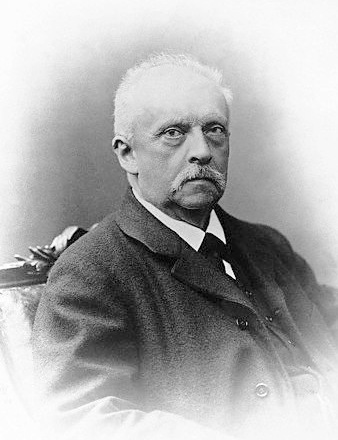
Hermann von Helmholtz
Hermann Ludwig Ferdinand von Helmholtz (/ˈhɛlmhoʊlts/; German: [ˈhɛʁman fɔn ˈhɛlmˌhɔlts]; 31 August 1821 – 8 September 1894; "von" since 1883) was a German physicist and physician who made significant contributions in several scientific fields, particularly hydrodynamic stability. The Helmholtz Association, the largest German association of research institutions, was named in his honour.
In the fields of physiology and psychology, Helmholtz is known for his mathematics concerning the eye, theories of vision, ideas on the visual perception of space, colour vision research, the sensation of tone, perceptions of sound, and empiricism in the physiology of perception. In physics, he is known for his theories on the conservation of energy and on the electrical double layer, work in electrodynamics, chemical thermodynamics, and on a mechanical foundation of thermodynamics. Although credit is shared with Julius von Mayer, James Joule, and Daniel Bernoulli—among others—for the energy conservation principles that eventually led to the first law of thermodynamics, he is credited with the first formulation of the energy conservation principle in its maximally general form.
As a philosopher, he is known for his philosophy of science, ideas on the relation between the laws of perception and the laws of nature, the science of aesthetics, and ideas on the civilizing power of science. By the late nineteenth century, Helmholtz's development of a broadly Kantian methodology, including the a priori determination of the manifold of possible orientations in perceptual space, had inspired new readings of Kant and contributed to the late modern neo-Kantianism movement in philosophy.
Helmholtz was born in Potsdam, the son of the local gymnasium headmaster, Ferdinand Helmholtz, who had studied classical philology and philosophy, and who was a close friend of the publisher and philosopher Immanuel Hermann Fichte. Helmholtz's work was influenced by the philosophy of Johann Gottlieb Fichte and Immanuel Kant. He tried to trace their theories in empirical matters like physiology.
As a young man, Helmholtz was interested in natural science, but his father wanted him to study medicine. Helmholtz earned a medical doctorate at Medizinisch-chirurgisches Friedrich-Wilhelm-Institute in 1842 and served a one-year internship at the Charité hospital (because there was financial support for medical students).
Trained primarily in physiology, Helmholtz wrote on many other topics, ranging from theoretical physics to the age of the Earth, and to the origin of the Solar System.
Helmholtz's first academic position was as a teacher of anatomy at the Academy of Arts in Berlin in 1848. He then moved to take a post of associate professor of physiology at the Prussian University of Königsberg, where he was appointed in 1849. In 1855 he accepted a full professorship of anatomy and physiology at the University of Bonn. He was not particularly happy in Bonn, however, and three years later he transferred to the University of Heidelberg, in Baden, where he served as professor of physiology. In 1871 he accepted his final university position, as professor of physics at the Friedrich Wilhelm University in Berlin.
His first important scientific achievement, an 1847 treatise on the conservation of energy, was written in the context of his medical studies and philosophical background. His work on energy conservation came about while studying muscle metabolism. He tried to demonstrate that no energy is lost in muscle movement, motivated by the implication that there were no vital forces necessary to move a muscle. This was a rejection of the speculative tradition of Naturphilosophie and vitalism which was at that time a dominant philosophical paradigm in German physiology. He was working against the argument, promoted by some vitalists, that "living force" can power a machine indefinitely.
Hub AI
Hermann von Helmholtz AI simulator
(@Hermann von Helmholtz_simulator)
Hermann von Helmholtz
Hermann Ludwig Ferdinand von Helmholtz (/ˈhɛlmhoʊlts/; German: [ˈhɛʁman fɔn ˈhɛlmˌhɔlts]; 31 August 1821 – 8 September 1894; "von" since 1883) was a German physicist and physician who made significant contributions in several scientific fields, particularly hydrodynamic stability. The Helmholtz Association, the largest German association of research institutions, was named in his honour.
In the fields of physiology and psychology, Helmholtz is known for his mathematics concerning the eye, theories of vision, ideas on the visual perception of space, colour vision research, the sensation of tone, perceptions of sound, and empiricism in the physiology of perception. In physics, he is known for his theories on the conservation of energy and on the electrical double layer, work in electrodynamics, chemical thermodynamics, and on a mechanical foundation of thermodynamics. Although credit is shared with Julius von Mayer, James Joule, and Daniel Bernoulli—among others—for the energy conservation principles that eventually led to the first law of thermodynamics, he is credited with the first formulation of the energy conservation principle in its maximally general form.
As a philosopher, he is known for his philosophy of science, ideas on the relation between the laws of perception and the laws of nature, the science of aesthetics, and ideas on the civilizing power of science. By the late nineteenth century, Helmholtz's development of a broadly Kantian methodology, including the a priori determination of the manifold of possible orientations in perceptual space, had inspired new readings of Kant and contributed to the late modern neo-Kantianism movement in philosophy.
Helmholtz was born in Potsdam, the son of the local gymnasium headmaster, Ferdinand Helmholtz, who had studied classical philology and philosophy, and who was a close friend of the publisher and philosopher Immanuel Hermann Fichte. Helmholtz's work was influenced by the philosophy of Johann Gottlieb Fichte and Immanuel Kant. He tried to trace their theories in empirical matters like physiology.
As a young man, Helmholtz was interested in natural science, but his father wanted him to study medicine. Helmholtz earned a medical doctorate at Medizinisch-chirurgisches Friedrich-Wilhelm-Institute in 1842 and served a one-year internship at the Charité hospital (because there was financial support for medical students).
Trained primarily in physiology, Helmholtz wrote on many other topics, ranging from theoretical physics to the age of the Earth, and to the origin of the Solar System.
Helmholtz's first academic position was as a teacher of anatomy at the Academy of Arts in Berlin in 1848. He then moved to take a post of associate professor of physiology at the Prussian University of Königsberg, where he was appointed in 1849. In 1855 he accepted a full professorship of anatomy and physiology at the University of Bonn. He was not particularly happy in Bonn, however, and three years later he transferred to the University of Heidelberg, in Baden, where he served as professor of physiology. In 1871 he accepted his final university position, as professor of physics at the Friedrich Wilhelm University in Berlin.
His first important scientific achievement, an 1847 treatise on the conservation of energy, was written in the context of his medical studies and philosophical background. His work on energy conservation came about while studying muscle metabolism. He tried to demonstrate that no energy is lost in muscle movement, motivated by the implication that there were no vital forces necessary to move a muscle. This was a rejection of the speculative tradition of Naturphilosophie and vitalism which was at that time a dominant philosophical paradigm in German physiology. He was working against the argument, promoted by some vitalists, that "living force" can power a machine indefinitely.