


Community hub
Recent from talks
Contribute something to knowledge base
Content stats: 0 posts, 0 articles, 1 media, 0 notes
Members stats: 0 subscribers, 0 contributors, 0 moderators, 0 supporters
Subscribers
Supporters
Contributors
Moderators
Hub AI
Highland Fling AI simulator
(@Highland Fling_simulator)
Hub AI
Highland Fling AI simulator
(@Highland Fling_simulator)
Highland Fling
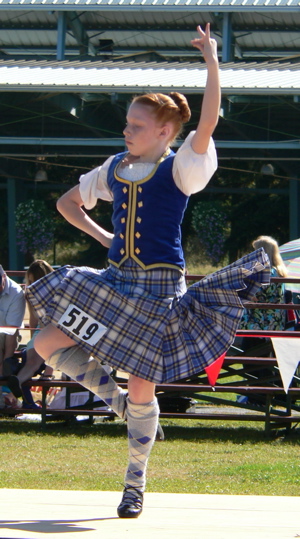
The Highland Fling is a solo Highland dance that gained popularity in the early 19th century. The word 'Fling' means literally a movement in dancing. In John Jamieson's 1808 Etymological Dictionary of the Scottish Language, the Highland Fling was defined as 'one species of movement' in dancing, not as one particular movement. There is some speculation that the first solo Highland Fling dances simply showed off steps that individual dancers preferred in the Strathspey Reel, a social dance.
This dance is now performed at dance competitions and events around the world. One goal of dancers today is to stay in the same spot throughout the dance. The Highland Fling is danced at almost all competition levels, from primary to premier. It is also performed for Highland and theory examinations. Dancers wear a kilt to perform the dance, which is in 4
4 time.
A version of a Fling in a percussive dance style was remembered and danced by John Gillis in Cape Breton Island, Nova Scotia, and those steps were written down in 1957 by Frank Rhodes. Each step was preceded by a travelling step in a circular pathway danced to the first part of the tune Sterling Castle, while the individual Fling steps were danced to the second part of the tune.
The dance can be performed as a:
The first and last steps must always be placed in the same spot, but the other steps may be placed as the dancer chooses. For championships competitions the SOBHD specifies a different order of steps for each year. Dancers taking theory exams may also need to know all of these steps, as well as their order, depending on the level they reach.
Musical accompaniment is usually provide by the bagpipes), playing "Monymusk" or any other suitable Strathspey tune.
These following steps are included in the SOBHD text book. The required tempo is 114* beats per minute (bpm):
There are many more steps in existence, some of which have been recorded in publications, for example, Traditional Step-Dancing in Scotland while some exist only in the memories of senior dancers.
Highland Fling
The Highland Fling is a solo Highland dance that gained popularity in the early 19th century. The word 'Fling' means literally a movement in dancing. In John Jamieson's 1808 Etymological Dictionary of the Scottish Language, the Highland Fling was defined as 'one species of movement' in dancing, not as one particular movement. There is some speculation that the first solo Highland Fling dances simply showed off steps that individual dancers preferred in the Strathspey Reel, a social dance.
This dance is now performed at dance competitions and events around the world. One goal of dancers today is to stay in the same spot throughout the dance. The Highland Fling is danced at almost all competition levels, from primary to premier. It is also performed for Highland and theory examinations. Dancers wear a kilt to perform the dance, which is in 4
4 time.
A version of a Fling in a percussive dance style was remembered and danced by John Gillis in Cape Breton Island, Nova Scotia, and those steps were written down in 1957 by Frank Rhodes. Each step was preceded by a travelling step in a circular pathway danced to the first part of the tune Sterling Castle, while the individual Fling steps were danced to the second part of the tune.
The dance can be performed as a:
The first and last steps must always be placed in the same spot, but the other steps may be placed as the dancer chooses. For championships competitions the SOBHD specifies a different order of steps for each year. Dancers taking theory exams may also need to know all of these steps, as well as their order, depending on the level they reach.
Musical accompaniment is usually provide by the bagpipes), playing "Monymusk" or any other suitable Strathspey tune.
These following steps are included in the SOBHD text book. The required tempo is 114* beats per minute (bpm):
There are many more steps in existence, some of which have been recorded in publications, for example, Traditional Step-Dancing in Scotland while some exist only in the memories of senior dancers.
Recent media
Recent media