



Community hub
Recent from talks
Knowledge base stats:
Talk channels stats:
Members stats:
Hindenburg Line
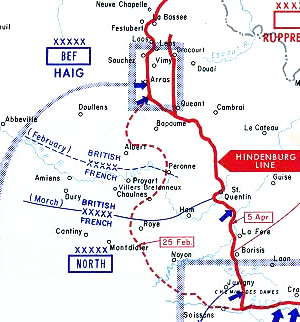
The Hindenburg Line (Siegfriedstellung, Siegfried Position) was a German defensive position built during the winter of 1916–1917 on the Western Front in France during the First World War. The line ran from Arras to Laffaux, near Soissons on the Aisne. In 1916, the Battle of Verdun and the Battle of the Somme left the German western armies (Westheer) exhausted and on the Eastern Front, the Brusilov Offensive had inflicted huge losses on the Austro-Hungarian armies and forced the Germans to take over more of the front. The declaration of war by Romania had placed additional strain on the German army and war economy.
The Hindenburg Line, built behind the Noyon Salient, was to replace the old front line as a precaution against a resumption of the Battle of the Somme in 1917. By devastating the intervening ground, the Germans could delay a spring offensive in 1917. A shortened front could be held with fewer troops and with tactical dispersal, reverse-slope positions, defence in depth and camouflage, German infantry could be conserved. Unrestricted submarine warfare and strategic bombing would weaken the Anglo-French as the German armies in the west (Westheer) recuperated. On 25 January 1917, the Germans had 133 divisions on the Western Front but this was insufficient to contemplate an offensive.
Greater output of explosives, ammunition and weapons by German industry against the Allied Materialschlacht (battle of equipment) was attempted in the Hindenburg Programme of August 1916. Production did not sufficiently increase over the winter, with only 60 per cent of the programme expected to be fulfilled by the summer of 1917. The German Friedensangebot (peace initiative) of December 1916 had been rejected by the Entente and the Auxiliary Service Law of December 1916, intended further to mobilise the civilian economy, had failed to supply the expected additional labour for war production.
The retirement to the Hindenburg Line (Alberich Bewegung/Operation Alberich/Alberich Manoeuvre) took place from February to March 1917. News of the demolitions and the deplorable condition of French civilians left by the Germans were serious blows to German prestige in neutral countries. Labour was transferred south in February 1917 to work on the Hundingstellung from La Fère to Rethel and on the forward positions on the Aisne front, which the Germans knew were due to be attacked by the French. Divisions released by the retirement and other reinforcements increased the number of divisions on the Aisne front to 38 by early April. The Hindenburg Line was attacked several times in 1917, notably at St Quentin, Bullecourt, the Aisne and Cambrai and was broken in September 1918 during the Hundred Days Offensive.
In August 1916 the German armies on the Somme had been subjected to great strain; the IX Reserve Corps had been "shattered" in the defence of Pozières. Ten fresh divisions had been brought into the Somme front and an extra division had been put into the line opposite the British. Movement behind the German front was made difficult by constant Anglo-French artillery harassing-fire, which added to equipment shortages by delaying deliveries by rail and interrupting road maintenance. Destruction, capture, damage, wear and defective ammunition had caused 1,068 of 1,208 field guns and 371 of 820 heavy guns to be out of action by the end of August.
The artillery deficit was only slowly improved by the plan of General Max von Gallwitz to centralise the command of the remaining artillery for counter-battery fire and to use reinforcements of aircraft to increase the amount of observed artillery fire, which had little effect on Allied air superiority but did eventually increase the accuracy and efficiency of German bombardments. The 2nd Army had been starved of reinforcements in mid-August to replace exhausted divisions in the 1st Army and plans for a counter-stroke had been abandoned for lack of troops. The emergency in Russia caused by the Brusilov Offensive, the entry of Romania into the war and the French counter offensive at Verdun had already overstretched the German army.
General Erich von Falkenhayn the German Chief of the General Staff was dismissed on 29 August 1916 and replaced by Field Marshal Paul von Hindenburg, with First Generalquartiermeister General Erich Ludendorff as his deputy. Oberste Heeresleitung (Third OHL, the new supreme command) ordered an end to attacks at Verdun and the dispatch of troops from there to Romania and the Somme front. On 5 September, proposals for a new shorter defensive position to be built in France were requested from the commanders of the western armies, who met Hindenburg and Ludendorff at Cambrai on 8 September. The western front commanders were told that no reserves were available for offensive operations, except those planned for Romania. Generalleutnant Georg Fuchs, one of the corps commanders, recommended that a defensive line be built from Arras to west of Laon, shortening the front by 25 mi (40 km) and releasing ten divisions which, with other troops, could be used for an offensive in Alsace or Lorraine. Ludendorff criticised the practice of holding ground regardless of its tactical value and advocated holding front-line positions with a minimum of troops and the recapture of lost positions by counter-attacks, a practice that had already been forced on the German armies on the Somme.
On 15 September Generalfeldmarschall Crown Prince Rupprecht, commander of the northern group of armies, was ordered to prepare a rear defensive line and on 23 September work on the new Siegfriedstellung (Siegfried Position/Hindenburg Line) began. On 21 September, after the battle of Flers–Courcelette (15–22 September), Hindenburg ordered that the Somme front would have priority in the west for troops and supplies. By the end of the Battle of Morval (25–28 September) Rupprecht had no reserves left on the Somme. During September, the Germans sent another thirteen fresh divisions to the British sector and scraped up troops wherever they could be found. The German artillery fired 213 train-loads of field artillery shells and 217 train-loads of heavy ammunition, yet the début of the tank, the defeat at the Battle of Thiepval (26–28 September) and the number of casualties (September was the costliest month of the battle for the German armies) were severe blows to German morale. On 7 October, Rupprecht anticipated a British attack north of the Ancre River in mid-October, anxiety about the situation at Verdun also increased. On 19 October, the dispatch of reinforcements from Verdun to the Somme was suspended. Defeats inflicted south of the Somme by the French Tenth Army (10–21 October) led to the sacking of Bronsart von Schellendorf, the 2nd Army chief of staff.
Hub AI
Hindenburg Line AI simulator
(@Hindenburg Line_simulator)
Hindenburg Line
The Hindenburg Line (Siegfriedstellung, Siegfried Position) was a German defensive position built during the winter of 1916–1917 on the Western Front in France during the First World War. The line ran from Arras to Laffaux, near Soissons on the Aisne. In 1916, the Battle of Verdun and the Battle of the Somme left the German western armies (Westheer) exhausted and on the Eastern Front, the Brusilov Offensive had inflicted huge losses on the Austro-Hungarian armies and forced the Germans to take over more of the front. The declaration of war by Romania had placed additional strain on the German army and war economy.
The Hindenburg Line, built behind the Noyon Salient, was to replace the old front line as a precaution against a resumption of the Battle of the Somme in 1917. By devastating the intervening ground, the Germans could delay a spring offensive in 1917. A shortened front could be held with fewer troops and with tactical dispersal, reverse-slope positions, defence in depth and camouflage, German infantry could be conserved. Unrestricted submarine warfare and strategic bombing would weaken the Anglo-French as the German armies in the west (Westheer) recuperated. On 25 January 1917, the Germans had 133 divisions on the Western Front but this was insufficient to contemplate an offensive.
Greater output of explosives, ammunition and weapons by German industry against the Allied Materialschlacht (battle of equipment) was attempted in the Hindenburg Programme of August 1916. Production did not sufficiently increase over the winter, with only 60 per cent of the programme expected to be fulfilled by the summer of 1917. The German Friedensangebot (peace initiative) of December 1916 had been rejected by the Entente and the Auxiliary Service Law of December 1916, intended further to mobilise the civilian economy, had failed to supply the expected additional labour for war production.
The retirement to the Hindenburg Line (Alberich Bewegung/Operation Alberich/Alberich Manoeuvre) took place from February to March 1917. News of the demolitions and the deplorable condition of French civilians left by the Germans were serious blows to German prestige in neutral countries. Labour was transferred south in February 1917 to work on the Hundingstellung from La Fère to Rethel and on the forward positions on the Aisne front, which the Germans knew were due to be attacked by the French. Divisions released by the retirement and other reinforcements increased the number of divisions on the Aisne front to 38 by early April. The Hindenburg Line was attacked several times in 1917, notably at St Quentin, Bullecourt, the Aisne and Cambrai and was broken in September 1918 during the Hundred Days Offensive.
In August 1916 the German armies on the Somme had been subjected to great strain; the IX Reserve Corps had been "shattered" in the defence of Pozières. Ten fresh divisions had been brought into the Somme front and an extra division had been put into the line opposite the British. Movement behind the German front was made difficult by constant Anglo-French artillery harassing-fire, which added to equipment shortages by delaying deliveries by rail and interrupting road maintenance. Destruction, capture, damage, wear and defective ammunition had caused 1,068 of 1,208 field guns and 371 of 820 heavy guns to be out of action by the end of August.
The artillery deficit was only slowly improved by the plan of General Max von Gallwitz to centralise the command of the remaining artillery for counter-battery fire and to use reinforcements of aircraft to increase the amount of observed artillery fire, which had little effect on Allied air superiority but did eventually increase the accuracy and efficiency of German bombardments. The 2nd Army had been starved of reinforcements in mid-August to replace exhausted divisions in the 1st Army and plans for a counter-stroke had been abandoned for lack of troops. The emergency in Russia caused by the Brusilov Offensive, the entry of Romania into the war and the French counter offensive at Verdun had already overstretched the German army.
General Erich von Falkenhayn the German Chief of the General Staff was dismissed on 29 August 1916 and replaced by Field Marshal Paul von Hindenburg, with First Generalquartiermeister General Erich Ludendorff as his deputy. Oberste Heeresleitung (Third OHL, the new supreme command) ordered an end to attacks at Verdun and the dispatch of troops from there to Romania and the Somme front. On 5 September, proposals for a new shorter defensive position to be built in France were requested from the commanders of the western armies, who met Hindenburg and Ludendorff at Cambrai on 8 September. The western front commanders were told that no reserves were available for offensive operations, except those planned for Romania. Generalleutnant Georg Fuchs, one of the corps commanders, recommended that a defensive line be built from Arras to west of Laon, shortening the front by 25 mi (40 km) and releasing ten divisions which, with other troops, could be used for an offensive in Alsace or Lorraine. Ludendorff criticised the practice of holding ground regardless of its tactical value and advocated holding front-line positions with a minimum of troops and the recapture of lost positions by counter-attacks, a practice that had already been forced on the German armies on the Somme.
On 15 September Generalfeldmarschall Crown Prince Rupprecht, commander of the northern group of armies, was ordered to prepare a rear defensive line and on 23 September work on the new Siegfriedstellung (Siegfried Position/Hindenburg Line) began. On 21 September, after the battle of Flers–Courcelette (15–22 September), Hindenburg ordered that the Somme front would have priority in the west for troops and supplies. By the end of the Battle of Morval (25–28 September) Rupprecht had no reserves left on the Somme. During September, the Germans sent another thirteen fresh divisions to the British sector and scraped up troops wherever they could be found. The German artillery fired 213 train-loads of field artillery shells and 217 train-loads of heavy ammunition, yet the début of the tank, the defeat at the Battle of Thiepval (26–28 September) and the number of casualties (September was the costliest month of the battle for the German armies) were severe blows to German morale. On 7 October, Rupprecht anticipated a British attack north of the Ancre River in mid-October, anxiety about the situation at Verdun also increased. On 19 October, the dispatch of reinforcements from Verdun to the Somme was suspended. Defeats inflicted south of the Somme by the French Tenth Army (10–21 October) led to the sacking of Bronsart von Schellendorf, the 2nd Army chief of staff.