Hubbry Logo
Hisar (Tajikistan)Hisar (Tajikistan)Main
Open search
Hisar (Tajikistan)
Community hub
Hisar (Tajikistan)
logo
8 pages, 0 posts
0 subscribers
Be the first to start a discussion here.
Hisar (Tajikistan)
Hisar (Tajikistan)
from Wikipedia

Hisor (Tajik: Ҳисор) or Hisar (Russian: Гиссар, Gissar) is a city in western Tajikistan, about 15 km west of Dushanbe. The city was the seat of the former Hisar District, and is part of the Districts of Republican Subordination. It lies at an altitude of 799–824 m, surrounded by high mountains (Gissar Range to the north, Babatag and Aktau ranges to the south).[2] The river Khanaka, a tributary to the Kofarnihon, flows through the town. Its population is estimated at 29,100 for the city proper and 308,100 for the city with the outlying communities (2020).[3] As of 2002, its population was composed 81.6% of Tajiks, 12.3% Uzbeks, 3.6% Russians, and 2.5% others.

Key Information

History

[edit]

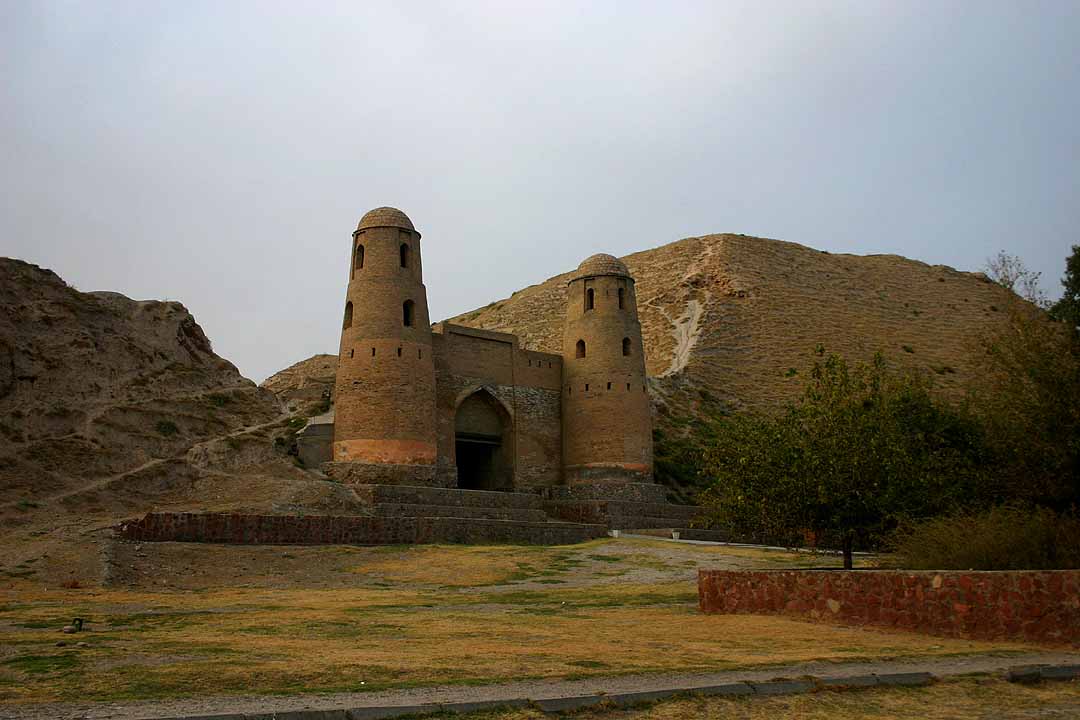
The fort of Hisar, residence of the Bukharan governor, is said to date back to Cyrus the Great and to have been captured twenty one times.[4]

In 1504 the region was conquered by Muhammad Shaybani.[5] Babur briefly conquered Hisar in 1511, but came back under control of the Uzbeks not long after. Hisar became a semi-independent principality in the next few decades and was ruled by a sultan, furnishing troops for Bukhara's military campaigns.[5] In the 17th century the Tajiks became the dominant power in the region, obtaining the governorship of Hisar. During this period the Bukharan khanate was split between the khan in Bukhara and the ruler (usually one of his relatives) in Balkh, and Hisar was generally subordinate to the latter. The decline of Bukharan power after the assassination of Ubaydullah Khan in 1711 resulted in Hisor asserting its independence.[5]

Only after the signing of the conclusion of the Russian conquest of Bukhara with the signing of "Russian-Bukharan treaty of 1868", and with Russian military aid, was Bukhara able to reintegrate Hisar into its domain. With the dissolution of Bukhara and the National delimitation in the Soviet Union, the region (and Eastern Bukhara as a whole) was again separated and it officially became the core of the Tajik ASSR. The process was a result of practical consideration, as the Eastern half of Bukhara Emirate was more remote, more feudal, and less economically developed than the Western half (where the capital Bukhara was located), as well as the emergence of Tajik national identity, its divergence and clash with Uzbek national identity, and the result of intense debates and mutual compromise between the two emerging respective Tajik and Uzbek intelligentsias.

Hisar was made a city on June 26, 1993.

Subdivisions

[edit]

Before ca. 2018, Hisar was the seat of Hisar District, which covered the rural part of the present city of Hisar isor.[6] The city of Hisar covers Hisar proper, the town Sharora and ten jamoats.[7] These are as follows:[8]

Jamoat Population (Jan. 2015)[8]
Sharora (town) 12,700[6]
Almosi 21,261
Dehqonobod 20,686
Durbat 20,052
Hisor 32,912
Khonaqohikuhi 27,624
Mirzo Rizo 25,971
Mirzo Tursunzoda 20,303
Oriyon
Navobod 26,321
Somon 28,691

Geography

[edit]

Climate

[edit]

Hisar has a hot-summer Mediterranean climate (Köppen climate classification Csa). The average annual temperature is 14.1 °C or 57.4 °F. The hottest month is July with an average temperature of 23.9 °C or 75.0 °F and the coolest January with an average temperature of 1.7 °C or 35.1 °F. The average annual precipitation is 568 millimetres or 22.36 inches and there is an average of 90.5 days with precipitation. The wettest month is March with an average of 107.2 millimetres or 4.22 inches of precipitation and the driest month is August with an average of 0.8 millimetres or 0.03 inches.[1]

Climate data for Hisar
Month Jan Feb Mar Apr May Jun Jul Aug Sep Oct Nov Dec Year
Daily mean °C (°F) 1.7
(35.1)
3.2
(37.8)
8.5
(47.3)
14.6
(58.3)
18.9
(66.0)
23.9
(75.0)
26.2
(79.2)
24.6
(76.3)
19.9
(67.8)
14.2
(57.6)
9.0
(48.2)
4.6
(40.3)
14.1
(57.4)
Average precipitation mm (inches) 65.7
(2.59)
73.4
(2.89)
107.2
(4.22)
105.0
(4.13)
86.2
(3.39)
7.4
(0.29)
3.8
(0.15)
0.8
(0.03)
3.1
(0.12)
30.8
(1.21)
43.2
(1.70)
59.4
(2.34)
568.0
(22.36)
Average precipitation days (≥ 0.1 mm) 11.0 12.2 14.8 12.9 10.2 2.9 1.5 0.6 1.1 5.4 7.3 10.6 90.5
Average relative humidity (%) 67.7 66.8 63.8 60.6 54.0 41.3 39.3 40.6 43.1 52.1 57.9 65.6 54.4
Source: "The Climate of Hisar". Weatherbase. Retrieved 2 August 2014.

References

[edit]
[edit]
Revisions and contributorsEdit on WikipediaRead on Wikipedia
from Grokipedia
Hisor (Tajik: Ҳисор) is a city in western , situated approximately 25 kilometers west of the capital along the route to . It functions as the administrative center of Hisor District within the Districts of Republican Subordination and lies in the fertile Hisor Valley near the Khanaka River. The city is renowned for the Hisor Fortress, a strategically positioned hilltop complex with archaeological evidence of occupation dating to at least the around 500 BC, making it one of Central Asia's oldest continuously significant sites. Over millennia, the fortress has been controlled by successive powers including , , and the , serving as a defensive stronghold, royal residence, and waypoint before the rise of as the regional hub. Hisor maintains cultural importance through preserved structures like 8th-century mosques and 18th-century madrasas, underscoring its role in Tajik heritage amid a landscape of historical trade and craftsmanship.

History

Ancient and medieval history

The Hisor Valley exhibits evidence of human habitation extending over 40,000 years, with cultural artifacts traceable to more than 3,000 BCE. Archaeological indications suggest the site's strategic hilltop location supported early fortifications during the around 500 BCE, potentially predating that era. The Hisor Fortress, constructed approximately 2,500 years ago, functioned as a defensive stronghold amid the region's frequent conquests, aligning with its position on ancient trade routes. In , Hisor emerged as a prominent trading and handicraft hub, leveraging its valley position for commerce along extensions. The fortress served as the residence for local rulers, including the Hisor bek, who acted as governor under the , underscoring its administrative role until the early . Surviving structures, such as the arched gate dating to circa 500 CE and the Chasmai Mohiyon Mosque built in 700 CE, reflect Islamic architectural influences and the site's enduring defensive and religious significance. Throughout this period, the fortress endured multiple destructions and reconstructions, adapting to shifts in regional powers from Samanid to later Central Asian emirates.

Russian Empire and Soviet period

In the 18th and 19th centuries, Hisor (also spelled Gissar) functioned as the administrative center of Gissar Bekstvo, one of the semi-autonomous beyliks within the Emirate, serving as a key market and handicraft hub in the Hisor Valley. Following the 's victory over Bukharan forces at the Battle of Zerabulak on May 12, 1868, the Emirate became a , with western —including the Hisor region—integrated into the Governor-Generalship established in 1867, though local governance under the Emir retained significant autonomy under Russian oversight. Hisor emerged as a sub-province administering eastern territories such as Qurghonteppa and Qubodiyon, where Bukharan expansion in , supported by Russian military aid, consolidated control over these areas amid limited direct Russian settlement or administrative overhaul prior to 1917. After the Bolshevik overthrow of the Bukhara Emirate in September 1920, Hisor fell under Soviet administration as part of the short-lived , which was dissolved and reorganized in 1924 to form the within the Uzbek SSR, encompassing the Hisor Valley. achieved status as a full union republic in 1929, prompting district delineations; the Gissar (district) was formally established in 1932, initially centered at Khanaka village, which had gained a railway station in 1929 to facilitate connectivity. The 1930s brought forced collectivization campaigns, sparking peasant resistance that revived Basmachi insurgencies in uplands, including the Hisor region, where rebels contested Soviet land reforms and anti-Islamic policies until largely suppressed by 1936. Soviet infrastructure development transformed the area's ; the , Tajikistan's largest project at the time, was completed in 1942 to expand and grain cultivation in the fertile valley. Administrative adjustments continued, with Khanaka village council split in 1954 to create the of Gissar as the district center. By the late , a historical-cultural reserve was established in Gissar to preserve local heritage amid ongoing Soviet modernization, though the region remained predominantly rural with state-controlled dominating the economy.

Civil War era and independence

Tajikistan declared independence from the on September 9, 1991, amid the dissolution of the USSR, marking the end of Soviet rule over the territory including Hisor. The transition to sovereignty was turbulent, as regional clan rivalries and power vacuums intensified following the collapse of centralized Soviet authority, setting the stage for violent conflict in the new republic. Hisor, located in the central valleys near , initially benefited from its proximity to the capital but soon became embroiled in the ensuing instability as local elites vied for influence in the post-Soviet order. The Tajik Civil War broke out in May 1992, driven by clashes between pro-government factions—primarily from Kulob, Kurgan-Tyube, and Hisor—and the United Tajik Opposition, which included Islamist groups like the Islamic Renaissance Party alongside democratic and regional elements from Garm and Gorno-Badakhshan. Militias from Hisor allied with Kulobi forces and local Uzbek militias, forming part of the neo-communist coalition that backed the government under President Emomali Rahmon after his rise in late 1992. These groups played a pivotal role in securing control over Dushanbe and adjacent areas, engaging in intense fighting that displaced populations and devastated infrastructure in the Hisor Valley, though the region avoided the most severe destruction seen in southern Tajikistan's Vakhsh Valley. The conflict, characterized by regional patronage networks rather than purely ideological divides, claimed between 20,000 and 150,000 lives overall, with Hisor's alignment contributing to the government's military advantage through 1993-1994 skirmishes. The concluded with the signing of the General Agreement on the Establishment of Peace and National Accord on June 27, 1997, brokered by the and , which mandated 30% power-sharing for opposition figures in government and military structures. In Hisor, the peace reinforced the dominance of pro-government clans, with limited integration of former opposition elements; the region's militias were partially demobilized and absorbed into state forces, stabilizing local administration under Rahmon's United Tajikistani National Movement. Post- reconstruction focused on restoring Soviet-era collective farms and roads in Hisor, though economic recovery lagged due to damage and national , with the area remaining a loyal base for the ruling elite amid ongoing Russian military presence at nearby bases.

Geography

Location and physical features

Hisor serves as the administrative center of Hisor District within 's Districts of Republican Subordination, situated roughly 24 kilometers west of the national capital, . The town occupies coordinates approximately 38°31′ N and 68°33′ E longitude. Elevated at about 800 meters above , Hisor lies in a setting characteristic of western Tajikistan's transitional terrain between lowland valleys and uplands. The immediate surroundings feature rugged mountainous landscapes, with the Gissar Range—part of the broader Gissar-Alay system—dominating to the north and contributing to the area's steep escarpments and elevated plateaus. The Hisor District exhibits diverse , including fertile valley floors that support amid an average of 1,588 meters, escalating to higher peaks in the encircling ranges that exceed several thousand meters. This configuration reflects 's predominantly mountainous , where over 90 percent of the land exceeds 3,000 meters, though Hisor's locale benefits from relatively accessible intermontane basins.

Climate and environmental conditions

Hisor lies at an of approximately 800 meters in the Hisor Valley, surrounded by the Gissar Range to the north and other mountain systems, which contribute to a varied influenced by topographic sheltering and seasonal winds. The region features a with dry warm summers (Köppen Dsb), characterized by hot, arid summers and very cold, snowy winters. Average annual precipitation totals around 290 mm, with the majority falling as rain in spring (peaking at 53 mm in ) and in winter, alongside about 95 rainy or snowy days per year. Temperatures vary widely, with average highs ranging from 5.2°C in to 32.4°C in July, and lows from -1.8°C to 20.9°C over the same months; extremes can reach below -7°C or above 39°C. Summers (June to September) are predominantly clear and dry, with minimal (as low as 2 mm in August), low (around 24% in summer months), and average wind speeds up to 10 km/h, resulting in comfortable conditions despite high temperatures. Winters (November to March) bring frequent (up to 88 mm equivalent in January), partly to skies, and calmer winds around 7 km/h, with snowfall accumulating during the period from November to March. Sunshine hours peak at 12.4 per day in August and drop to 6.4 in January. Environmental conditions reflect the semi-arid valley setting, supporting diverse ecosystems including and broadleaf forests, alpine meadows, and grasslands amid steep, rugged terrains, though the low fosters in lower elevations. The absence of muggy days year-round and overall dryness limit humidity-related discomfort but contribute to risks of and , exacerbated by regional trends toward further drying in Tajikistan's western areas.

Demographics

Population dynamics

The of was estimated at 29,100 in 2020, encompassing the urban core, while the broader area including surrounding communities reached approximately 308,100. Historical data indicate steady urban expansion since the mid-20th century, with the city recording 6,318 residents in the 1959 Soviet , rising to 10,414 by 1970, 13,695 in 1979, and 22,961 in 2002. This trajectory reflects an average annual growth rate exceeding 3% during the Soviet period, driven by industrialization, improved healthcare, and natural increase in a predominantly Tajik rural-to-urban migration context. Post-independence growth moderated but remained robust, with the urban increasing by about 132.5% between 1975 and 2015, reaching an estimated 31,636 by the latter year, characterized by a near-even distribution (50.2% , 49.8% ). The 1992–1997 Tajik Civil War disrupted national demographics through displacement and mortality, yet Hisor's proximity to and relative stability likely buffered severe declines, aligning with broader republican trends of recovery via high fertility rates (around 20–25 births per 1,000 nationally in recent decades). Recent estimates for the encompassing Hisor suggest continued expansion to 346,800 by 2024, underscoring rural contributions to overall dynamics amid Tajikistan's national growth of approximately 2% annually. Out-migration for labor, particularly to , exerts pressure on working-age cohorts, though remittances support family-based natural increase.

Ethnic and cultural composition

The population of Hisar is predominantly ethnic Tajik, reflecting the broader demographic patterns of central Tajikistan's , where Tajiks form the overwhelming majority due to historical settlement patterns tied to Persian-speaking Iranian groups. According to 2002 data, ethnic constituted 81.6% of the town's residents, with at 12.3%, at 3.6%, and other groups (including smaller numbers of , Kyrgyz, and ) accounting for 2.5%. These proportions align with national trends, where Tajiks comprise 84-86% of the population, but Hisar's figures show a higher Tajik share compared to regions with stronger Uzbek presence, such as northern Sughd Province, attributable to geographic and historical factors favoring Tajik in the fertile valleys near . Recent census data specific to Hisar remains limited following administrative mergers in the late , but out-migration of and other non-Tajik minorities since has likely increased the Tajik proportion further, mirroring national declines in Russian numbers from 3.5% in 2000 to under 1% by 2020. Culturally, Hisar's residents adhere to Tajik traditions rooted in Persian literary and poetic heritage, including of figures like and , alongside Central Asian customs such as celebrations and communal hospitality norms shaped by agrarian lifestyles. The primary language is Tajik, a Persian dialect written in , used in daily communication, education, and local governance, with Russian serving as a secondary among older generations due to Soviet legacies. Religious life centers on of the , practiced by over 95% of the population, influencing social norms, festivals like , and architecture such as mosques; this dominance stems from the region's integration into Islamic networks since the , with minimal presence of other faiths like Ismaili Shiism found in eastern Pamir areas. include traditional music with instruments like the rubab and , folk dances, and cuisine featuring plov and non, preserved amid post-Soviet revival of despite economic pressures driving labor migration.

Economy and development

Primary sectors and agriculture

The economy of Hisor District relies predominantly on agriculture as its primary sector, leveraging the fertile Hisor Valley's conditions for irrigated crop production. Wheat farming is a key activity, with local farmers harvesting the crop across 4,659 hectares in 2020 at an average yield of 2,670 kilograms per hectare. The district ranks among Tajikistan's leaders in grape cultivation, supporting both fresh produce and wine production alongside regions like Tursunzade and Shahrinav. Hisor Valley specializes in , producing grapes, berries, apples, and cherries for wholesale trade, with the latter contributing to the country's early-season cherry harvests primarily from this area and Khatlon Province. Onion cultivation also features prominently, though yields have faced challenges from and input costs in recent years. rearing, including and small ruminants, supplements crop-based incomes, aligning with national patterns where constitutes about 31% of agricultural output, though district-specific production data remains sparse.

Industry, trade, and recent growth

Hisor district's industrial activities center on production and light , supported by local mineral resources and proximity to . The Tojikcement CJSC leverages the district's favorable geography, including reserves like Kalai Hisor, for , with expansions contributing to regional output. In 2020, Tajikistan's overall production rose 1% to 4.24 million tons, with facilities in areas like Hisor benefiting from such trends amid national demand. Additionally, CJSC "Agrotekhservice" in Hisor city produces and exports tractors, highlighting a niche in . Trade in Hisor relies on traditional bazaars, such as the market square adjacent to the reconstructed Hisor fortress, where local goods including produce, textiles, and handicrafts are exchanged. These markets facilitate intra-regional commerce within of Republican Subordination (DRS), connecting to larger hubs in , though formal export data specific to Hisor remains limited amid Tajikistan's broader focus on minerals and aluminum. Recent growth in Hisor aligns with DRS industrial expansion, recording a 119% increase in 2021, driven by and sectors. Infrastructure proximity and national projects, including cement plant commissions around 2021-2023, have bolstered local output, though the district's remains tied to and remittances rather than heavy industrialization. Tajikistan's industrial production grew 24.5% overall in early 2025, with up 6%, potentially extending benefits to peripheral districts like Hisor through spillover effects.

Administration and infrastructure

Governance and subdivisions

Hisor functions as a city-level administrative unit within the Districts of Republican Subordination, a region comprising districts and cities placed directly under the central executive authority of Tajikistan's president, bypassing provincial intermediaries. Local executive power resides in the city , headed by an appointed chairman who oversees execution, , and service delivery, while aligning with national directives amid Tajikistan's unitary . Elected local councils (majlises of people's deputies) exercise limited legislative functions, including budget approval, execution review, and socioeconomic planning guidance, though their autonomy is constrained by central oversight and appointed executives. Administrative subdivisions of Hisor consist primarily of jamoats, the foundational rural municipalities responsible for village-level management, land allocation, agricultural coordination, and basic infrastructure maintenance. These units integrate urban and rural elements, with examples including the Almosi jamoat and the Sharora jamoat, the latter encompassing a town bearing the same name integrated into the city's jurisdiction. Jamoat chairmen, often appointed or elected locally under hukumat supervision, handle day-to-day operations, reflecting the tiered structure where central control permeates to the grassroots level.

Transportation and utilities

Hisor maintains connectivity to primarily via road and rail. Taxis provide the quickest access to , a journey of approximately 37 minutes costing $5–7. Rail service operates through Khanaka station in Hisor District, with daily trains to taking 53 minutes to 1 hour 9 minutes. Road infrastructure aligns with national priorities emphasizing highways linking central districts to the capital, though specific upgrades in Hisor remain limited compared to remote corridors. Utilities in Hisor District draw from Tajikistan's national grid, where generates over 95% of . Nationwide rationing ended in June 2024, resolving prior seasonal shortages that affected even central areas, though occasional district-level blackouts persist due to technical issues or maintenance. falls under the and Water Resources, with rural utilities facing financial and operational hurdles that may extend to district peripheries, despite abundant national resources. Central locations like Hisor benefit from proximity to Dushanbe's infrastructure, mitigating some rural deficiencies.

Culture and society

Religious practices and traditions

The residents of Hisor primarily follow of the , aligning with Tajikistan's national religious profile where more than 90 percent of the population identifies as Muslim, the vast majority adhering to this school. Daily practices center on the five obligatory prayers (salat), with congregational worship occurring at local mosques such as the historic Sangin Mosque, constructed between the 12th and 16th centuries and named for its stone architecture, which serves as a focal point for prayers (Jumu'ah). The Azam Central Mosque in Hisor City hosts large gatherings exceeding 5,000 attendees weekly, where imams integrate sermons on faith with messages, reflecting community-oriented religious observance. Key annual traditions include observance of Ramadan, involving fasting from dawn to sunset, followed by Eid al-Fitr celebrations marked by communal prayers, feasting, and charity (zakat al-fitr). Eid al-Adha (Idi Qurbon) features ritual animal sacrifice commemorating Abraham's devotion, with meat distributed to family, neighbors, and the needy, a practice rooted in Hanafi jurisprudence prevalent in the region. Historical sites like the 8th-century mosque near Hisor Fortress and the 17th-century Kuhna Madrasah, originally a center for religious scholarship, underscore enduring ties to Islamic education and jurisprudence, though Soviet-era suppression diminished formal madrasa functions until post-independence revival. Sufi influences, particularly from the order, persist in informal practices such as veneration at mausoleums like that of Makhmudi Azam, where pilgrims seek from saints (awliya), blending orthodox Hanafi rites with mystical elements historically embedded in Central Asian Islam since the . However, 's government imposes restrictions on unregistered religious activities, long beards, and hijab-wearing in public institutions to curb perceived extremism, limiting overt expressions of piety despite widespread private adherence. These measures, enacted post-1990s , prioritize state over unfettered tradition, resulting in occasional tensions between official policy and grassroots devotion.

Education and social services

In Hisor , social include a state-run residential dedicated to providing care for individuals with mental disabilities, operating as part of the national framework for specialized support. This facility addresses needs for long-term accommodation and assistance among vulnerable populations, reflecting broader efforts in to maintain institutional care options amid limited community-based alternatives. Healthcare provision falls under the oversight of the Ministry of Health and Social Protection of the Republic of , which coordinates reforms aimed at enhancing and universal coverage, though district-level implementation in Hisor remains aligned with centralized delivery. Education in the district adheres to Tajikistan's national structure, featuring four years of followed by five years of basic secondary and two years of upper secondary schooling, with compulsory attendance free through age 17. Enrollment patterns mirror national trends, where primary gross enrollment exceeds 99%, though dropout risks increase at secondary levels due to socioeconomic factors prevalent in rural districts like Hisor. No higher education institutions are located in Hisor, with residents typically accessing universities in or other regional centers for post-secondary studies. Social welfare programs, including those for and alleviation, are supported by international partners like , which promote family-based interventions over institutionalization where feasible, though specific uptake in Hisor is not distinctly documented beyond national coverage rates of about 27% for at least one benefit.

Notable landmarks and heritage

The Hisor Fortress stands as the principal historical landmark in Hisor, , situated on a hilltop overlooking the Khanaka River valley approximately 25 kilometers west of . Archaeological evidence indicates human activity at the site dating to at least 1000 BC, with the fortress complex evolving through multiple reconstructions amid regional conflicts. It functioned primarily as a defensive protecting trade caravans along ancient routes and as a residence for local governors, including those under Bukharan emirate rule from the 18th to early 20th centuries. Today, the site operates as an encompassing 86 hectares, preserving mud-brick walls, gates, and towers that reflect medieval Central Asian . Other heritage sites in Hisor contribute to its cultural reserve status, including the of Makhmudi Azam, a domed structure honoring a revered Sufi saint, and the Madrassa-i Kuhna, an ancient Islamic exemplifying traditional educational . The Khishtin served as a resting point for travelers, featuring vaulted halls typical of 19th-century caravan infrastructure, while the Dome Mosque Sangin represents vernacular design with its expansive dome and . These monuments, collectively part of the Hisor Historical and Cultural Reserve, highlight the town's role in preserving Tajikistani heritage from pre-Islamic to emirate eras, though preservation efforts face challenges from seismic activity and limited funding.

References

  1. https://www.wikidata.org/wiki/Q655771
Add your contribution
Related Hubs
User Avatar
No comments yet.