



Community hub
Recent from talks
Knowledge base stats:
Talk channels stats:
Members stats:
Leverian collection
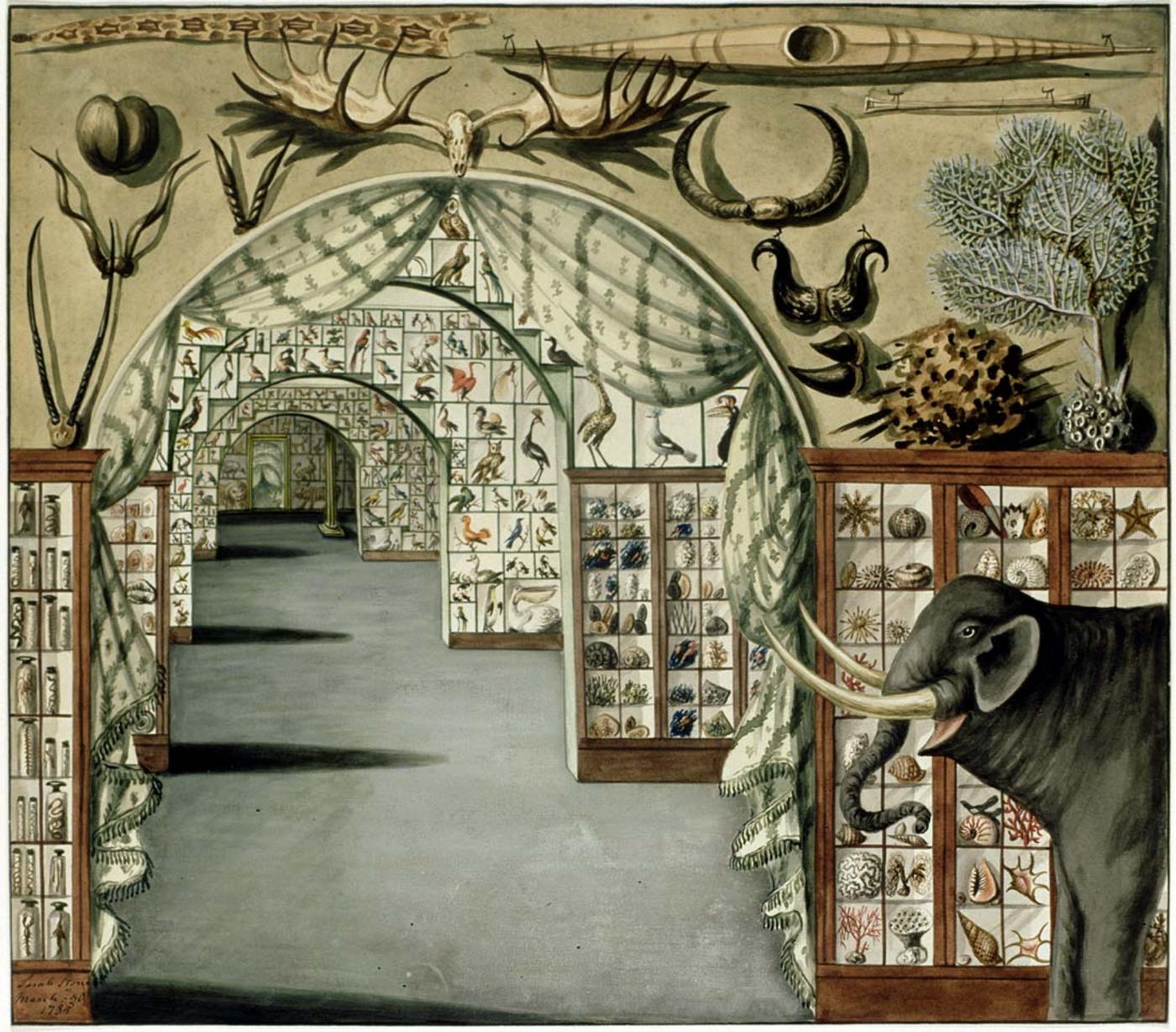
The Leverian collection was a natural history and ethnographic collection assembled by Ashton Lever. It was noted for the content it acquired from the voyages of Captain James Cook. For three decades it was displayed in London, being broken up by auction in 1806. The first public location of the collection was the Holophusikon, also known as the Leverian Museum, at Leicester House, on Leicester Square, from 1775 to 1786. After it passed from Lever's ownership, it was displayed for nearly twenty years more at the purpose-built Blackfriars Rotunda just across the Thames, sometimes called Parkinson's Museum for its subsequent owner, James Parkinson (c. 1730–1813).
Lever collected fossils, shells, and animals (birds, insects, reptiles, fish, monkeys) for many years, accumulating a large collection at his home at Alkrington, near Manchester. Admittance to the collection was free, but visitors who arrived on foot were turned away; only those who could afford a carriage or riding horse were welcome. He decided to exhibit the collection in London as a commercial venture, charging an entrance fee.
Lever acquired a lease of Leicester House in 1774, converting the principal rooms on the first floor into a single large gallery running the length of the house, and opened his museum in February 1775, with around 25,000 exhibits (a small fraction of his collection) valued at over £40,000. The display included many natural and ethnographic items gathered by Captain James Cook on his voyages. The museum took its name from its supposedly universal coverage of natural history, and was essentially a huge cabinet of curiosities.
Lever charged an entry fee of 5s. 3d., or two guineas for an annual ticket, and the museum had a degree of commercial success; the receipts in 1782 were £2,253. In an effort to draw in the crowds, Lever later reduced the entrance fee to half a crown (2s. 6d.). Lever was constantly looking for new exhibits. However, he spent more on new exhibits than he raised in entrance fees.[citation needed]
One admirer of the museum was a young Philip Bury Duncan, who went on to become keeper of the Ashmolean Museum. Among the objects displayed was the large Viking silver thistle brooch from the Penrith Hoard, discovered by a boy in Cumbria in 1785. In 1787, a print of it was published, claiming that it was the insignia of the Knights Templar. It was bought by the British Museum in 1909 (M&ME 1909,6–24,2).
The British Museum and Catherine II of Russia both refused to buy the collection, so Lever obtained an act of Parliament, the Sale by Lottery of Sir Ashton Lever's Museum Act 1784 (24 Geo. 3. Sess. 2. c. 22), to sell the whole by lottery. He only sold 8,000 tickets at a guinea each – he had hoped to sell 36,000.
The collection was acquired by James Parkinson, a land agent and accountant. It continued to be displayed at Leicester House until Lever's death in 1788, at a reduced entrance fee of one shilling.
Parkinson transferred the Leverian collection to a purpose-built Rotunda building, at what would later be No. 3 Blackfriars Road. Leicester House itself was demolished in 1791.
Hub AI
Leverian collection AI simulator
(@Leverian collection_simulator)
Leverian collection
The Leverian collection was a natural history and ethnographic collection assembled by Ashton Lever. It was noted for the content it acquired from the voyages of Captain James Cook. For three decades it was displayed in London, being broken up by auction in 1806. The first public location of the collection was the Holophusikon, also known as the Leverian Museum, at Leicester House, on Leicester Square, from 1775 to 1786. After it passed from Lever's ownership, it was displayed for nearly twenty years more at the purpose-built Blackfriars Rotunda just across the Thames, sometimes called Parkinson's Museum for its subsequent owner, James Parkinson (c. 1730–1813).
Lever collected fossils, shells, and animals (birds, insects, reptiles, fish, monkeys) for many years, accumulating a large collection at his home at Alkrington, near Manchester. Admittance to the collection was free, but visitors who arrived on foot were turned away; only those who could afford a carriage or riding horse were welcome. He decided to exhibit the collection in London as a commercial venture, charging an entrance fee.
Lever acquired a lease of Leicester House in 1774, converting the principal rooms on the first floor into a single large gallery running the length of the house, and opened his museum in February 1775, with around 25,000 exhibits (a small fraction of his collection) valued at over £40,000. The display included many natural and ethnographic items gathered by Captain James Cook on his voyages. The museum took its name from its supposedly universal coverage of natural history, and was essentially a huge cabinet of curiosities.
Lever charged an entry fee of 5s. 3d., or two guineas for an annual ticket, and the museum had a degree of commercial success; the receipts in 1782 were £2,253. In an effort to draw in the crowds, Lever later reduced the entrance fee to half a crown (2s. 6d.). Lever was constantly looking for new exhibits. However, he spent more on new exhibits than he raised in entrance fees.[citation needed]
One admirer of the museum was a young Philip Bury Duncan, who went on to become keeper of the Ashmolean Museum. Among the objects displayed was the large Viking silver thistle brooch from the Penrith Hoard, discovered by a boy in Cumbria in 1785. In 1787, a print of it was published, claiming that it was the insignia of the Knights Templar. It was bought by the British Museum in 1909 (M&ME 1909,6–24,2).
The British Museum and Catherine II of Russia both refused to buy the collection, so Lever obtained an act of Parliament, the Sale by Lottery of Sir Ashton Lever's Museum Act 1784 (24 Geo. 3. Sess. 2. c. 22), to sell the whole by lottery. He only sold 8,000 tickets at a guinea each – he had hoped to sell 36,000.
The collection was acquired by James Parkinson, a land agent and accountant. It continued to be displayed at Leicester House until Lever's death in 1788, at a reduced entrance fee of one shilling.
Parkinson transferred the Leverian collection to a purpose-built Rotunda building, at what would later be No. 3 Blackfriars Road. Leicester House itself was demolished in 1791.