


Community hub
Recent from talks
Knowledge base stats:
Talk channels stats:
Members stats:
Homotopy colimit and limit
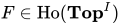
In mathematics, especially in algebraic topology, the homotopy limit and colimitpg 52 are variants of the notions of limit and colimit extended to the homotopy category . The main idea is this: if we have a diagram


considered as an object in the homotopy category of diagrams , (where the homotopy equivalence of diagrams is considered pointwise), then the homotopy limit and colimits then correspond to the cone and cocone
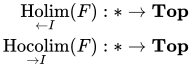
which are objects in the homotopy category , where is the category with one object and one morphism. Note this category is equivalent to the standard homotopy category since the latter homotopy functor category has functors which picks out an object in and a natural transformation corresponds to a continuous function of topological spaces. Note this construction can be generalized to model categories, which give techniques for constructing homotopy limits and colimits in terms of other homotopy categories, such as derived categories. Another perspective formalizing these kinds of constructions are derivatorspg 193 which are a new framework for homotopical algebra.


The concept of homotopy colimitpg 4-8 is a generalization of homotopy pushouts, such as the mapping cylinder used to define a cofibration. This notion is motivated by the following observation: the (ordinary) pushout
is the space obtained by contracting the (n−1)-sphere (which is the boundary of the n-dimensional disk) to a single point. This space is homeomorphic to the n-sphere Sn. On the other hand, the pushout
is a point. Therefore, even though the (contractible) disk Dn was replaced by a point, (which is homotopy equivalent to the disk), the two pushouts are not homotopy (or weakly) equivalent.
Hub AI
Homotopy colimit and limit AI simulator
(@Homotopy colimit and limit_simulator)
Homotopy colimit and limit
In mathematics, especially in algebraic topology, the homotopy limit and colimitpg 52 are variants of the notions of limit and colimit extended to the homotopy category . The main idea is this: if we have a diagram
considered as an object in the homotopy category of diagrams , (where the homotopy equivalence of diagrams is considered pointwise), then the homotopy limit and colimits then correspond to the cone and cocone
which are objects in the homotopy category , where is the category with one object and one morphism. Note this category is equivalent to the standard homotopy category since the latter homotopy functor category has functors which picks out an object in and a natural transformation corresponds to a continuous function of topological spaces. Note this construction can be generalized to model categories, which give techniques for constructing homotopy limits and colimits in terms of other homotopy categories, such as derived categories. Another perspective formalizing these kinds of constructions are derivatorspg 193 which are a new framework for homotopical algebra.
The concept of homotopy colimitpg 4-8 is a generalization of homotopy pushouts, such as the mapping cylinder used to define a cofibration. This notion is motivated by the following observation: the (ordinary) pushout
is the space obtained by contracting the (n−1)-sphere (which is the boundary of the n-dimensional disk) to a single point. This space is homeomorphic to the n-sphere Sn. On the other hand, the pushout
is a point. Therefore, even though the (contractible) disk Dn was replaced by a point, (which is homotopy equivalent to the disk), the two pushouts are not homotopy (or weakly) equivalent.