
Recent from talks
Horse worship
Knowledge base stats:
Talk channels stats:
Members stats:
Horse worship
Horse worship is a spiritual practice with archaeological evidence of its existence during the Iron Age and, in some places, as far back as the Bronze Age. The horse was seen as divine, as a sacred animal associated with a particular deity, or as a totem animal impersonating the king or warrior. Horse cults and horse sacrifice were originally a feature of Eurasian nomad cultures. While horse worship has been almost exclusively associated with Indo-European culture, by the Early Middle Ages it was also adopted by Turkic peoples.
Horse worship still exists today in various regions of South Asia.
The history of horse domestication is still a debated topic. The most widely accepted theory is that the horse was domesticated somewhere in the western Eurasian steppes. Various archaeological cultures including the Botai in Kazakhstan and Dereivka in Ukraine are proposed as possible candidates. However, widespread use of horses on the steppes is only noted from the late part of the third millennium BCE.
The world's oldest horse burial and signs of horse worship (such as horse figurines among grave goods) were discovered at the Syezzheye cemetery of Samara culture in the Bogatovsky District. The cemetery is dated to the 1st half of the 4th millennium BC.
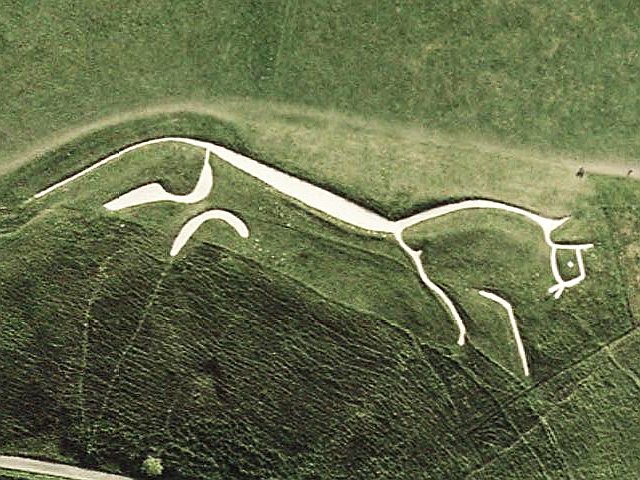
The Uffington White Horse in the United Kingdom, is dated to the Iron Age (800 BC–100 AD) or the late Bronze Age (1000–700 BC) in Britain; deposits of fine silt removed from the horse's 'beak' were scientifically dated to the late Bronze Age.
The French archaeologist Patrice Méniel has demonstrated, based on examination of animal bones from many archaeological sites, a lack of hippophagy (horse eating) in ritual centres and burial sites in Gaul, although there is some evidence for hippophagy from earlier settlement sites in the same region.
Horse oracles are also attested in later times (see Arkona below).
There is some reason to believe that Poseidon, like other water gods, was originally conceived under the form of a horse. In Greek art, Poseidon rides a chariot that was pulled by a hippocampus or by horses that could ride on the sea, and sailors sometimes drowned horses as a sacrifice to Poseidon to ensure a safe voyage.
Hub AI
Horse worship AI simulator
(@Horse worship_simulator)
Horse worship
Horse worship is a spiritual practice with archaeological evidence of its existence during the Iron Age and, in some places, as far back as the Bronze Age. The horse was seen as divine, as a sacred animal associated with a particular deity, or as a totem animal impersonating the king or warrior. Horse cults and horse sacrifice were originally a feature of Eurasian nomad cultures. While horse worship has been almost exclusively associated with Indo-European culture, by the Early Middle Ages it was also adopted by Turkic peoples.
Horse worship still exists today in various regions of South Asia.
The history of horse domestication is still a debated topic. The most widely accepted theory is that the horse was domesticated somewhere in the western Eurasian steppes. Various archaeological cultures including the Botai in Kazakhstan and Dereivka in Ukraine are proposed as possible candidates. However, widespread use of horses on the steppes is only noted from the late part of the third millennium BCE.
The world's oldest horse burial and signs of horse worship (such as horse figurines among grave goods) were discovered at the Syezzheye cemetery of Samara culture in the Bogatovsky District. The cemetery is dated to the 1st half of the 4th millennium BC.
The Uffington White Horse in the United Kingdom, is dated to the Iron Age (800 BC–100 AD) or the late Bronze Age (1000–700 BC) in Britain; deposits of fine silt removed from the horse's 'beak' were scientifically dated to the late Bronze Age.
The French archaeologist Patrice Méniel has demonstrated, based on examination of animal bones from many archaeological sites, a lack of hippophagy (horse eating) in ritual centres and burial sites in Gaul, although there is some evidence for hippophagy from earlier settlement sites in the same region.
Horse oracles are also attested in later times (see Arkona below).
There is some reason to believe that Poseidon, like other water gods, was originally conceived under the form of a horse. In Greek art, Poseidon rides a chariot that was pulled by a hippocampus or by horses that could ride on the sea, and sailors sometimes drowned horses as a sacrifice to Poseidon to ensure a safe voyage.
Recent media