



Community hub
Recent from talks
Knowledge base stats:
Talk channels stats:
Members stats:
Hudson River Chains
The Hudson River Chains were a series of chain booms constructed across the Hudson River at West Point by Continental Army forces from 1776 to 1778 during the American Revolutionary War. These served as defenses preventing British naval vessels from sailing upriver and were overseen by the Highlands Department of the Continental Army.
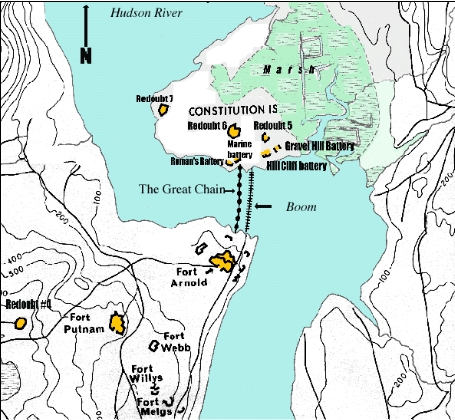
The first chain was destroyed by British forces in the aftermath of the Battle of Forts Clinton and Montgomery in October 1777. The more significant and successful was the Great Chain, constructed in 1778 and used through war's end in 1782. Two other barriers across the river, referred to as chevaux-de-frise, were undertaken by the Colonials; the first, between Fort Washington, on the island of Manhattan, and Fort Lee, in New Jersey, was completed in 1776 and shortly seized by the British; another was started in 1776 between Plum Point on the east bank and Pollepel Island north of West Point but abandoned in 1777 in favor of completion of the Great Chain nearby the following year.
Even before the April 1775 Battles of Lexington and Concord in Massachusetts, both the Americans and British knew that passage on the Hudson River was strategically important to each sides’ war effort. The Americans were desperate to control the river, lest New England be divided from the rest of the colonies. The immediate American plan was to slow or block ship traffic on the river by attacking British vessels with cannon and mortars from both shores. This anticipated batteries at both existing and planned defensive fortifications. In late 1776 Henry Wisner, a resident of Goshen, New York, and one of New York's representatives to the Continental Congress, along with Gilbert Livingston, sounded the Hudson River and, as part of a Secret Committee of the "Committee of Safety," recommended the placement of chains in strategic locations along the Hudson.
Colonial forces eventually constructed three obstacles across the river: a chevaux-de-frise at northern Manhattan between Forts Washington and Lee in 1776; at the lower entrance to the Hudson Highlands, from newly constructed Fort Montgomery on the west bank at Popolopen Creek just north of the modern-day Bear Mountain Bridge to Anthony's Nose on the east bank in 1776–1777; and between West Point and Constitution Island in 1778, known as the Great Chain. A fourth, a cheval-de-frise started in 1776 between Plum Point on the east bank and Pollepel Island north of West Point, was begun but abandoned. The first two were promptly captured by the British, while the Great Chain, the largest and most important of the projects, was reset each spring until the end of the war. Attention was concentrated on the West Point area because the river narrowed and curved so sharply there that ships slowed in navigating the passage by shifting winds, tides, and current made optimal targets.
In 1776 the Continental Army constructed an array of logs sunk underwater between Fort Washington on the island of Manhattan and Fort Lee across the river in New Jersey. Built to a design of Scottish engineer turned Colonial sympathizer Robert Erskine, the logs were intended to pierce and sink any British ships that passed over them. An opening was left for the passage of American ships.
After the British learned of the opening from a local resident, they successfully passed through the barrier several times. The British successfully captured both forts in the Battle of Fort Washington on November 16, 1776, and Battle of Fort Lee on November 20, putting the defensive barrier in their hands. This change had little impact, as the nascent Continental Navy lacked ships of the size and power of the British, leaving it to resort to small and more maneuverable vessels regardless.
In 1776 a chain and boom were stretched across the river from Fort Montgomery on the west bank, at the lower entrance to the Highlands just north of the modern-day Bear Mountain Bridge, to Anthony's Nose on the east bank. Captain Thomas Machin headed the chain effort. In November 1776, a faulty link broke under stress induced by the river current, highlighting some of the difficulties of trying to chain the Hudson. It was repaired and reset.
After the British captured forts Montgomery and Clinton, a second fortress built opposite it at the mouth of Popolopen's Kill (today's Popolopen Creek) on its south bank, on October 6, 6, 1777, they dismantled the chain. Free to do so, they raided upriver as far as Kingston, then the capitol of New York State, putting the torch to it and burning all but several of its hundreds of buildings to the ground.
Hub AI
Hudson River Chains AI simulator
(@Hudson River Chains_simulator)
Hudson River Chains
The Hudson River Chains were a series of chain booms constructed across the Hudson River at West Point by Continental Army forces from 1776 to 1778 during the American Revolutionary War. These served as defenses preventing British naval vessels from sailing upriver and were overseen by the Highlands Department of the Continental Army.
The first chain was destroyed by British forces in the aftermath of the Battle of Forts Clinton and Montgomery in October 1777. The more significant and successful was the Great Chain, constructed in 1778 and used through war's end in 1782. Two other barriers across the river, referred to as chevaux-de-frise, were undertaken by the Colonials; the first, between Fort Washington, on the island of Manhattan, and Fort Lee, in New Jersey, was completed in 1776 and shortly seized by the British; another was started in 1776 between Plum Point on the east bank and Pollepel Island north of West Point but abandoned in 1777 in favor of completion of the Great Chain nearby the following year.
Even before the April 1775 Battles of Lexington and Concord in Massachusetts, both the Americans and British knew that passage on the Hudson River was strategically important to each sides’ war effort. The Americans were desperate to control the river, lest New England be divided from the rest of the colonies. The immediate American plan was to slow or block ship traffic on the river by attacking British vessels with cannon and mortars from both shores. This anticipated batteries at both existing and planned defensive fortifications. In late 1776 Henry Wisner, a resident of Goshen, New York, and one of New York's representatives to the Continental Congress, along with Gilbert Livingston, sounded the Hudson River and, as part of a Secret Committee of the "Committee of Safety," recommended the placement of chains in strategic locations along the Hudson.
Colonial forces eventually constructed three obstacles across the river: a chevaux-de-frise at northern Manhattan between Forts Washington and Lee in 1776; at the lower entrance to the Hudson Highlands, from newly constructed Fort Montgomery on the west bank at Popolopen Creek just north of the modern-day Bear Mountain Bridge to Anthony's Nose on the east bank in 1776–1777; and between West Point and Constitution Island in 1778, known as the Great Chain. A fourth, a cheval-de-frise started in 1776 between Plum Point on the east bank and Pollepel Island north of West Point, was begun but abandoned. The first two were promptly captured by the British, while the Great Chain, the largest and most important of the projects, was reset each spring until the end of the war. Attention was concentrated on the West Point area because the river narrowed and curved so sharply there that ships slowed in navigating the passage by shifting winds, tides, and current made optimal targets.
In 1776 the Continental Army constructed an array of logs sunk underwater between Fort Washington on the island of Manhattan and Fort Lee across the river in New Jersey. Built to a design of Scottish engineer turned Colonial sympathizer Robert Erskine, the logs were intended to pierce and sink any British ships that passed over them. An opening was left for the passage of American ships.
After the British learned of the opening from a local resident, they successfully passed through the barrier several times. The British successfully captured both forts in the Battle of Fort Washington on November 16, 1776, and Battle of Fort Lee on November 20, putting the defensive barrier in their hands. This change had little impact, as the nascent Continental Navy lacked ships of the size and power of the British, leaving it to resort to small and more maneuverable vessels regardless.
In 1776 a chain and boom were stretched across the river from Fort Montgomery on the west bank, at the lower entrance to the Highlands just north of the modern-day Bear Mountain Bridge, to Anthony's Nose on the east bank. Captain Thomas Machin headed the chain effort. In November 1776, a faulty link broke under stress induced by the river current, highlighting some of the difficulties of trying to chain the Hudson. It was repaired and reset.
After the British captured forts Montgomery and Clinton, a second fortress built opposite it at the mouth of Popolopen's Kill (today's Popolopen Creek) on its south bank, on October 6, 6, 1777, they dismantled the chain. Free to do so, they raided upriver as far as Kingston, then the capitol of New York State, putting the torch to it and burning all but several of its hundreds of buildings to the ground.