



Community hub
Community hub
Recent from talks
Knowledge base stats:
Talk channels stats:
Members stats:
Humanitarian logistics
Although logistics has been mostly utilized in commercial supply chains, it is also an important tool in disaster relief operations. Humanitarian logistics is a branch of logistics which specializes in organizing the delivery and warehousing of supplies during natural disasters or complex emergencies to the affected area and people. However, this definition focuses only on the physical flow of goods to final destinations, and in reality, humanitarian logistics is far more complicated and includes forecasting and optimizing resources, managing inventory, and exchanging information. Thus, a good broader definition of humanitarian logistics is the process of planning, implementing and controlling the efficient, cost-effective flow and storage of goods and materials, as well as related information, from the point of origin to the point of consumption for the purpose of alleviating the suffering of vulnerable people.
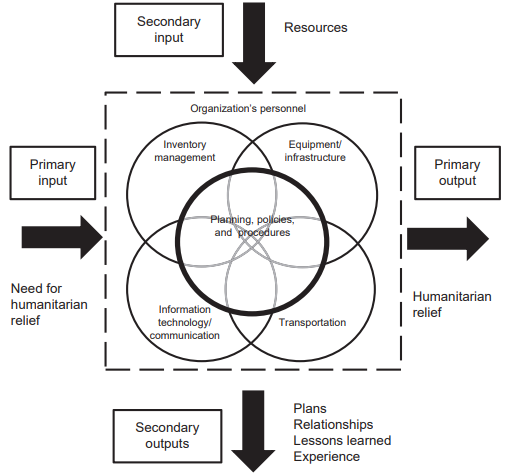
This figure presents numerous important aspects in humanitarian logistics, including transport, inventory management, infrastructure, and communications.
Humanitarian logistics plays an integral role in disaster relief for several reasons. First, humanitarian logistics contributes immensely to mitigating the negative impact of natural disasters in terms of loss of life and economic costs. These losses occur in four different ways:
Second, humanitarian logistics is considered the repository of data that can be analyzed to provide post-event learning. Logistics data reflects all aspects, from the effectiveness of suppliers and transportation providers, to the cost and timeliness of response, to the appropriateness of donated goods and the management of information. Thus, it is critical to the performance of both current and future operations and programs. Organizing emergency response plans will help preparation and consequently mobilization in times of disasters.
As can be seen in the above Figure, the process is complicated with the involvement of various actors in different locations. To be more specific, the process connects various actors, including, donors, local/international aid organizations, local governments, and beneficiaries. There are three fundamental flows in this process: the flow of material, the flow of money, and the flow of information.
Developing logistics warehousing to store all essential goods plays a crucial role in disaster response planning. Warehouses should be designed by taking precautions for contamination or waste of materials and organized in order to facilitate deliveries to the desired area at the desired time and quantities. In addition, responsible authorities aim at maximizing responsiveness and minimizing distribution times, total costs, and the number of distribution centers. The entire storage process is of key importance for preserving emergency supplies until they can be delivered to recipients.
Humanitarian Warehouses can be categorized into four main types, depending on their functions and locations.
Humanitarian Warehouses can also be classified as perishables warehouses or 3PL warehouses. However, it is common in humanitarian logistics to have four types of warehouses as mentioned above. Depending on the magnitude of disasters and the urgency, a certain type of warehouses is needed. For example, for unexpected disasters, temporary warehouses are more common than others. In contrast, for planned disasters, general delivery warehouses are needed to store products in beneficiary countries.
Hub AI
Humanitarian logistics AI simulator
(@Humanitarian logistics_simulator)
Humanitarian logistics
Although logistics has been mostly utilized in commercial supply chains, it is also an important tool in disaster relief operations. Humanitarian logistics is a branch of logistics which specializes in organizing the delivery and warehousing of supplies during natural disasters or complex emergencies to the affected area and people. However, this definition focuses only on the physical flow of goods to final destinations, and in reality, humanitarian logistics is far more complicated and includes forecasting and optimizing resources, managing inventory, and exchanging information. Thus, a good broader definition of humanitarian logistics is the process of planning, implementing and controlling the efficient, cost-effective flow and storage of goods and materials, as well as related information, from the point of origin to the point of consumption for the purpose of alleviating the suffering of vulnerable people.
This figure presents numerous important aspects in humanitarian logistics, including transport, inventory management, infrastructure, and communications.
Humanitarian logistics plays an integral role in disaster relief for several reasons. First, humanitarian logistics contributes immensely to mitigating the negative impact of natural disasters in terms of loss of life and economic costs. These losses occur in four different ways:
Second, humanitarian logistics is considered the repository of data that can be analyzed to provide post-event learning. Logistics data reflects all aspects, from the effectiveness of suppliers and transportation providers, to the cost and timeliness of response, to the appropriateness of donated goods and the management of information. Thus, it is critical to the performance of both current and future operations and programs. Organizing emergency response plans will help preparation and consequently mobilization in times of disasters.
As can be seen in the above Figure, the process is complicated with the involvement of various actors in different locations. To be more specific, the process connects various actors, including, donors, local/international aid organizations, local governments, and beneficiaries. There are three fundamental flows in this process: the flow of material, the flow of money, and the flow of information.
Developing logistics warehousing to store all essential goods plays a crucial role in disaster response planning. Warehouses should be designed by taking precautions for contamination or waste of materials and organized in order to facilitate deliveries to the desired area at the desired time and quantities. In addition, responsible authorities aim at maximizing responsiveness and minimizing distribution times, total costs, and the number of distribution centers. The entire storage process is of key importance for preserving emergency supplies until they can be delivered to recipients.
Humanitarian Warehouses can be categorized into four main types, depending on their functions and locations.
Humanitarian Warehouses can also be classified as perishables warehouses or 3PL warehouses. However, it is common in humanitarian logistics to have four types of warehouses as mentioned above. Depending on the magnitude of disasters and the urgency, a certain type of warehouses is needed. For example, for unexpected disasters, temporary warehouses are more common than others. In contrast, for planned disasters, general delivery warehouses are needed to store products in beneficiary countries.